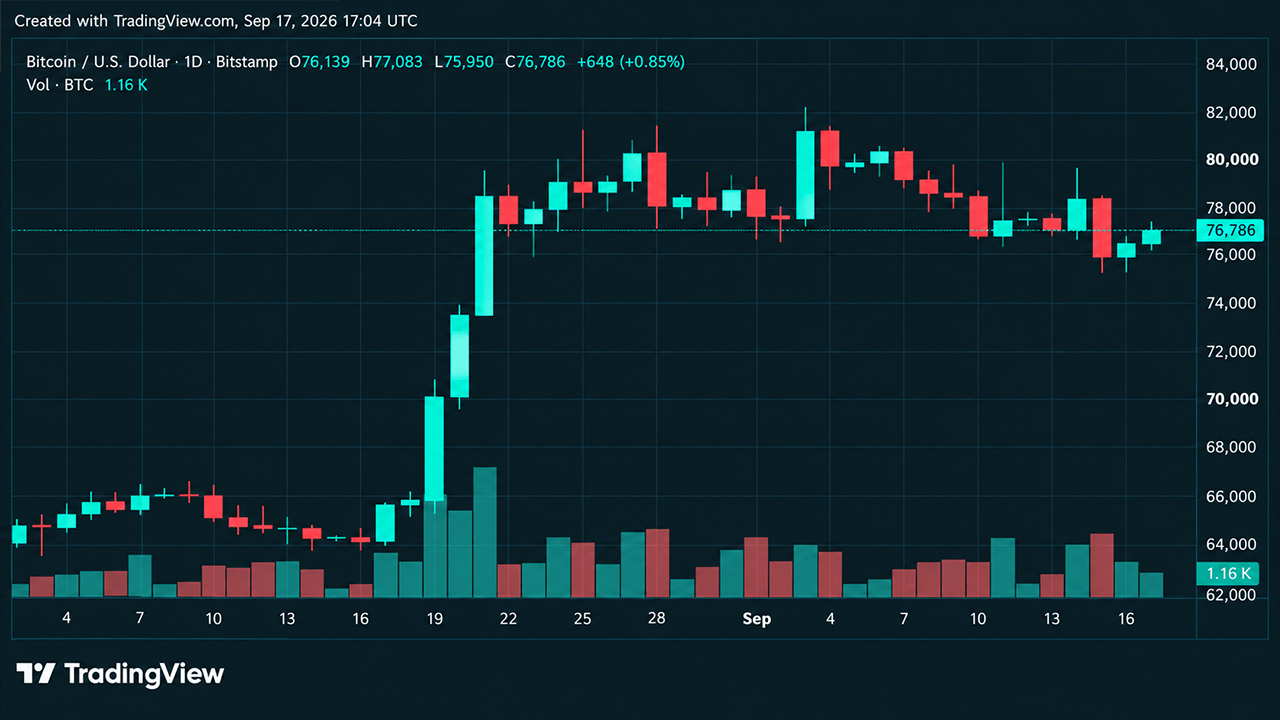
Bitcoin's price snapped a recent downward trend Thursday, briefly touching $77,000 before settling around $76,600. The recovery came less than 24 hours after the cryptocurrency hit a monthly low, pressured by the Federal Open Market Committee's unanimous decision to raise interest rates by 25 basis points on Wednesday.
Trading data from Bitstamp showed $76,000 initially acting as resistance before becoming a support level by 7 p.m. Wednesday. Sharp price swings followed in both directions, with an early surge driving bitcoin past $77,000 followed by a quick sell-off that briefly sent it below $76,000. The volatility eventually tapered around $76,200 before the price recovered near $76,600 by noon EST.
Despite session volatility, bitcoin posted a 1% daily gain and maintained a $1.54 trillion market cap. The price movement forced significant liquidations across the crypto market: $66 million in short liquidations and $32 million in long positions for bitcoin specifically, while the broader market saw nearly $260 million in short liquidations and $138 million in longs.
The price recovery occurred as the crypto industry absorbed the failure of the Senate's CLARITY Act, a bill that would have provided explicit legal definitions distinguishing decentralized protocols from centralized entities. Democratic lawmakers defended rejecting the bill despite securing key Republican concessions, with one senator citing the GOP's refusal to accept strict presidential ethics and divestment demands.
According to decentralized exchange Curve Finance, the bill's defeat represented a setback for the DeFi sector. The legislation would have clarified who controls a protocol and what changes they can make—a distinction Curve Finance noted as important for regulated institutions seeking to interact with decentralized finance. The bill also included protections for software developers and coverage of certain DeFi activities to distinguish them from traditional financial intermediaries.