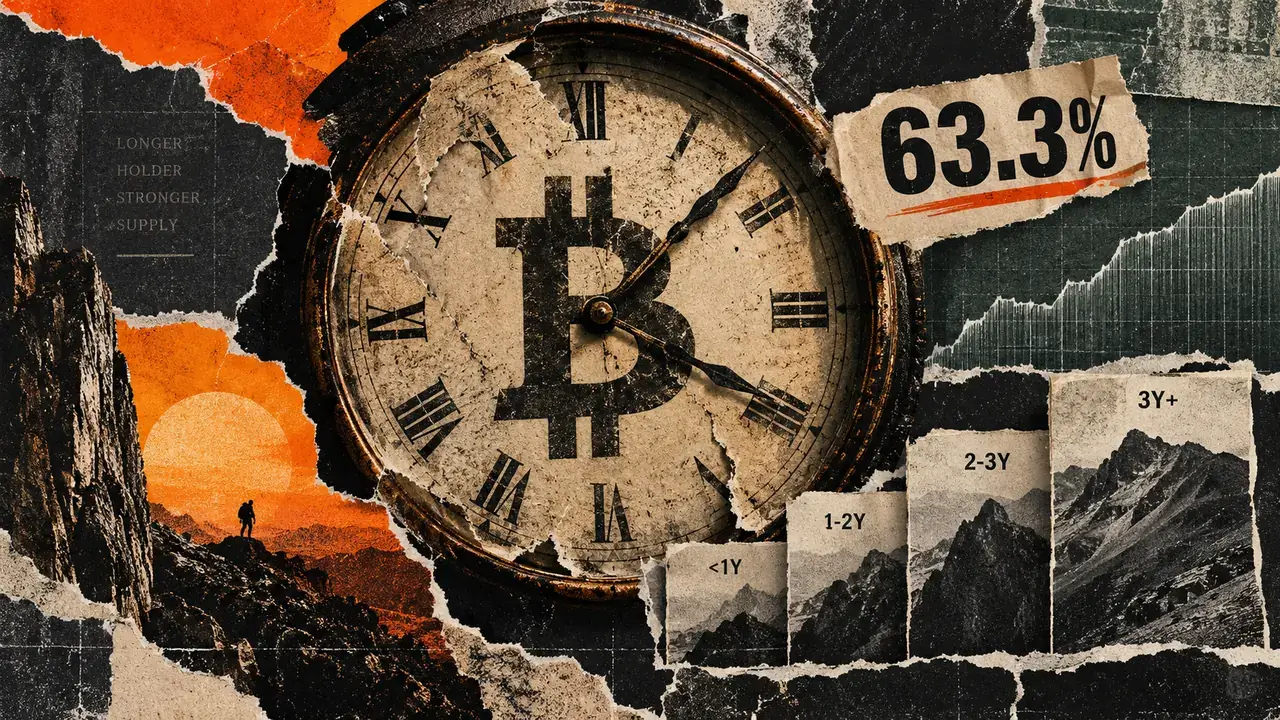
Bitcoin's share of supply last moved at least one year ago reached 63.3% on September 18, up from 62.32% a month earlier, according to Maketo's HODL-wave data. While the increase has been cited as a bullish indicator, the metric requires additional corroboration to establish genuine accumulation.
HODL waves categorize Bitcoin's unspent transaction outputs into age bands based on their last on-chain movement. A rising one-year share indicates more supply sits in older age bands, but this alone does not confirm whether coins are being deliberately held or newly purchased.
Age Bands and Threshold Crossings
The one-to-two-year band increased to 14.57% of supply from 13.52% during the same period, the largest positive change among cohorts already older than one year. Simultaneously, the six-to-twelve-month band fell to 17.53% from 19.10%. These paired movements are consistent with coins crossing the one-year age threshold through the passage of time rather than fresh buying activity.
Under current measurement methodology, unmoved outputs advance into older bands as they cross each age threshold. Movement resets the clock to the youngest cohort. This means coins can appear to age into older bands simply by remaining stationary, without indicating any change in ownership or intent.
Limitations of the Metric
Last-movement age does not resolve beneficial ownership or holder intent. A transfer between wallets controlled by the same entity can make an output appear young even when ownership has not changed. Similarly, lost coins can remain in the oldest bands without representing a deliberate decision to hold.
Coins moved within one month accounted for 7.03% of supply on September 18, down from 7.30% a month earlier, indicating reduced recent on-chain activity.
Identifying a fresh-accumulation thesis requires corroboration from entity-adjusted balance changes, exchange flows, and spending behavior. Until those measures align, the rising one-year HODL wave reflects an aging supply distribution rather than proof of new demand.