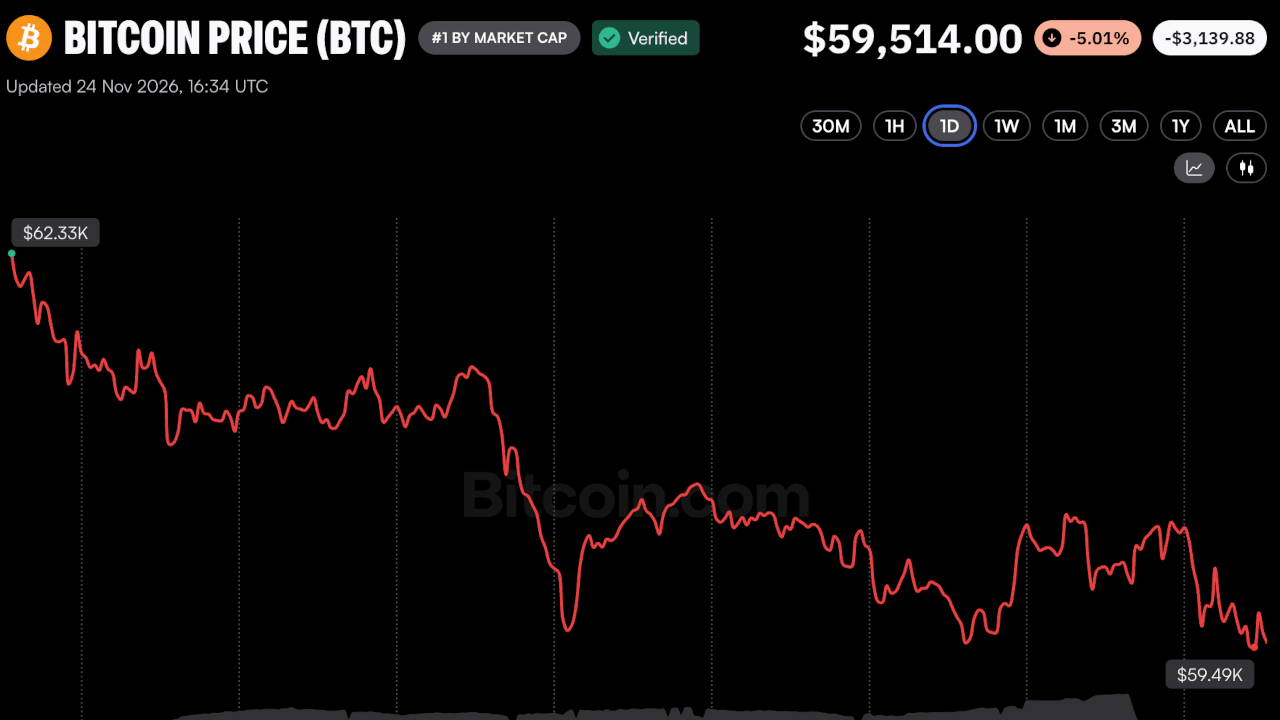
Bitcoin struggled to maintain gains above $60,000 on Tuesday as a tech stock rally sparked by Nvidia CEO Jensen Huang's reinstatement quickly reversed course. The cryptocurrency fell to a low of $59,321 early in the trading session after peaking at $64,505 on Monday, then recovered to test the $60,500 level multiple times before sliding back below $59,700.
The volatile price action reflected a pattern of range-bound trading throughout the day. Bitcoin liquidations in the derivatives market totaled $179 million, comprising $147 million in long bets and $32 million in shorts, representing roughly a 50% drop from earlier levels. Across the broader crypto market, liquidations reached $463 million.
Spot Bitcoin ETFs recorded significant outflows, with $569.74 million in net withdrawals on November 23 alone, extending the outflow streak to five consecutive trading sessions. November's cumulative outflows reached a record $4.71 billion, signaling persistent selling pressure on digital assets.
Tech Momentum vs. Macroeconomic Headwinds
Industry analysts remain divided on bitcoin's near-term trajectory. Andrew Forson, president of DeFi Technologies, argued that broader AI and tech momentum remain a long-term catalyst for digital assets, noting that tech rallies reinforce blockchain adoption across finance and settlement applications.
However, other market observers highlighted macroeconomic constraints. Utkarsh Ahuja, founder and managing partner at Moon Pursuit Capital, pointed to a strengthening U.S. Dollar Index, which climbed above 104 to its highest level since March 2025, potentially tightening financial conditions for global investors and weighing on risk assets.
Ahuja also noted shifting rate expectations, citing BNP Paribas forecasts of three consecutive 25-basis-point Federal Reserve rate increases at December, January, and March meetings, potentially pushing the Fed funds range to 4.5% to 4.75%. He emphasized that the near-term outlook hinges on whether tech-led risk appetite or tightening liquidity prevails, with real yields, dollar strength, and incoming economic data as key indicators.