Every blockchain must solve a fundamental challenge: ensuring thousands of independent computers agree on a single, shared history without a central authority. This process is known as a consensus algorithm, determining who adds transactions, how competing ledgers are resolved, and when payments become locked in.
While Bitcoin established the original model known as Nakamoto Consensus, other prominent digital assets utilize distinct methods to secure their networks and finalize transactions.
Bitcoin and the Nakamoto Consensus Baseline
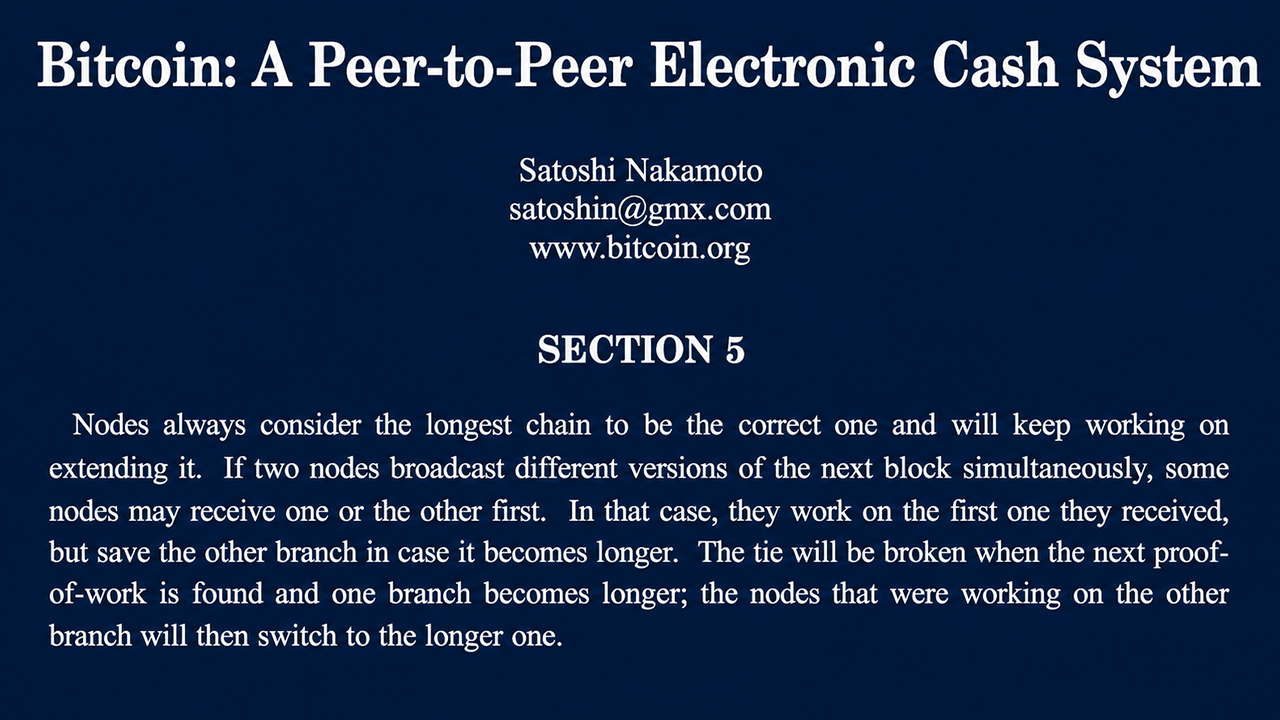
Bitcoin introduced a stack of rules where miners compete using proof-of-work (PoW) with SHA-256 to find a block about every ten minutes. Difficulty resets every 2,016 blocks. Worker nodes independently reject invalid blocks and follow the valid chain carrying the greatest accumulated computational work. This produces probabilistic finality, meaning reversing a transaction becomes progressively harder as work stacks above it.
Ethereum: Moving to Validators and Stake
Ethereum replaced mining with a proof-of-stake system via an upgrade called the Merge, utilizing a hybrid consensus protocol dubbed Gasper. Operating in 12-second slots, validators commit ETH to propose blocks and vote. LMD-GHOST weighs the latest votes by stake to determine the leading branch, while Casper FFG adds checkpoint finality in about 12.8 minutes. Consensus power comes from economic stake that can be slashed for dishonest acts rather than computational work.
BNB Smart Chain: Speed via Proof-of-Staked-Authority
BNB Smart Chain runs on a Proof-of-Staked-Authority model, blending delegated stake, scheduled block production, and validator voting. The network relies on 45 elected validators, including 21 cabinet validators and 24 candidates, utilizing BLS validator votes to lock in finality quickly.
XRP Ledger: Trust Lists and Quorums
The XRP Ledger uses neither proof-of-work nor proof-of-stake. Instead, servers maintain Unique Node Lists (UNLs) containing validators they consider unlikely to collude. Participants compare proposed transaction sets until the network reaches an 80% validation quorum, typically settling transactions in four to five seconds.
Solana: Clocks, Stake, and Tower BFT
Solana utilizes proof-of-history as a cryptographic clock to establish event order, paired with stake-weighted Tower BFT for voting and fork selection. Leaders are scheduled according to stake, and validators vote when competing branches appear, achieving finality in roughly 12.8 seconds.
Tron: Scheduled Super Representatives
Tron uses a delegated proof-of-stake model where TRX holders vote for Super Representatives, with the top 27 acting as active block producers rotating through scheduled turns. A block becomes solidified after at least 19 of the 27 active representatives produce at that height or later.
Dogecoin and Zcash: Nakamoto Models with Modified Machinery
Dogecoin and Zcash both remain inside the Nakamoto Consensus family, relying on cumulative work and difficulty adjustments that react faster than Bitcoin's two-week window. Dogecoin pairs Scrypt proof-of-work with Litecoin merged mining to target one-minute blocks, while Zcash uses Equihash proof-of-work and incorporates shielded transaction privacy via zero-knowledge proofs without altering its base consensus rules.
Conclusion
The differences among these networks highlight that consensus goes beyond simple labels. Networks like Bitcoin, Dogecoin, and Zcash rely on computational work, Ethereum relies on economic stake, BNB Smart Chain, Solana, and Tron rely on selected validator groups, and the XRP Ledger uses trust lists. The core security of each network depends on what an attacker must control to rewrite history and how the protocol responds if those assumptions fail.