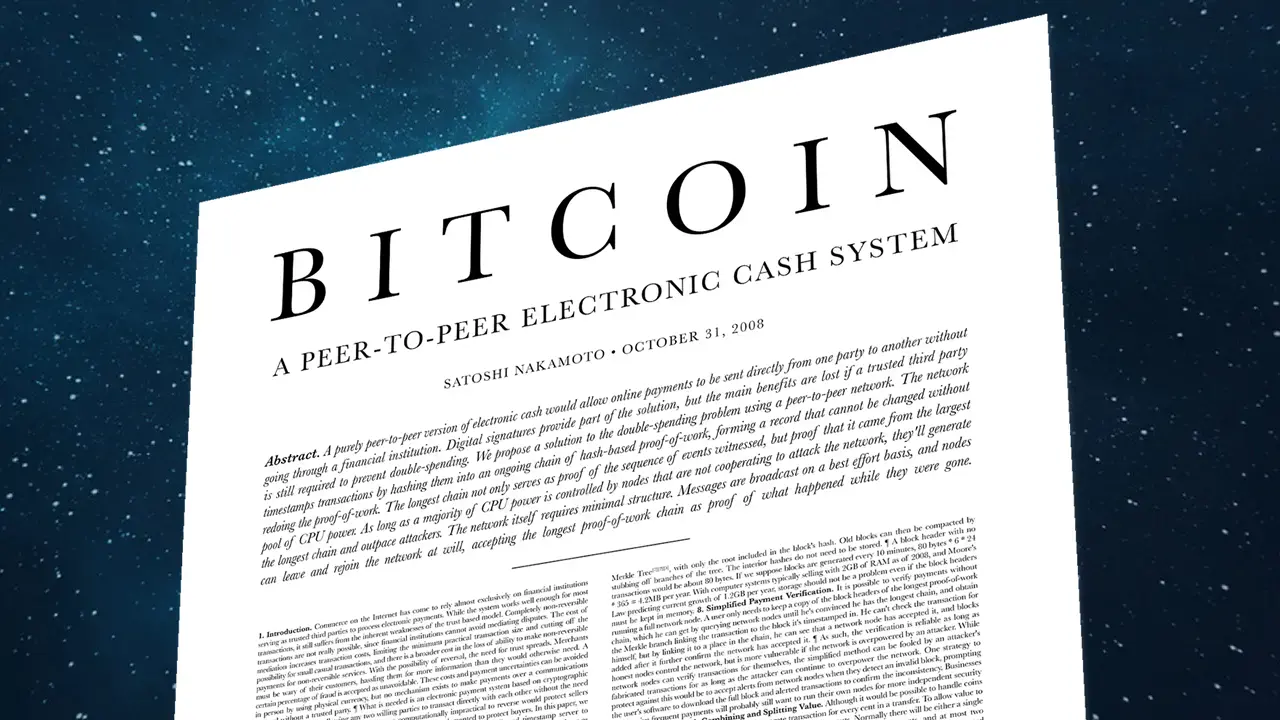
Bitcoin was conceived as a way to send money without intermediaries. Eighteen years after its October 31, 2008 publication, the nine-page white paper has inspired a global financial system where major investment firms manage billions in bitcoin holdings and governments maintain strategic reserves.
The contrast reflects a central tension: a network designed to reduce reliance on institutions has become an asset those institutions want to own and control.
The Original Problem and Solution
Satoshi Nakamoto's white paper addressed a fundamental challenge of digital money: preventing the same coin from being spent twice without a trusted central authority. Bitcoin solved this by maintaining a shared transaction history across a distributed network of participants called miners.
Miners compete through proof-of-work, using computing power to add and verify transaction blocks. To alter confirmed history, an attacker would need to redo that computational work and overtake the honest network—a task that becomes exponentially harder as the network grows.
The system drew on earlier cryptographic work, including Wei Dai's b-money proposal and Adam Back's Hashcash, combining those tools with new incentives for network participants to maintain consensus.
Institutional Adoption and Market Growth
Bitcoin remained experimental for years. On January 3, 2009, Nakamoto created the first block, embedding a newspaper headline referencing the 2008 financial crisis. The first notable transaction occurred on May 22, 2010, when programmer Laszlo Hanyecz exchanged 10,000 bitcoins for pizza.
Institutional entry accelerated in recent years. In August 2020, software company MicroStrategy announced a $250 million bitcoin purchase and began holding it as a principal treasury asset. The U.S. Securities and Exchange Commission approved spot Bitcoin exchange-traded products on January 10, 2024, allowing investors to gain exposure through traditional brokerage accounts.
By October 26, 2026, BlackRock's iShares Bitcoin Trust held approximately $64.7 billion in net assets, demonstrating the scale of institutional participation.
Government Approaches Diverge
Governments have taken different paths. El Salvador made Bitcoin legal tender in September 2021, though subsequent reforms tied to its International Monetary Fund program allowed businesses to choose whether to accept it, with taxes payable in US dollars.
The United States adopted a different model. A March 6, 2025 executive order directed creation of a Strategic Bitcoin Reserve using bitcoin forfeited to the government and called for budget-neutral acquisition methods, without announcing an unrestricted buying program.
The Unresolved Security Question
Bitcoin's code halves the new coins paid to miners every 210,000 blocks, roughly every four years. The fourth halving in April 2024 reduced the subsidy to 3.125 BTC per block. By March 9, 2026, mined supply had reached 20 million coins, representing more than 95% of the eventual 21 million ceiling.
The white paper anticipated that transaction fees would eventually replace newly minted coins as miners' primary compensation. However, an October 2026 report from Cambridge's Centre for Alternative Finance found that fees accounted for just 0.67% of miner revenue in the 90 days ending October 4.
This gap raises a critical question that institutional adoption does not resolve: who will pay enough to secure the network as new coin issuance continues to decline over the coming decades.
Evolving Roles and Risks
The network has experienced failures that highlighted risks beyond the double-spending problem Nakamoto addressed. Mt. Gox, a prominent exchange, shut down in 2014 following wallet thefts. FTX collapsed in 2022 after its founder diverted billions in customer funds. These episodes exposed custody and management failures rather than flaws in the underlying network.
Users face distinct risks depending on how they participate. Those holding their own coins gain control but bear responsibility for key management and cannot reverse transactions. Institutional investors through brokers avoid some operational risks but remain exposed to price volatility. Governments must account for stewardship of public assets, while miners must cover operating costs as rewards decline.
Security vulnerabilities also remain. Quantum computing advances could theoretically break the elliptic curve cryptography protecting bitcoin by deriving private keys from public keys.
Eighteen years after publication, bitcoin's fundamental proposition endures: users can avoid a financial middleman, but they cannot avoid risk. The network has demonstrated viability as both a technical system and an asset class, yet core questions about long-term incentive structures remain unanswered.