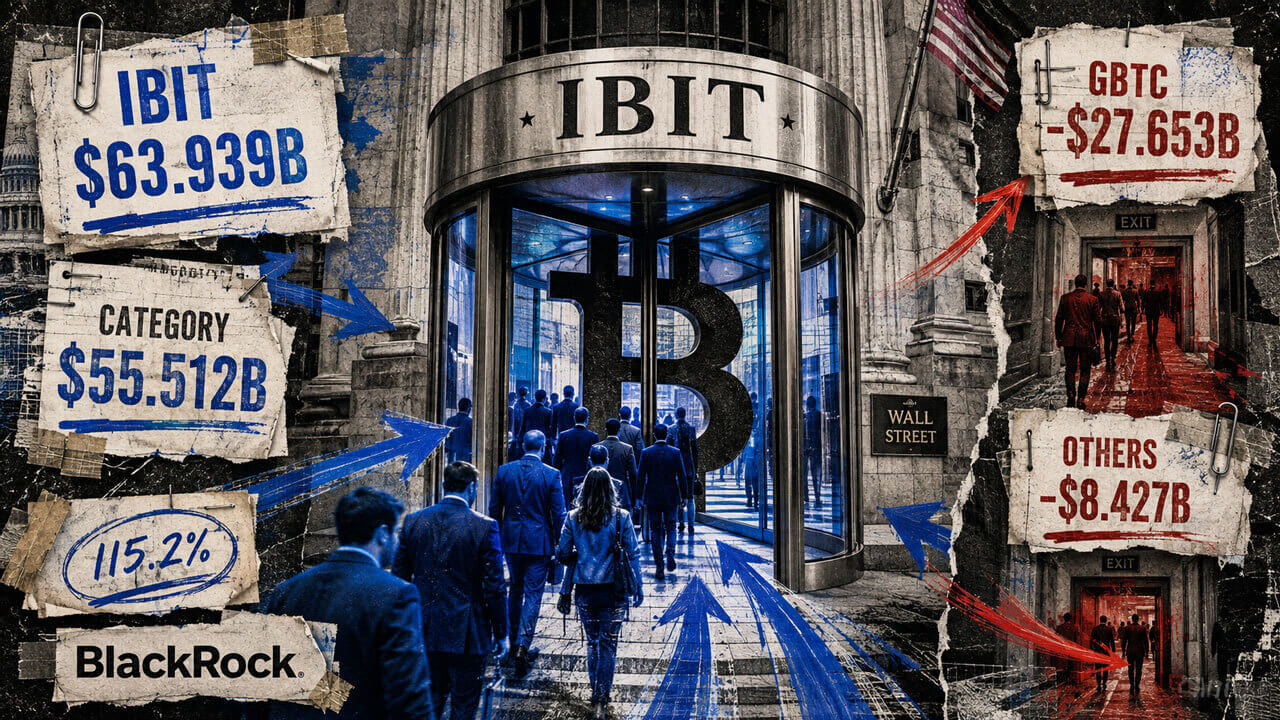
BlackRock's iShares Bitcoin Trust (IBIT) has become the sole driver of net inflows to the US spot Bitcoin ETF market, accumulating $63.9 billion in cumulative net inflows from its January 2024 launch through September 3, 2026, according to data from Farside Investors.
While the entire US spot Bitcoin ETF category retained $55.5 billion in net inflows over that period, every other fund combined posted $8.4 billion in net outflows. This means IBIT supplied 115.2% of the category's net inflow—enough to offset withdrawals from competing products while adding fresh capital.
Market Concentration
Grayscale's Bitcoin Trust (GBTC) accounted for the largest portion of outflows, recording $27.6 billion in net redemptions since January 2024. The conversion of GBTC from a closed-end fund to an ETF, combined with its 1.50% fee compared to IBIT's 0.25% fee, prompted significant shareholder migrations to lower-cost alternatives.
Removing both IBIT and GBTC from the calculation, the remaining field of cheaper products—led by Fidelity and smaller issuers—attracted $19.2 billion in net inflows. IBIT still brought in more than three times that combined total.
From August 17 through September 3, IBIT captured $2.843 billion of the category's $3.655 billion in inflows across 14 trading sessions, representing 77.8% of total flows.
How ETF Flows Work
ETF activity operates through two interconnected markets. In the secondary market, investors trade existing IBIT shares on Nasdaq throughout the trading day. In the primary market, authorized participants create and redeem large share blocks, which expands or contracts the trust's actual Bitcoin holdings.
When IBIT trades above the net asset value of its underlying Bitcoin, arbitrage incentivizes new share creation. When it trades below, redemptions occur. This mechanism keeps the fund aligned with Bitcoin's value while generating the flow data that measures capital entering or leaving the vehicle.
Structural Advantages
IBIT's dominance reflects several structural advantages. Financial advisers can integrate the ETF into model portfolios, companies can hold it through familiar custody arrangements, and retirement investors gain Bitcoin exposure without managing private keys or exchange operations.
As of September 3, BlackRock reported approximately $63.44 billion in IBIT net assets with 1.375 billion shares outstanding and a 0.02% median bid-ask spread. Heavy daily trading liquidity attracts institutional orders and lowers execution costs.
Limitations of the Backstop
While IBIT's consistent inflows resemble a buyer of last resort for Bitcoin, the parallel has important limits. Unlike a central bank, IBIT cannot create money or maintain a reserve fund. It expands only when investors purchase shares and contracts when they redeem.
On September 1, IBIT recorded $201.2 million in outflows while the category posted a $236.5 million loss. One day later, IBIT rebounded with $115.4 million in inflows and helped lift the category positive. The mechanism faithfully follows investor demand in both directions, meaning the backstop effect can reverse quickly during market stress or changing sentiment.
The concentration of fresh US Bitcoin investment through a single sponsor and trust represents a shift from Bitcoin's early emergence as an alternative to conventional finance. IBIT now serves as the primary institutional entry point, allowing traditional investors to gain exposure within familiar account structures and trading systems.