BNB Chain published a litepaper on November 26 outlining a new layer-1 blockchain being developed alongside BNB Smart Chain. The proposed network would introduce a different fee structure that bills traders for reserved computing capacity, even if unused.
Under the current BNB Smart Chain model, network fees reflect only the gas a transaction actually consumes. The new devnet would order transactions before execution and charge users for their entire declared gas limit, regardless of how much computing power they ultimately use.
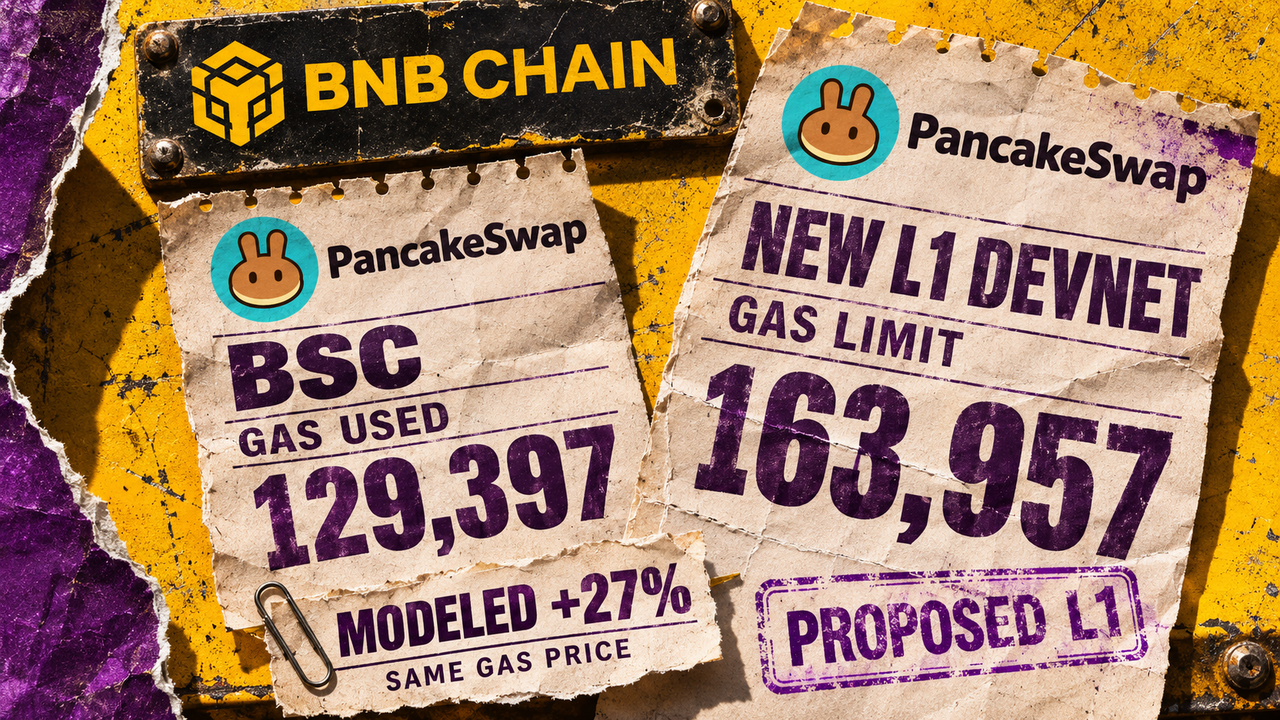
A historical PancakeSwap trade illustrates the impact. A swap executed on June 26 used 129,397 gas at 0.05 gwei per unit, costing 0.00000646985 BNB. Applying the new billing model at the same gas price with a 163,957-gas limit would have increased the fee to 0.00000819785 BNB—a 27% increase. At lower limits of 150,000 gas and 200,000 gas, the fee would rise approximately 16% and 55% respectively.
The proposed design keeps BNB as the gas token and includes protected lanes that reserve block capacity for governance-approved contract addresses. A public testnet is in preparation. Transactions sent to unregistered routers cannot access reserved lanes, and eligible transactions still compete for space within designated lanes.
Block producers would have roughly 20 milliseconds to provide a signed update showing a transaction's intended position in the block. Transaction results become final after execution is committed and the block carrying that commitment has finalized.
Market makers could benefit from early signals about transaction placement, potentially using this information to avoid costly stale quotes. However, for the network to gain adoption, the economic model would need to prove viable at real gas prices during public testing.
BNB Smart Chain processed $484.13 million in 24-hour decentralized exchange volume as of November 27, according to DefiLlama.