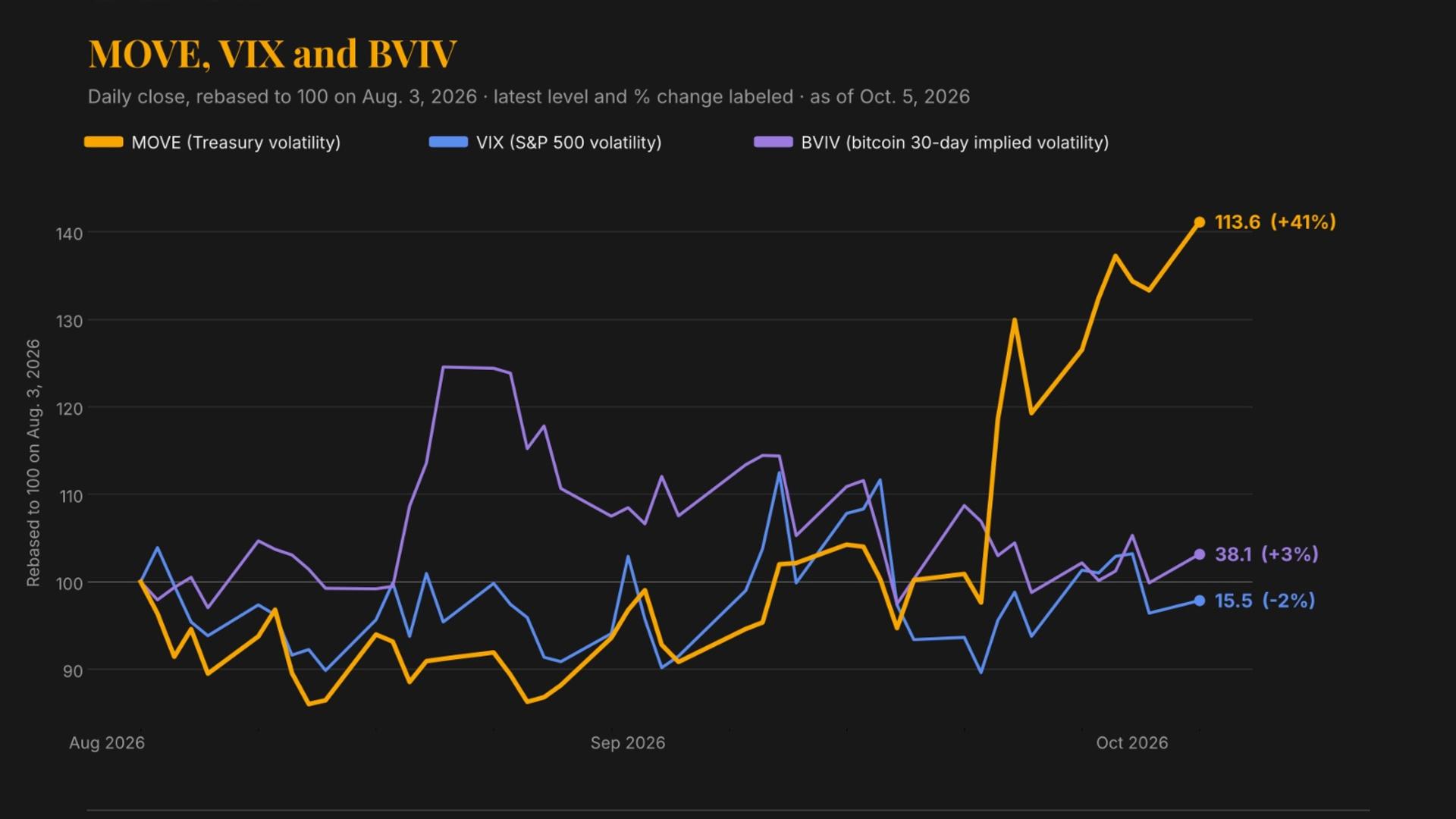
Treasury bond volatility is climbing sharply, with the MOVE Index—the bond market's equivalent to the VIX—jumping 46% in June and hovering around 116, close to its March high and the loftiest reading since April 2025. Yet Bitcoin and U.S. stocks continue trading near calm levels, raising questions about whether market stress is building beneath the surface.
The MOVE Index, officially the ICE BofA U.S. Bond Market Option Volatility Estimate, gauges how much U.S. Treasury yields are expected to swing over the next month using options on 2-, 5-, 10-, and 30-year bonds. Because Treasury notes serve as preferred collateral in international finance and affect borrowing costs across the economy, rising volatility in these instruments can trigger global financial tightening, push up risk premiums, and spark broad-based risk aversion.
Some macro observers view the MOVE Index's rise as an early warning signal. According to Kurt S. Altrichter, wealth manager and author of the RiskSIGNAL Report, the MOVE Index has historically led market stress. "The MOVE Index is making higher lows while the VIX makes lower highs. The MOVE leads: it flashed turbulence before the VIX in 2022, in 2023, and at the start of the Iran war. Stocks are usually the last to get the message," Altrichter said.
Corporate borrowing markets are already feeling the effects. Investment-grade and high-yield corporate bond volatilities have climbed sharply, rising from the 6th and 11th percentile lows two weeks prior to their 79th and 84th percentile highs respectively, according to data from Cboe.
Bitcoin's daily returns do not track the MOVE Index closely over 60- or 90-day windows, according to analysis by CoinDesk. However, analysts have noted that sudden jumps in Treasury volatility can hurt Bitcoin, with the magnitude of moves in bonds mattering more than whether yields rise or fall.
Bitcoin's 30-day implied volatility gauge and the S&P 500's VIX remain near year-to-date lows. Traders may want to watch for a potential spike in Bitcoin and S&P 500 volatility, particularly if the MOVE Index clears its March high. The next key resistance level for the MOVE Index is seen at 140, the level reached in early April when trade tensions between the U.S. and China roiled global markets.
For now, steady exchange-traded fund inflows, fewer whale deposits to exchanges, and supportive regulatory tailwinds support the bull case.