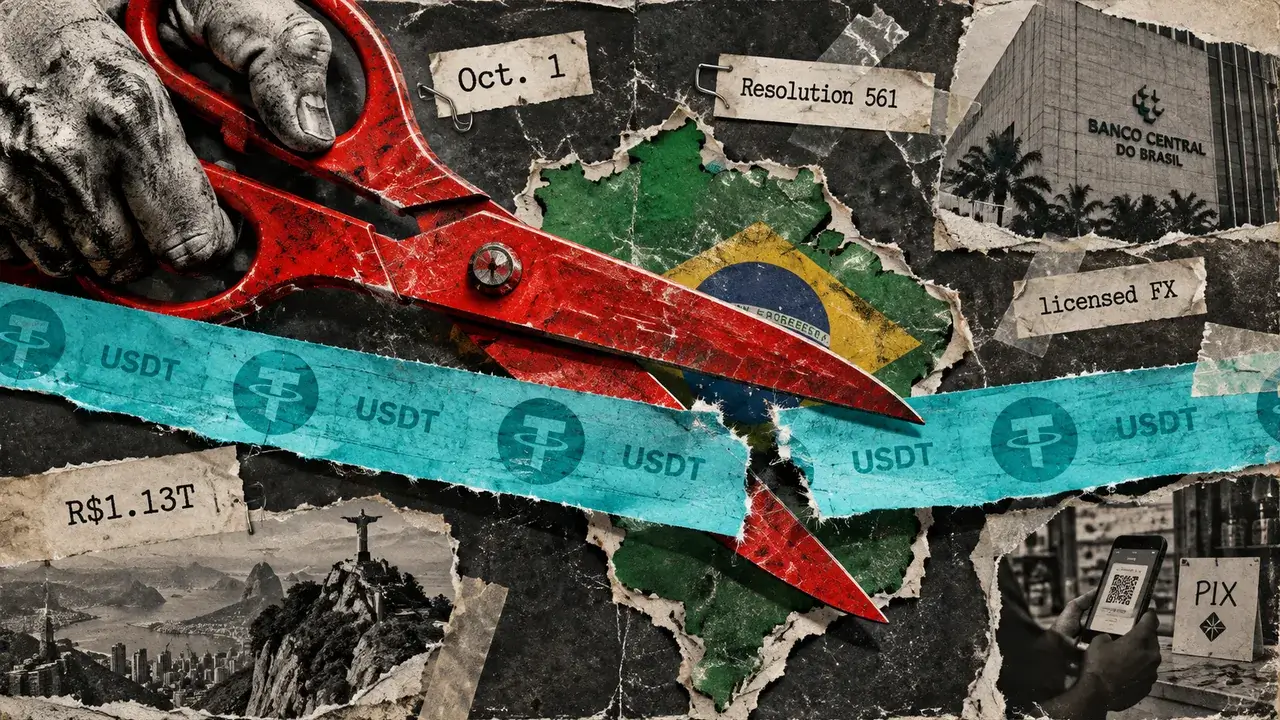
Brazil's central bank will prohibit virtual assets, including stablecoins, from settling one specific category of international payment flows beginning October 1. Resolution 561 targets the settlement leg between regulated foreign-exchange providers and their overseas counterparties, requiring that leg to process through either a licensed FX transaction or a qualifying non-resident real account.
Individual international transfers using virtual assets remain permitted under Brazil's existing regulatory framework, meaning the restriction does not constitute a general stablecoin ban. The rule specifically eliminates stablecoin settlement in the aggregated eFX model, where providers consolidate multiple payments, net balances across a day, and settle once with their foreign counterparty.
What the restriction closes
Oscar Guillermo Farah Osorio, founding partner at Zanella & Farah, characterized the move as resolving genuine regulatory ambiguity. Brazil's 2022 virtual assets law authorized the central bank to determine which crypto operations qualify as foreign-exchange activity, but specific implementing rules never materialized, leaving a gap some market participants exploited.
The aggregated model suits high-volume, low-value flows like streaming subscriptions, online gaming payments, and e-commerce transactions. The new resolution removes stablecoin settlement as an option for this consolidated structure, while preserving other methods including licensed FX transactions and qualifying non-resident accounts.
Scale of stablecoin activity
Brazil's tax authority recorded R$1.13 trillion in declared stablecoin transactions between August 2019 and December 2025, representing roughly 72% of all declared crypto activity in that period. Stablecoins accounted for close to 80% of declared crypto volume in 2025 alone, with USDT comprising nearly 89% of that stablecoin total.
Cost implications
Farah noted that losing stablecoin settlement for bulk payments could force providers to absorb Brazil's financial transaction tax on conventional FX conversions and correspondent-bank and SWIFT-network fees that stablecoin settlement previously avoided. He expects these costs will eventually pass to Brazilian consumers and businesses.
A July Bank of Italy study testing 200-dollar USDC transfers across ten international corridors, including Brazil, found total costs ranging from 0.3% to nearly 9%. The research determined that blockchain transfer costs represented only a marginal share of total expense, while currency conversion and local payment infrastructure drove most costs. Settlement completed in under 20 minutes where instant payment systems existed and took one to two business days elsewhere.
Broker infrastructure adaptation
Shawn Yan, CEO of Cregis, said brokers are increasingly using stablecoins for treasury management, liquidity movement between entities, and internal settlement. As volumes grow, the question shifts from whether to use stablecoins to how much infrastructure brokers control directly, including fund location, transaction speed, and approval processes.
Yan noted that brokers can maintain wallets and treasury controls in-house where permitted while routing specific settlement legs through licensed intermediaries where jurisdictions require it. He stated that the core business remains FX, with infrastructure underneath changing to accommodate regulatory requirements.
Regulatory intent and remaining questions
Farah raised a question the resolution leaves unresolved: Brazil's virtual-assets law lists free enterprise, competition, and operational efficiency among its stated goals, yet individual international stablecoin transfers remain permitted while the aggregated eFX version does not. Regulated providers could plausibly supply the same transaction data the central bank seeks through either method. Farah reads the rule primarily as an attempt to keep flows inside channels the central bank can already monitor and control.
Market outlook
The bull case suggests Brazil's explicit boundary reduces legal uncertainty, allowing larger firms to obtain proper permissions, partner with licensed institutions, and build standardized compliance workflows. Stablecoins could continue serving treasury management and cross-border liquidity functions outside the restricted eFX settlement leg.
The bear case posits that required settlement paths add sufficient FX, banking, and correspondent costs that stablecoins lose meaningful advantage for Brazil-linked flows. Smaller payment firms may struggle to justify separate architecture for a single market, particularly if regulated payment chain costs eliminate efficiency gains.