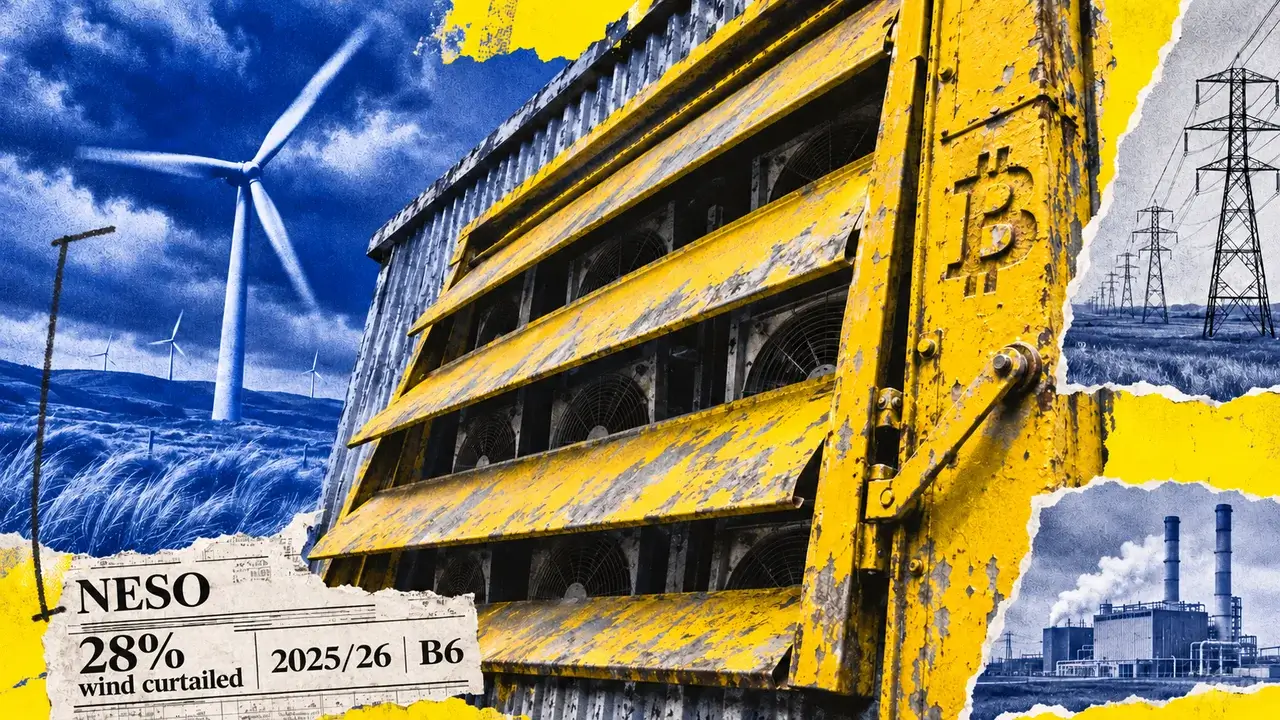
Britain's National Energy System Operator (NESO) has forecast approximately £4 billion in costs from transmission bottlenecks in 2027, raising questions about whether flexible Bitcoin mining operations could help offset these expenses by consuming otherwise wasted wind energy.
Thermal constraints occur when transmission lines cannot safely carry all available electricity. When this happens, NESO pays generators to reduce output while securing replacement supply elsewhere. According to NESO's latest breakdown, about 75% of thermal constraint costs paid for replacement energy, predominantly from gas units.
Scottish Wind Curtailment
Scotland presents a potential case study. NESO reported that 28% of wind in the northern area above a transmission boundary known as B6 was curtailed in 2025/26, compared with 13% across Great Britain. A flexible mining operation could theoretically reduce wind turn-down costs by consuming curtailed electricity at locations and times that help manage bottlenecks.
However, the savings picture is more complex. Adding northern demand does not deliver more power to the south. While the transmission boundary remains constrained and southern demand unchanged, replacement supply remains necessary in those areas. This means reduced wind turn-down does not automatically translate to equivalent reductions in gas generation or consumer bills.
Path to Implementation Unclear
NESO identified additional flexible demand in constrained areas as a potential mitigation strategy. In March, the operator proposed a Demand for Constraints design focused on Scottish boundaries, with service deliveries proposed to begin in 2028. The design contemplated registration and dispatch through NESO's Balancing Mechanism, which directs electricity supply and demand in real time.
For a mining operation to participate, several conditions would need to be met: a suitable grid connection, service qualification, and sufficient operating hours to cover costs. No Bitcoin-specific approval or payment entitlement has been established. For consumers, the relevant comparison remains the actual system cost avoided after accounting for project expenses.