Cardano and Solana are testing two competing approaches to on-chain governance, highlighting the vulnerabilities of voter absence and default representation. The distinctions between the two models have become apparent during simultaneous votes on both networks.
Cardano's model maintains strict independence between constituencies but exposes the network to the direct cost of voter apathy. Its constitutional committee renewal requires separate, independent approval from both delegated representatives (DReps) and stake pool operators.
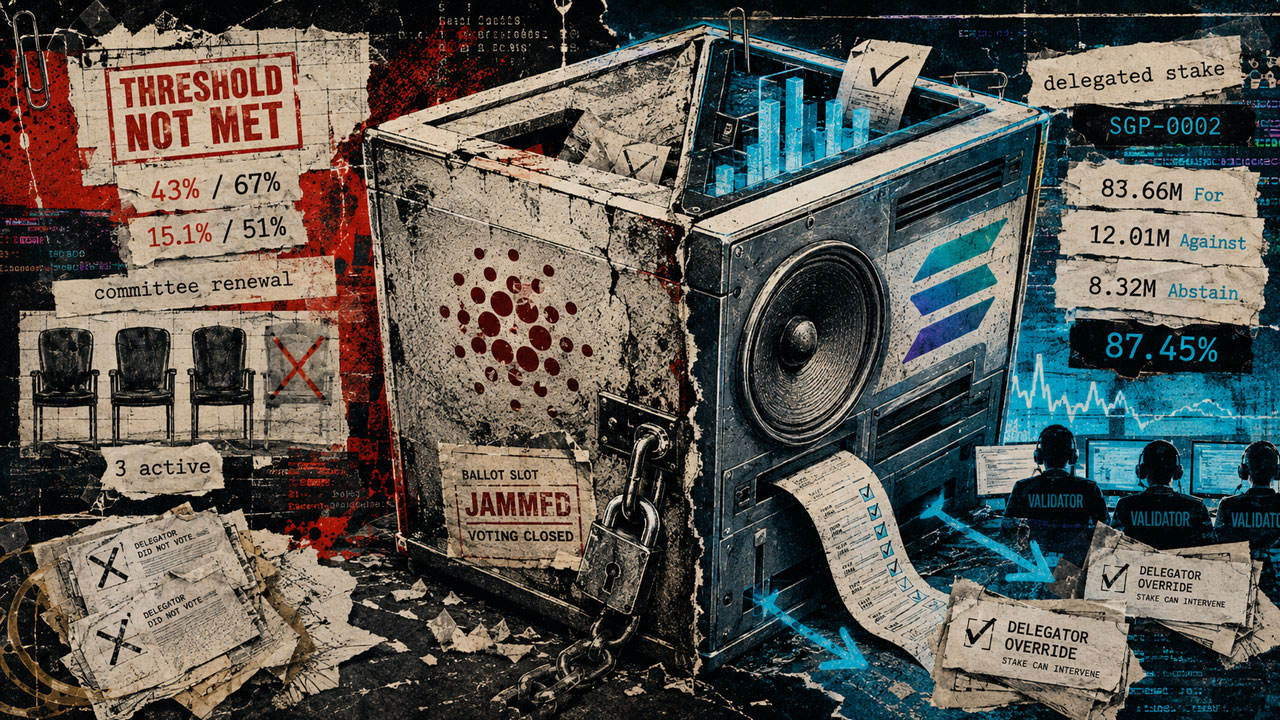
An Aug. 26 DRepTalk snapshot showed support for the Update Constitutional Committee 2026 proposal at 43% for DReps, falling short of the 67% requirement. Meanwhile, stake pool operator support stood at 15.1% against a 51% threshold. Because each group must independently clear its requirement, strong participation from one cannot offset a shortfall in the other.
The vote carries fixed operational consequences because four committee terms expire at epoch 799, with replacements required by epoch 653 and a published deadline of Sept. 1. If the proposal fails, Cardano would be left with three active committee members, falling below the five-member minimum required for committee-dependent actions. Intersect warned that such a disruption could affect the timing of the Dijkstra upgrade, though it would not halt block production or freeze the network.
Solana addresses the participation bottleneck by lowering the voter burden, allowing validators to cast governance votes using the active stake delegated to them unless individual stakers manually override the choice. While eligible stakers can override a validator for an individual stake account, the mechanism shifts oversight responsibilities onto passive holders.
This dynamic was visible during the SGP-0002 proposal, which sought support for faster SOL disinflation. An Aug. 26 Validator Info snapshot recorded 83.66 million SOL voting For, 12.01 million Against, and 8.32 million Abstain, with support among decisive votes reaching 87.45%. Direct delegator overrides were active but accounted for only a small fraction of the roughly 104 million SOL represented in the tally.
The vote also underscored questions regarding validator economic exposure and incentive alignment. For instance, Solana Company—a publicly traded SOL treasury firm that opposed SGP-0002 on timing and policy stability grounds—reported in its second-quarter filing that staking revenue accounted for roughly 99.4% of its total revenue. The proposed policy aimed to accelerate annual disinflation from 15% to 30%, though stakers retained the ability to override validator preferences.
Additionally, Solana faced uncertainty over conflicting public descriptions for proposal passage. The Solana governance FAQ states that one-third of network stake must participate and two-thirds of participating stake must vote For, whereas the governance proposal repository states there is no quorum requirement and that For must receive two-thirds of For plus Abstain. Under the repository rule, the observed vote clears the support threshold, while the FAQ indicates participation remained below the one-third line.
Ultimately, both networks demonstrate that delegation alters the form of participation risk rather than eliminating it. Cardano faces immediate, measurable threats from low voter turnout ahead of fixed deadlines, while Solana raises long-term questions regarding agency, oversight, and whether on-chain governance can remain effective when most tokenholders stay inactive.