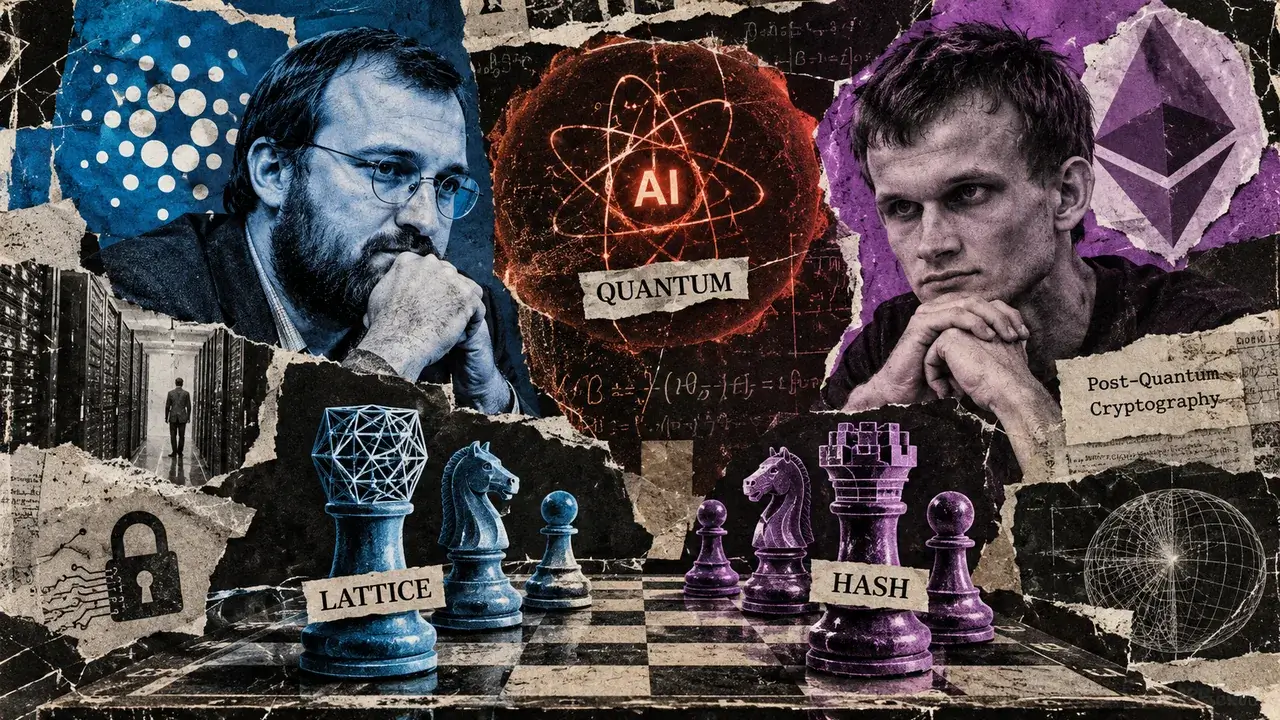
Charles Hoskinson, founder of Cardano, has challenged Vitalik Buterin's skepticism toward lattice-based cryptography, arguing that established security research has already accounted for the technology's known vulnerabilities. Hoskinson warned that discouraging developers from adopting lattice-based approaches could slow the deployment of quantum-resistant protections across internet infrastructure.
The dispute centers on post-quantum alternatives to elliptic-curve signatures used by Bitcoin and Ethereum. Buterin has expressed concern that AI-assisted mathematical discoveries could reveal unexpected weaknesses in lattice-based systems, similar to how the general number field sieve dramatically improved attacks on RSA encryption. He suggested that AI could compress decades of mathematical progress into a shorter timeframe.
Hoskinson rejected this reasoning, noting that the general number field sieve relied on specific techniques involving arithmetic relationships and smooth numbers. He argued that no comparable mechanism has been demonstrated against the lattice problems underlying modern post-quantum cryptography standards.
The Cardano founder pointed to over four decades of lattice research, including advances in lattice reduction and sieving algorithms, that have progressively improved attacks without producing a breakthrough capable of defeating properly configured systems. The US National Institute of Standards and Technology standardized ML-KEM for key encapsulation and ML-DSA for digital signatures in 2024, with security parameters designed to account for known attacks.
Hoskinson also questioned Buterin's suggestion that increasing key sizes tenfold could protect against AI-driven mathematical advances, calling such approaches "numerology" rather than security engineering. He argued that security parameters must be adjusted based on measurable improvements in attack algorithms.
Extending his critique, Hoskinson challenged the assumption that hash-based cryptography offers greater protection against unforeseen mathematical discoveries. He cited historical weaknesses in MD5 and SHA-1 as evidence that hash functions can contain exploitable structures, though he noted these failures do not necessarily affect modern constructions such as SHA-256.
Hoskinson argued that hash-based designs relevant to Ethereum's cryptographic research, including those for zero-knowledge proofs, also present potential targets for mathematical advances. He questioned why lattice-based systems should face greater skepticism while hash-based alternatives face fewer concerns.
Hash-based signatures can provide quantum-resistant transaction authorization, while lattice techniques support key encapsulation for encryption and advanced cryptographic constructions. Hoskinson suggested that abandoning lattice research could limit options available to developers building privacy systems, secure communications, and other applications requiring those capabilities.