Cardano's 2026 Constitutional Committee renewal crossed both voting thresholds required for approval in a pre-boundary snapshot on September 1, though formal ratification awaited the epoch boundary transition.
The network's governance system distributes authority among three groups: delegated representatives who vote with delegated ADA, stake pool operators who represent block-producing pools, and the Constitutional Committee which reviews the constitutionality of actions requiring its approval. For committee membership updates, only DReps and SPOs vote.
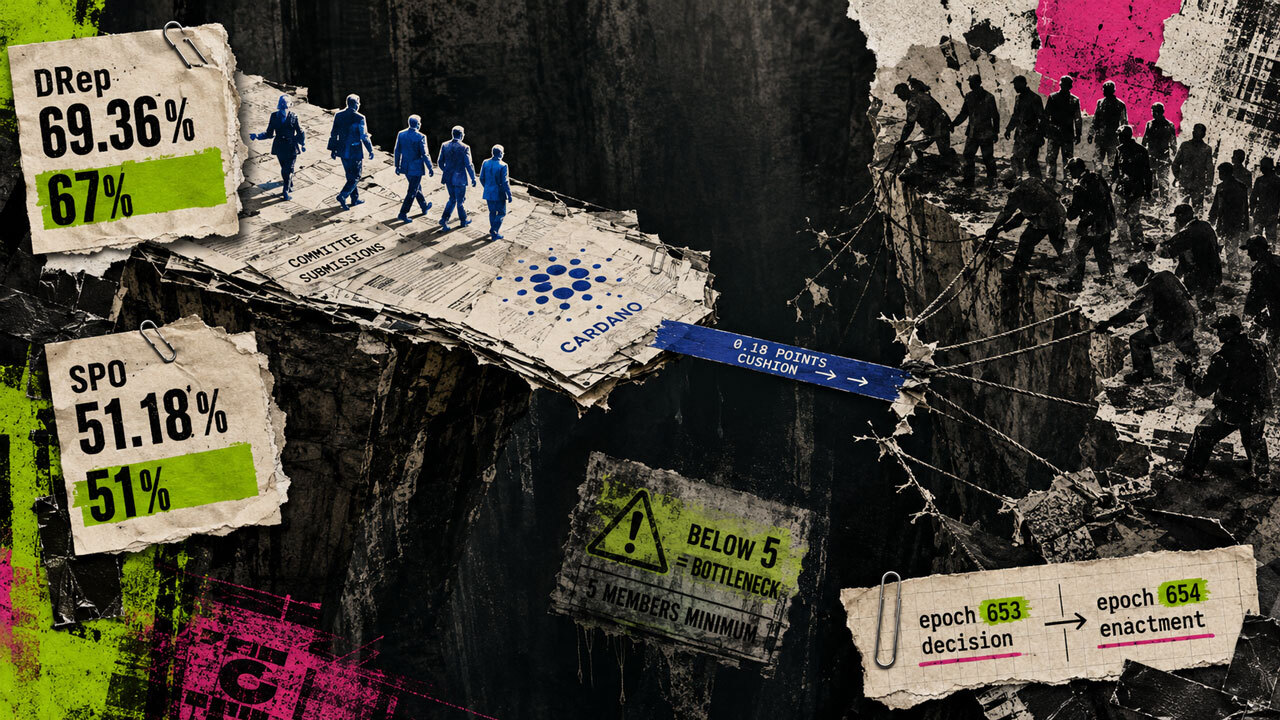
A synchronized voting snapshot taken at approximately 09:59 UTC showed delegated representative support at 69.36%, exceeding the 67% threshold. Stake pool operator approval stood at 51.18%, surpassing the 51% requirement by 0.18 percentage points. The formal decision was scheduled for the epoch 653 boundary at approximately 21:44 UTC on September 1.
The narrow SPO margin exposed a critical governance mechanism: stake behind pools that do not cast a ballot counts against ratification in the effective calculation. Billions of ADA in non-voting stake created most of the resistance to passage. By contrast, explicit abstentions are removed from the denominator entirely.
The stakes for this renewal are significant. Four of the committee's nine seats expire as epoch 654 begins on September 6. Without an enacted renewal, the committee would fall to three active members, below the mandatory five-member minimum. A committee below that threshold cannot approve treasury withdrawals, protocol parameter changes, hard fork initiations, or constitutional updates. Other governance actions like no-confidence measures would remain available because the committee does not vote on them.
If ratified at the epoch boundary, the renewal would enact one epoch later, avoiding the operational gap. The thin approval margin nonetheless demonstrated how Cardano's participation rules allow governance silence to influence network decision-making.