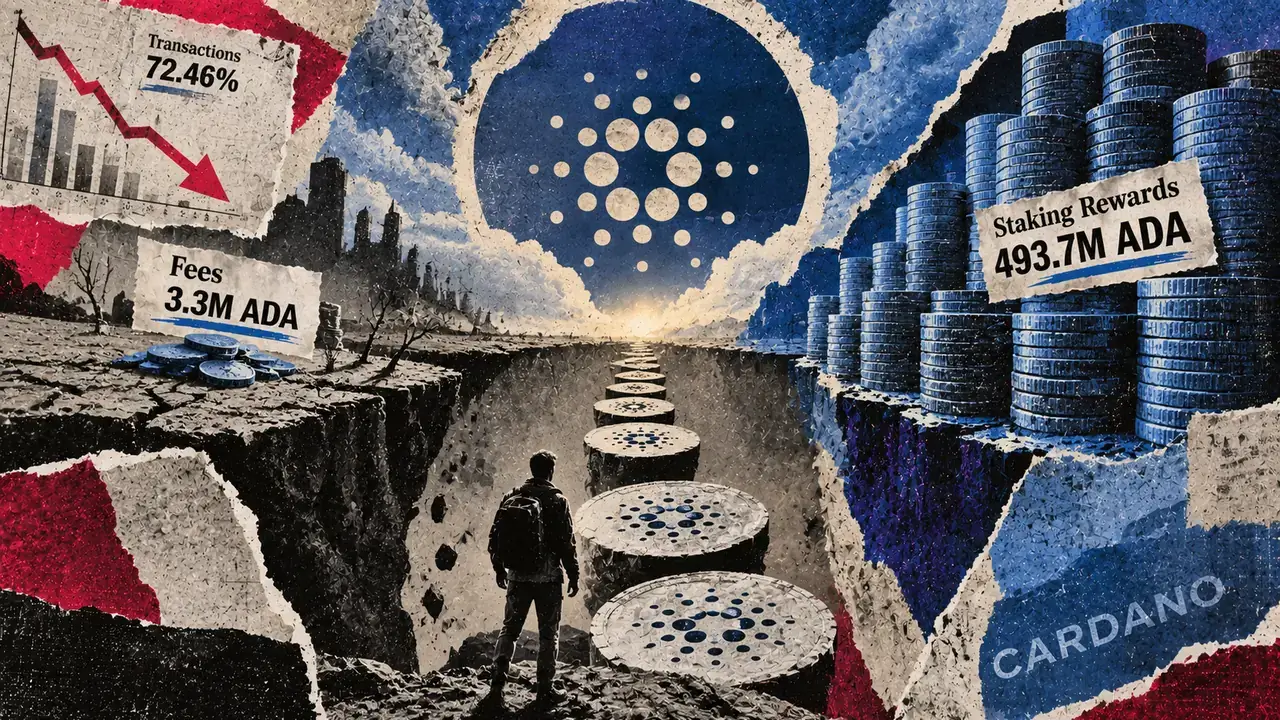
Cardano's transaction fees covered just 0.668% of staking rewards across the 73 five-day epochs from September 1, 2025, through September 1, 2026, according to Bitquery's analysis. The network collected 3.3 million ADA in fees while distributing 493.7 million ADA in staking rewards, leaving fees roughly 149.6 times smaller than reward payouts.
Reserve emissions supplied the dominant share of Cardano's reward economy during the period. The reserve held 6.127 billion ADA as of epoch 655, equal to 13.62% of the network's 45 billion ADA maximum supply. Under Cardano's monetary policy, the reserve is designed to decline, with transaction fees and 0.3% of the remaining reserve entering a virtual pot each epoch to fund stake rewards.
Transaction Activity Declines Sharply
Cardano averaged 90,294 transactions per day in 2022. From January through August 2026, that figure fell to 24,869 transactions daily, representing a 72.46% decline. The shorter measurement window of epoch 654 showed 33,855 ADA in fees across 108,500 transactions, or approximately 21,700 transactions per day—roughly 0.251 transactions per second.
The composition of on-chain activity also shifted. Bots' share of transactions rose from 11.5% in 2022 to 32.8% in 2026, with batchers forming the largest identified bot subgroup. The share of circulating ADA staked declined from 75.6% at the end of 2022 to 58.3% by the end of the study period.
Scaling and Reserve Dynamics
To match current reward levels with fees alone, Cardano would need to sustain approximately 43.1 transactions per second—a simplified calculation that accounts for the measured gap and excludes the 20% treasury allocation. This aligns broadly with earlier analysis estimating that replacing reserve-funded rewards could require 36 to 50 sustained transactions per second.
Cardano's Linear Leios protocol upgrade is designed to process throughput above that range. The August public testnet showed roughly sixfold performance improvements under synthetic traffic conditions, demonstrating increased capacity. Intersect's planning document targets code completion in the fourth quarter of 2026, though the mainnet hard-fork date remains undetermined.
The declining reserve contribution changes the reward equation over time. As reserve emissions fall, nominal reward outlays can decrease, reducing the fee revenue needed to sustain them. However, Cardano's larger economic test remains whether mainnet activity will generate sufficient paid transactions to convert expanded capacity into durable network income.