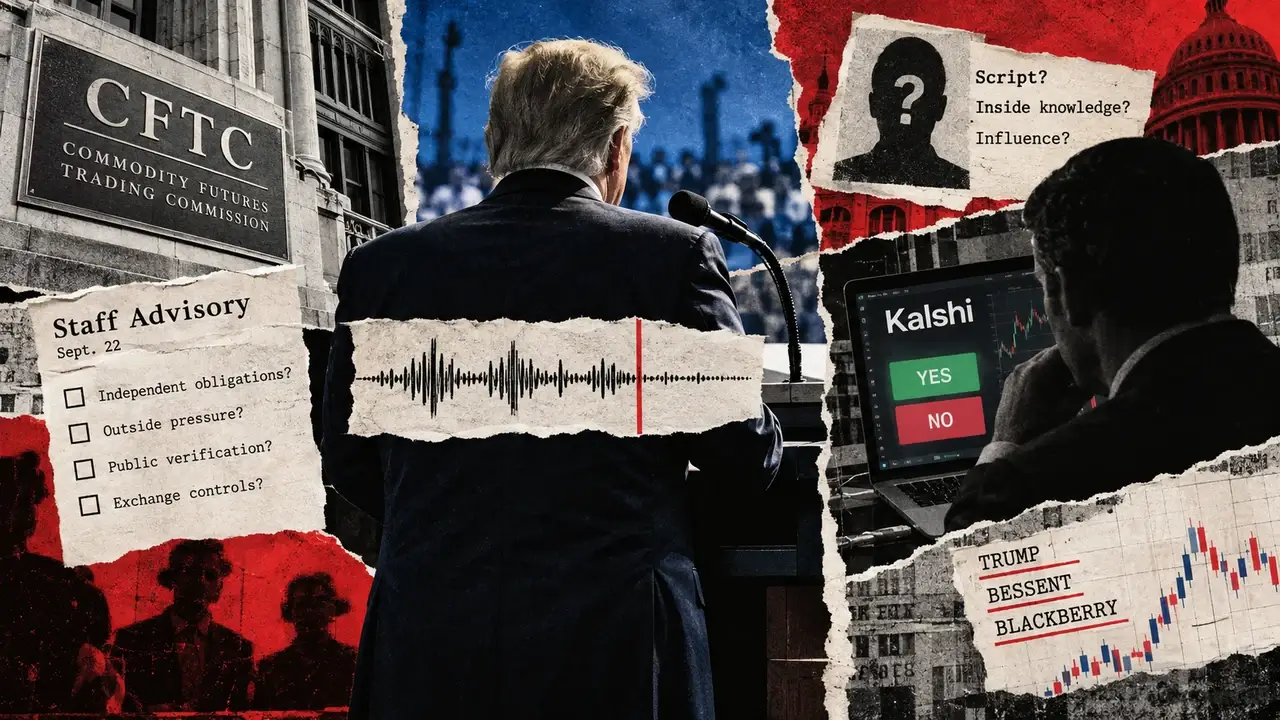
The Commodity Futures Trading Commission's Division of Market Oversight issued an advisory on September 22 asking exchanges to provide stronger, contract-specific explanations of safeguards for prediction markets based on named individuals' words, appearance, or interactions. The staff identified these contracts as carrying heightened manipulation risk and potentially subject to the regulatory standard of being "readily susceptible to manipulation."
The advisory does not prohibit speech markets outright and creates no binding rule, but signals staff concern about gaps in current oversight. Exchange Kalshi continued listing speech markets the day after the advisory was released.
The Verification Problem
Public video evidence can confirm whether a statement was made, but it cannot reveal who knew the script in advance or whether a speaker was influenced by market positions. This asymmetry forms the core of the CFTC's concern.
The staff advisory asks exchanges four non-exhaustive questions: Does the person determining the outcome face independent legal or professional obligations that would deter manipulation? Could that person be pressured or induced to affect the outcome? Can outsiders verify the result under substantial public scrutiny? Are the exchange's trading restrictions, surveillance, and controls suited to the particular risk?
Recent Examples
A review of Kalshi's mention markets in late September identified contracts on Donald Trump's remarks at a state ceremony, Treasury Secretary Scott Bessent's television interview, and BlackBerry's earnings call. These markets showed trading volumes of approximately $125,776, $5,333, and $23,973 respectively during September 23 checks.
The Trump contract wagered on whether he would say "China" at least five times. Its rules specified that live video or official transcripts would determine the outcome, and prohibited trading by source agency employees and those holding material nonpublic information. Kalshi stated it screens political figures and government employees, restricts trading by insiders, and monitors trading patterns, with capability to freeze flagged accounts and refer cases to regulators. However, these stated controls were not independently assessed for their effectiveness in each contract.
Prior Enforcement Actions
A CFTC settlement in August found that a White House teleprompter operator used advance access to presidential speeches to trade mention contracts between December 2025 and February 2026, earning $107,539. The settlement order did not allege the operator changed the speech content; rather, the advantage derived from knowing speech details before other traders.
A separate July settlement addressed a different manipulation vector: the CFTC found that former Representative George Santos traded a contract on his State of the Union attendance while posting misleading statements about his plans. The issue centered on the subject's ability to control the outcome and influence public expectations about it.
Neither settlement directly addresses the three recent Kalshi contracts, but both illustrate distinct manipulation pathways: advance information and outcome control.