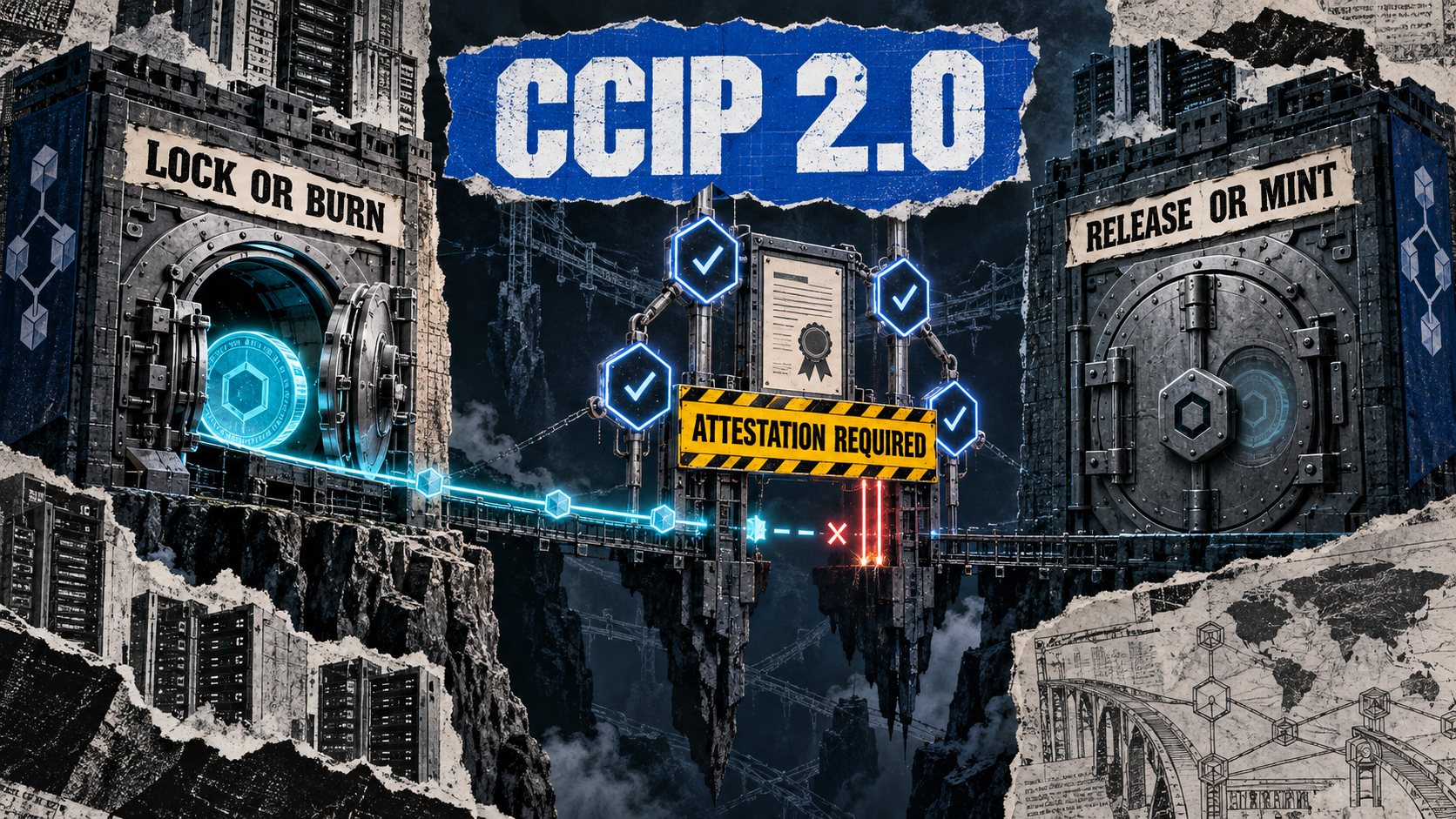
Chainlink announced CCIP 2.0 on September 28, introducing an optional verification mechanism that gives token issuers greater control over cross-chain transfers. The feature allows issuers to require Cross-Chain Verifiers (CCVs) alongside Chainlink's default Committee Verifier, making issuer approval a condition of token delivery.
Under CCIP's existing architecture, tokens are locked or burned on the source chain before verification occurs. With CCIP 2.0, an issuer or third-party operator can configure a required verifier whose attestation must be obtained before the receiving chain can release or mint tokens. This creates a potential delay point where a source transaction may have succeeded while destination delivery remains pending.
How the Verification Process Works
The mechanism operates in stages. When a transfer is initiated, CCIP's OnRamp locks or burns tokens and records the message for offchain verifier services. These services apply their verification rules and publish attestations tied to the message ID. On the destination chain, CCIP's OffRamp checks all required attestations before the pool releases or mints tokens.
Chainlink's default Committee Verifier comprises 16 independent node operators. Additional CCVs configured by issuers sit alongside this baseline verification. An unresponsive verifier can stall every message requiring its attestation, according to Chainlink's trust model.
Recovery Options for Delayed Transfers
Execution on the destination chain becomes permissionless once every required proof exists. While Chainlink's default executor normally submits the transaction, anyone can submit it through a manual execution path. However, changing the executor or paying destination-chain gas does not bypass missing required CCV attestations.
If a required attestation has not been assembled, a destination message can remain untouched with no execution recorded. Failed execution attempts can be retried after the underlying problem is fixed. Chainlink's default executor retries failures within a configured window currently set at eight hours.
Chainlink's manual execution guide allows holders to inspect verifier status and execution state, but the published guidance does not specify a general automatic cancellation, refund, or return of source-chain tokens when a required verifier never attests.
Configuration and Deployment Details
Chainlink's mainnet directory lists supported networks and tokens, but does not publicly show whether a given production lane requires an issuer-operated verifier or has enabled additional gates. Partner announcements or asset migrations do not establish these settings either.
The release also offers faster-than-finality transfers as an optional feature. The faster option can expose a transfer to duplicate destination execution after a deep enough blockchain reorganization, according to Chainlink's documentation. Full source-chain finality remains the default.
For token holders, the key questions are which verification checks apply to their specific asset, who controls them, and what remedy exists if a required verifier cannot complete its attestation after a transfer has started.