


Charles Hoskinson, Cardano’s founder, is turning his public focus back to the blockchain network, and Midnight, one of his largest ventures outside crypto, prepares to close.
The shift comes at a difficult moment for the Cardano founder. His Wyoming health care project is winding down after years of investment, while the blockchain he helped build is facing one of the clearest tests of its new governance model.
That convergence has pulled Hoskinson back into Cardano’s political center. He is trying to defend the network’s research culture, reassure a divided community, and build a stronger coordination layer before the next governance cycle hardens the rules of engagement.
A Wyoming retreat gives the Cardano pledge more weight
According to a report from the Cowboy State Daily, Hoskinson Health & Wellness Clinic in Gillette, Wyoming, is set to close July 31, ending an attempt to build a more advanced rural health care system in a region where patients often travel long distances for specialty treatment.
The clinic was built around a broad promise. It aimed to bring modern medical technology, prevention programs, and higher-end providers closer to patients in northeastern Wyoming.
For Hoskinson, the project also showed a willingness to deploy capital outside the digital asset industry and test an operating model far removed from blockchains, tokens, and governance systems.
However, the business proved harder to sustain than the ambition.
Clinic leaders reportedly said the organization was no longer financially viable in its current form, despite efforts to recruit skilled providers from across the country and abroad.
Meanwhile, the closure followed months of strain. In January, the clinic announced 40 layoffs and acknowledged that it had grown too quickly while burning cash at an unsustainable pace.
William Hoskinson, the clinic’s co-founder and Charles Hoskinson’s brother, said at the time that Charles had spent nearly $250 million on infrastructure, salaries, and local investment without reimbursement.
Notably, the pressure had already reached the companies built around the medical project. In December 2025, Hoskinson Contracting and Hoskinson Concrete laid off a combined 136 workers after completing a 75,000-square-foot medical building. A planned surgery center, which would have been connected to the main clinic by an underground tunnel, was later put on hold.
William Hoskinson publicly accepted responsibility for the pace of expansion, saying the family moved too quickly because it wanted to respond to every request for help.
Speaking on the imminent closure of the hospital, the Cardano founder said:
“[This has] been one of the worst weeks of my life.”
The treasury vote puts Cardano’s research model on trial
Hoskinson’s renewed focus lands inside a dispute that cuts into the central promise of Cardano’s Voltaire era.
Cardano’s decentralized governance system was designed to give ADA holders and their Delegated Representatives (DReps) control over the network’s treasury and development direction.
That structure is now producing a politically difficult result for Hoskinson, as the founder-backed proposal from Input Output Global faces serious resistance from the voter base.
The dispute centers on IOG’s “Cardano Vision 2026: Human Centred, Scalable, Post Quantum Secure – IO Research” proposal. The request seeks 32.9 million ADA from the treasury to support work on post-quantum cryptography, zero-knowledge proofs, scalability research, and academic partnerships.
The package includes Leios, Cardano’s next-generation scaling architecture, which is tied to the network’s long-term throughput ambitions.
It also includes research into quantum-resistant cryptography, a field focused on protecting blockchain systems from future advances in computing that could threaten existing cryptographic standards.
To IOG, the proposal is a continuation of Cardano’s original development model. The network has long differentiated itself through academic research, formal methods, and a slower engineering culture that favors peer review over rapid deployment.
However, that argument has not settled the vote.
Several DReps have objected to the way the request was structured, arguing that important research was bundled with spending items that should be reviewed separately. Some want the proposal broken into smaller submissions, giving voters the option to approve specific workstreams, such as Leios, without backing the full package.
The pushback has widened the fight beyond a simple funding request. Cardano’s voters are now deciding how much discretion IOG should have over a treasury created to be governed by the community, not automatically directed by the founding development company.
Recent voting snapshots show the proposal tracking well below the 67% approval threshold required under Cardano’s governance rules, with less than 30% of votes in support. Voting would end on June 8.
DReps turn a budget fight into an identity test
In response to this issue, Hoskinson has warned that the consequences would extend beyond one failed proposal.
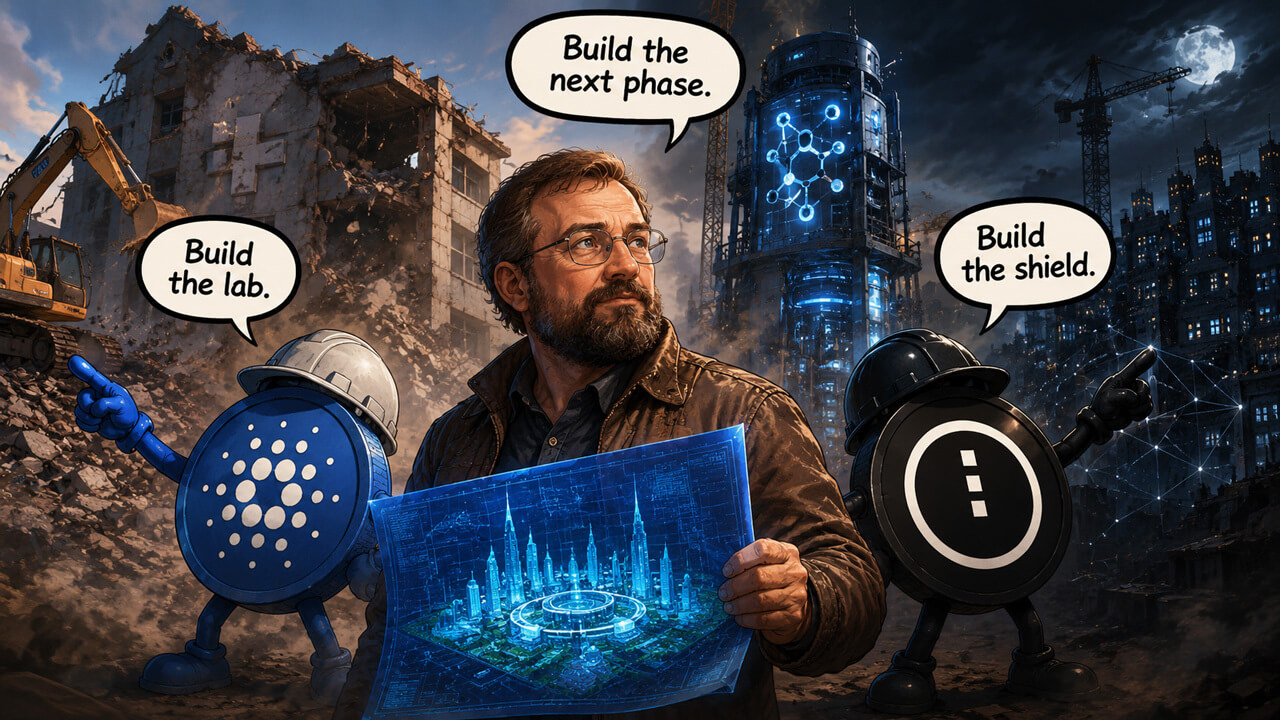
He said Cardano could lose its scientists if the measure fails and warned that the core research lab could be forced to close. He also said IOG would not resubmit the request if voters reject it, raising the prospect of layoffs and a disruption to work tied to Cardano’s next technical phase.
His appeal was aimed, in part, at Japanese D-Reps who voted against the measure. Notably, Japan holds historical weight in Cardano because the network’s early vouchered initial coin offering had a large Japanese base.
He said:
“If this proposal does not pass, we want the entire Japanese community to fully recognize that Cardano will lose its scientists, and our lab will be forced to close.”
That warning reframed the vote in terms of Cardano’s identity. Hoskinson argues that the network cannot maintain its reputation as a research-led blockchain by withholding treasury support from the people and institutions behind that research.
The opposing view is less about rejecting research than controlling the terms of funding. DReps pushing back against the proposal have raised questions over scope, accountability, and the size of bundled requests.
Their position is that a decentralized treasury should force sharper choices, even when the request comes from the company most closely associated with Cardano’s core engineering.
That is what makes the dispute difficult to resolve. Hoskinson is defending the long-term research model that shaped the network. DReps are asserting the voter control that Cardano’s governance era was built to deliver.
Both claims come from inside Cardano’s own logic. The conflict is happening because the network is trying to be both research-led and community-governed, and the treasury vote has exposed the tension between those goals.
Hoskinson turns to the Pentad as 2027 reforms come into view
Faced with a decentralized electorate that is no longer guaranteed to rubber-stamp IOG initiatives, Hoskinson is fundamentally altering his engagement strategy.
Moving past public ultimatums, the founder is now attempting to consolidate the network’s disparate leadership factions to navigate the new political reality.
Over the weekend, Hoskinson announced a comprehensive review of global decentralized autonomous organizations (DAOs) to draft constitutional amendments that would streamline executive functions and roadmap execution.
To push these reforms through before the 2027 governance cycle, he is considering registering as a DRep himself to directly wield on-chain voting power, and plans to host a mini-convention to align stakeholders.
More critically, Hoskinson has called for an emergency summit of “The Pentad“—the five foundational pillars of the Cardano ecosystem: IOG, EMURGO, the Cardano Foundation, the Midnight Foundation, and Intersect.
Hoskinson urged the entities to formalize their operations, while acknowledging that this coordination layer is necessary to bypass ongoing legislative gridlock.
Frederik Gregaard, the CEO of the Cardano Foundation, immediately accepted the invitation, offering to host the leadership summit in Switzerland.
Gregaard noted that while the network does not require complete ideological unity, it desperately needs directional alignment to avoid further administrative gridlock.
To publicly solidify this pivot, Hoskinson announced a partial top-up of the network’s Token2049 sponsorship to the Title level and committed to taking the main stage at the upcoming Cardano Summit in Singapore.
The strategy represents a high-stakes gamble. By severing his ties to traditional healthcare infrastructure and redirecting all capital and operational focus back to digital assets, Hoskinson must now prove he can navigate a governance system that has matured enough to tell him no.