

In brief
- ChatGPT can now connect to over 12,000 financial institutions via Plaid, giving it read-only access to your balances, transactions, and subscriptions.
- The feature launches in preview for ChatGPT Pro users in the U.S. and defaults to GPT-5.5 Thinking, OpenAI’s latest reasoning model.
- OpenAI acquired two AI finance startups in the past year—Roi and Hiro—to build toward this moment.
ChatGPT has been giving generic budgeting advice for years. You know the drill: track your subscriptions, automate your savings, maybe cook at home more.
But some people wanted more—for some reason.
If you are one of those people, OpenAI just launched a personal finance feature in ChatGPT that connects to your actual bank accounts and answers money questions based on what you’ve actually spent—not what the average American spends. It’s rolling out to Pro subscribers ($200/month) in the U.S. on web and iOS first.
The feature works through Plaid, the financial data infrastructure that already powers Venmo, Robinhood, and thousands of other fintech apps. Once you connect, ChatGPT gets read-only access to your balances, transactions, investments, and liabilities across more than 12,000 financial institutions—including Chase, Fidelity, Schwab, American Express, and Capital One.
It cannot move money or see your full account numbers: It simply reads all your financial information, thus having the ability to generate a full financial profile of who you are. That’s it, nothing to be afraid of… right?
The difference in output is stark. Without your accounts connected, ChatGPT responds to “help me save more” with a generic list of suggestions: cut subscriptions, reduce takeout, automate transfers, etc. With your accounts linked, it looks at your last 90 days of actual spending across dining, shopping, and transportation—and builds a personalized monthly plan with real dollar targets based on what you’ve already been spending.
If you wanted more personalized advice with the normal ChatGPT you would have to download your bank statements one-by-one and feed all that information, consuming a lot of time.
This new feature automatically fetches everything for you.
This move didn’t come out of nowhere. OpenAI acquired Hiro Finance just last month—a fintech startup that had billed itself as an “AI personal CFO.” The deal was effectively an acqui-hire, with the Hiro team folding into OpenAI as Hiro’s product shut down. It was OpenAI’s second fintech acquisition in less than a year, following its earlier pickup of Roi, a personalized investing app.
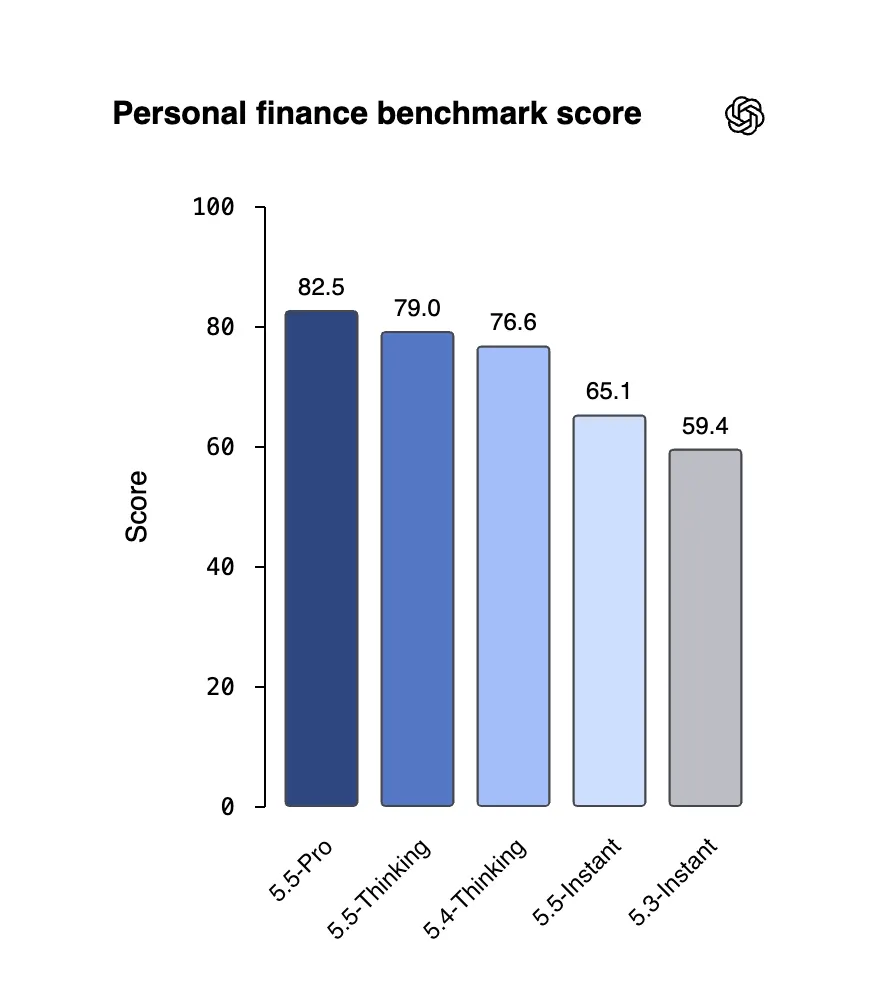
The new tool also sets a financial benchmark of its own. OpenAI worked with over 50 finance professionals to evaluate model performance on complex personal finance tasks. GPT-5.5 Thinking—the default model for the Finances feature—scored 79 out of 100 on that benchmark. GPT-5.5 Pro, available for Pro subscribers, scored 82.5.
OpenAI isn’t the only one moving here. Perplexity recently launched its own Plaid-connected finance product, and Intuit is coming to ChatGPT soon, which would enable things like estimating the tax impact of selling stock or getting odds on credit card approval—all inside the chat interface.
But why?
The obvious question: Is it safe to hand this much financial data to a chatbot?
Plaid uses bank-level encryption, doesn’t store your bank credentials, and has processed over 150 million connections across 12,000+ institutions without a major breach. The security layer here is Plaid. The real question is what OpenAI does with your data once it arrives.
“Your conversations with connected financial accounts follow the same model training settings you choose across ChatGPT,” the policy says—so if you’ve opted out of contributing to model training, then that applies here too. You can also disconnect at any time, and OpenAI says synced data gets deleted from its systems within 30 days.
One important caveat OpenAI makes clearly: This is not a financial advisor. It can spot patterns and suggest targets, but it has no fiduciary duty—that is, no legal obligation to act in your best interest, so your screw-ups are yours and yours alone. That’s a real limitation that banks and regulators will scrutinize closely as the product expands beyond Pro users.
OpenAI ran the same playbook with healthcare earlier this year, launching a specialized ChatGPT for clinicians, without actually claiming any responsibility for the clinical advice it provides.
Personal finance is the next sector in the same pattern: take a domain where people already use ChatGPT informally, add structured data access, and launch a purpose-built vertical. OpenAI said over 200 million people already ask ChatGPT financial questions every month; the product is just catching up to how people are already using it.
The rollout to Plus users comes after OpenAI collects feedback from the Pro preview. Those without a pricey paid account can always go the DIY route: a powerful Hermes agent with a powerful model (even better if it’s a local model or a privacy-focused provider like Venice) and some manual data feeding should net you roughly similar results. It’s less convenient, but your data stays yours.
Daily Debrief Newsletter
Start every day with the top news stories right now, plus original features, a podcast, videos and more.