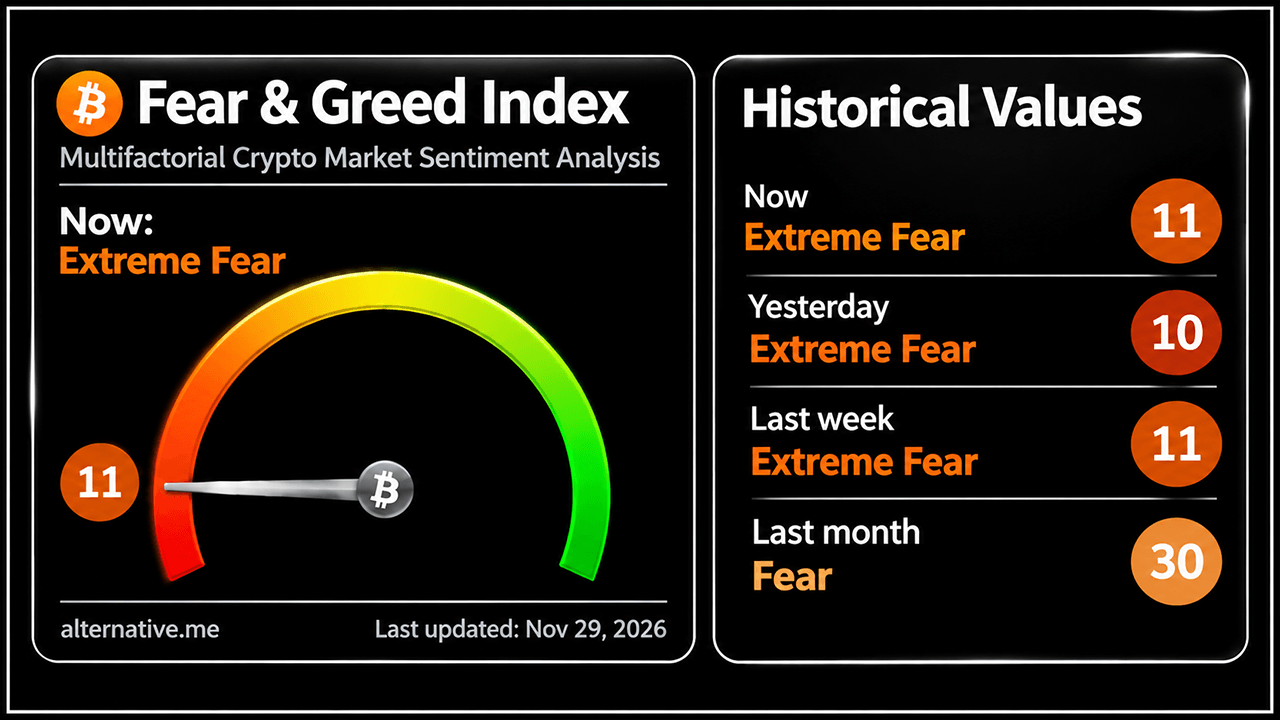
The cryptocurrency market has now logged 17 consecutive days of extreme fear as of Sunday, Nov. 29, 2026, with bitcoin trading near $60,000 after one of its steepest monthly declines since 2022. The sentiment backdrop comes as U.S. spot bitcoin exchange-traded funds (ETFs) post record monthly outflows.
Sentiment Remains Deeply Pessimistic
Alternative.me's Crypto Fear & Greed Index registered 11 out of 100 on Sunday, compared with 10 the previous day and 11 a week earlier. About one month ago, the index stood near 30. Coinmarketcap's sentiment gauge has also shown readings between nine and 10 in recent days.
Bitcoin (BTC) traded between $59,950 and $60,000 around midday Sunday, gaining roughly 0.7% to 1% over 24 hours. The leading cryptocurrency carries a market capitalization of about $1.2 trillion. It remains approximately 52% below its Oct. 6, 2025, all-time high of $126,080, and November losses currently range between 23% and 26%.
2026 Ranks Among the Most Fearful Years on Record
Historical Fear & Greed Index data dating back to February 2018 shows that 2026 has been unusually negative. Through Nov. 29, the dataset counts 155 extreme fear days, or about 47% of the year's elapsed calendar days.
- 2022 recorded 207 extreme fear days, the most in the dataset, a year marked by several high-profile financial failures.
- 2026 ranks second with 155 days through Nov. 29.
- 2018 recorded 138 extreme fear days.
- The combined total for 2023, 2024 and 2025 is 77 days, less than half of 2026's count.
The longest uninterrupted extreme fear streak in the dataset lasted 74 days between May and July 2022, a period that coincided with the Terra collapse and financial troubles at Celsius and Three Arrows Capital. The COVID-19 market crash produced a 49-day streak in 2020. Three of the longest episodes in the dataset occurred in 2026, including a 46-day stretch beginning in late January, a 35-day period beginning in early June and a 30-day episode beginning in March. The current 17-day streak is 13 days short of matching the 30-day episodes.
Record ETF Outflows Add to Pressure
U.S. spot bitcoin ETFs have recorded approximately $5.39 billion in net outflows for November. That exceeds the previous monthly record of roughly $4.51 billion set in June 2026. BlackRock's iShares Bitcoin Trust (IBIT) accounts for a substantial majority of November's withdrawals.
Technical indicators also point to caution. Bitcoin's 14-day relative strength index (RSI) has recently been near 29, a level traditionally associated with oversold conditions, and BTC continues to trade below the widely monitored 50-day and 200-day moving averages. Market analyses cite potential support between $55,000 and $58,000, with resistance concentrated around $60,000 to $62,000. Bitcoin's dominance remains elevated at roughly 58% to 60% of the broader crypto market.
What the Index Does and Does Not Indicate
The Alternative.me index combines volatility, market momentum, trading volume, social media activity, bitcoin dominance and search interest. Its survey component is currently suspended. Readings from zero to 24 fall into the extreme fear category.
Historical outcomes after extreme fear readings are mixed. Some datasets show modestly positive median 30-day returns of about 1% to 2%, while longer 90-day results have often been weaker. Analysts note that extreme fear can coincide with attractive valuations but can also persist through further losses. Whether bitcoin can reclaim higher price levels and attract renewed institutional capital may matter more over the coming weeks than the sentiment reading alone.