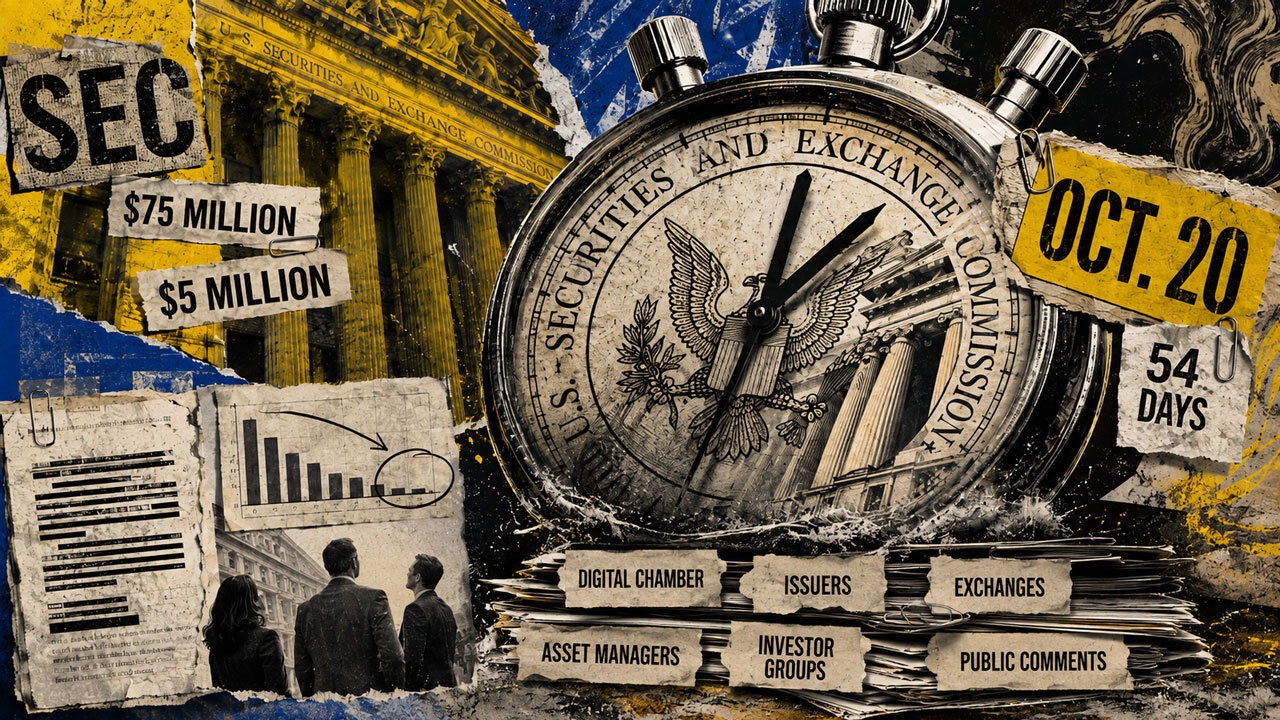
The U.S. Securities and Exchange Commission's proposed crypto fundraising exemptions face an October 20, 2026 deadline for public comment, leaving stakeholders 54 days to shape the framework as of late August.
As of August 27, the proposal had received 31 posted public comments plus one separately labeled meeting memorandum. The comment window shows no major crypto exchanges, large asset managers, large token issuers, or established investor advocacy groups among the visible submissions.
The two proposed exemptions would allow eligible crypto ventures to raise capital under different limits. One path permits fundraising of up to $5 million in any four-year period, while the second allows up to $75 million in each 12-month period.
Key Issues Under Debate
Early commenters have focused on the exemptions' mechanics, testing where the SEC should set boundaries around disclosure requirements, investor protections, non-cash compensation, and the $75 million ceiling.
Ohanae Securities, an SEC- and FINRA-registered broker-dealer, requested clarification on the $75 million exemption's availability and proposed additional protections for regulated intermediaries relying on issuer representations.
ARKONIX challenged whether independent offerings should share the $75 million ceiling if they use the same infrastructure, arguing that separate partner vaults should not be aggregated. The firm used an example in which 10 partners each raising $20 million would not constitute a $200 million issuer.
Beeezo asked the SEC to distinguish genuine commercial activity with stable-value compensation from services furnished to an issuer for its own token when calculating non-cash consideration under the $5 million path.
Tilden Moschetti opposed the startup exemption as currently proposed and sought entity eligibility requirements, individual investment limits, scaled financial assurance, permanent EDGAR disclosure, four-business-day material updates, and tighter resale and insider safeguards.
The Digital Chamber noted that its Token Alliance submitted 13 responses covering all 48 questions in an earlier SEC request, drawing input from more than 75 members, though those materials sit in a pre-proposal archive outside the current comment tally.