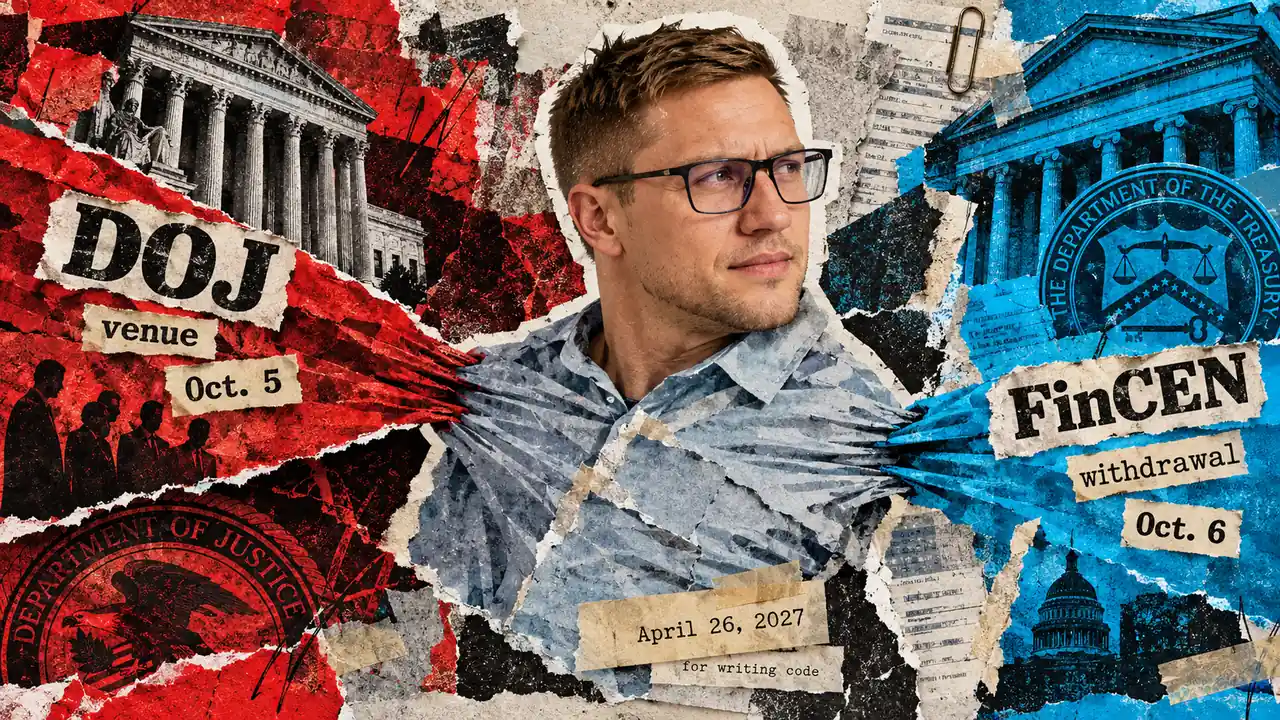
Federal prosecutors are pressing forward with charges against Roman Storm, co-founder of Tornado Cash, a cryptocurrency mixer that obscures transaction trails. In an Oct. 5 filing, the Department of Justice asked Judge Katherine Polk Failla to reject Storm's venue challenge on money-laundering and money-transmission conspiracy counts.
Prosecutors cited a Sept. 25 decision from the D.C. Circuit in United States v. Sterlingov, involving Bitcoin Fog, another cryptocurrency mixer, as precedent for their venue argument. The government contends that a Manhattan customer, Shakeeb Ahmed, whose deposits helped enlarge the anonymity pool, establishes venue for the money-transmission count.
Storm faces charges centered on allegations that he knowingly participated in criminal activity through building and maintaining Tornado Cash. He already has an August 2025 conviction on one money-transmission conspiracy count carrying a statutory maximum of five years. A court order from Aug. 25, 2026 scheduled his retrial for April 26, 2027.
The case proceeds even as policy shifts suggest changing attitudes toward cryptocurrency privacy. The Treasury Department's Financial Crimes Enforcement Network withdrew a 2023 proposal for enhanced reporting and recordkeeping requirements for international cryptocurrency mixing, citing concerns about a "chilling effect on legitimate activity." The withdrawal was filed Oct. 5 for Oct. 6 publication.
Policy Changes Do Not Resolve Criminal Case
The Treasury withdrawal addresses an administrative reporting proposal and does not repeal criminal offenses or impact Storm's prosecution. The Department of Justice similarly issued guidance limiting certain mixer-related charges. In an April 7, 2025 memo, Deputy Attorney General Todd Blanche directed prosecutors away from targeting mixers for their users' conduct or unwitting regulatory violations.
However, the guidance expressly excludes charges involving funds known to come from crime or intended for unlawful activity. In August 2025 remarks, DOJ official Matthew Galeotti outlined protections against new charges for qualifying software: it must be truly decentralized, solely automate peer-to-peer transactions, and leave the third party without custody and control over user assets.
The government's theory in Storm's case focuses on the developers' responsibility for running and maintaining a service used by criminals. Prosecutors argue that legitimate deposits helped conceal criminal funds. At an April 9, 2026 hearing, prosecutor Ben Arad distinguished the perspective of innocent depositors from that of Storm and alleged co-conspirators, emphasizing active steps to maintain and improve the service rather than merely leaving its pools operational.
Storm has contested the criminal treatment of his developer activity. The next significant developments will be judicial decisions on his pending challenges and any adjustments to trial scheduling.