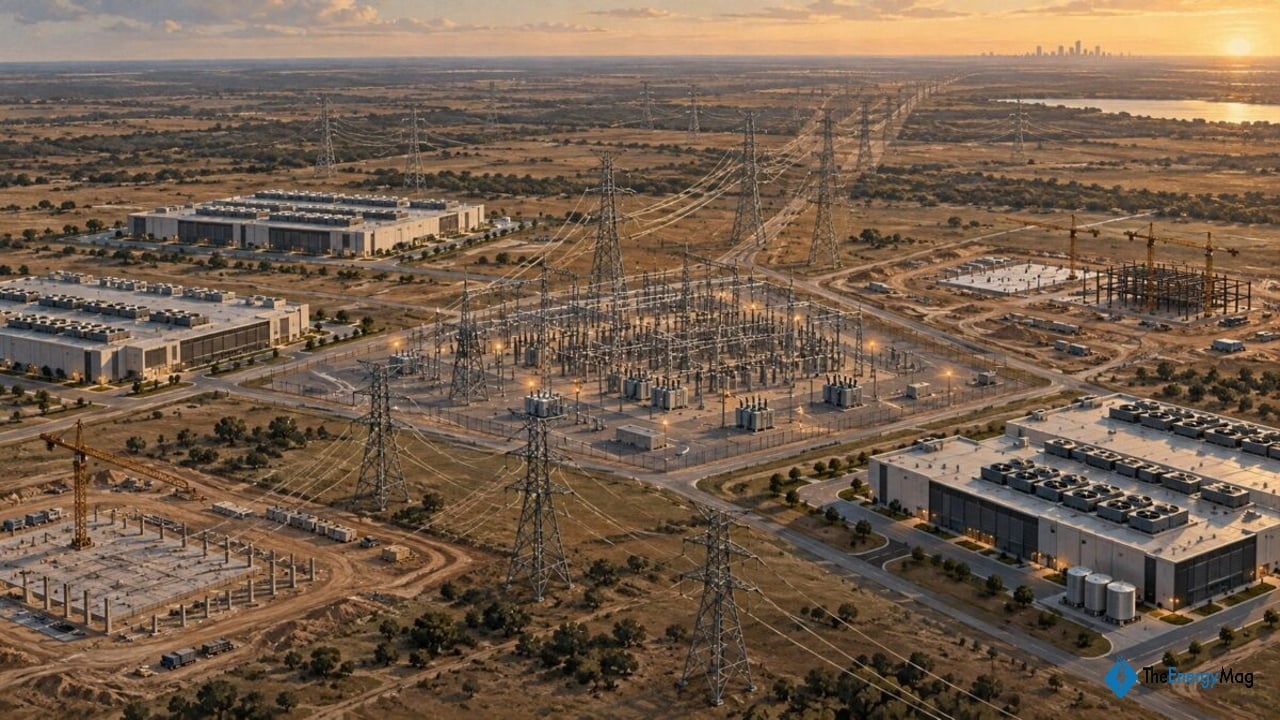
Bitcoin miners and data center companies are competing on a new front: their standing in Texas's power interconnection process. What was once a technical grid classification has become a public measure of competitive position, with companies announcing ERCOT Batch Zero designations as evidence of substantive expansion plans.
Recent announcements highlight the trend. IREN highlighted conditional Base Load status for its 2 GW Sweetwater hub. Hut 8 flagged the designation for Beacon Point. Soluna announced it for the full 166 MW Kati campus. Galaxy disclosed five projects covering approximately 4.2 GW, with 1.63 GW classified as Base Load and 2.6 GW as Studied Load.
Classification Distinctions Matter
The announcements mask critical differences in project advancement. ERCOT's classifications distinguish between capacity retained from earlier studies (Base Load) and requests still awaiting allocation (Studied Load). Base Load projects enter the study's starting model without new capacity allocation, providing a meaningful advantage. Studied Load projects still face evaluation and allocation.
Galaxy's own disclosures illustrate the distinction. The company submitted the 700 MW Caspian project as Base Load, but ERCOT provisionally classified it as Studied Load. Even within one company's portfolio, similar-sounding announcements represent different levels of certainty.
Scale of Requests Outpaces Historical Demand
When Texas regulators approved Batch Zero in June, ERCOT reported more than 438 GW of large-load connection requests, nearly 89% from data centers. By August 3, Governor Greg Abbott's office cited more than 474 GW of requests, roughly 90% from data centers—more than five times ERCOT's record peak demand. These figures measure proposed connections, not a forecast that every requested megawatt will materialize.
Batch Zero represents ERCOT's transitional approach to evaluating large loads together and assessing their combined effects on transmission capacity. The process generally concerns facilities of at least 75 MW with sufficient prior study work and development commitments.
Conditional Status Requires Resolution
Companies describe their classifications as conditional, but the source of that conditionality varies. Abbott's August directive required verification and audit of data centers advancing through the interconnection process. ERCOT's September 3 notice identified possible conditions including successful verification, corrections to technical modeling data, and regulatory exceptions where eligibility requirements were not met. Failure to satisfy an applicable condition can disqualify a project.
Company disclosures do not consistently identify which conditions apply to each site. A project awaiting verification differs materially from one requiring an eligibility exception, even if both carry conditional status.
The Timeline Ahead
For investors tracking the industry's expansion, the relevant comparison is project by project: capacity already operating, capacity preserved as Base Load, requested capacity still awaiting allocation, and the remaining steps before customers can use it. As with the 2021 hashrate announcements, the test ahead is how many of the announced megawatts become operating facilities and when.