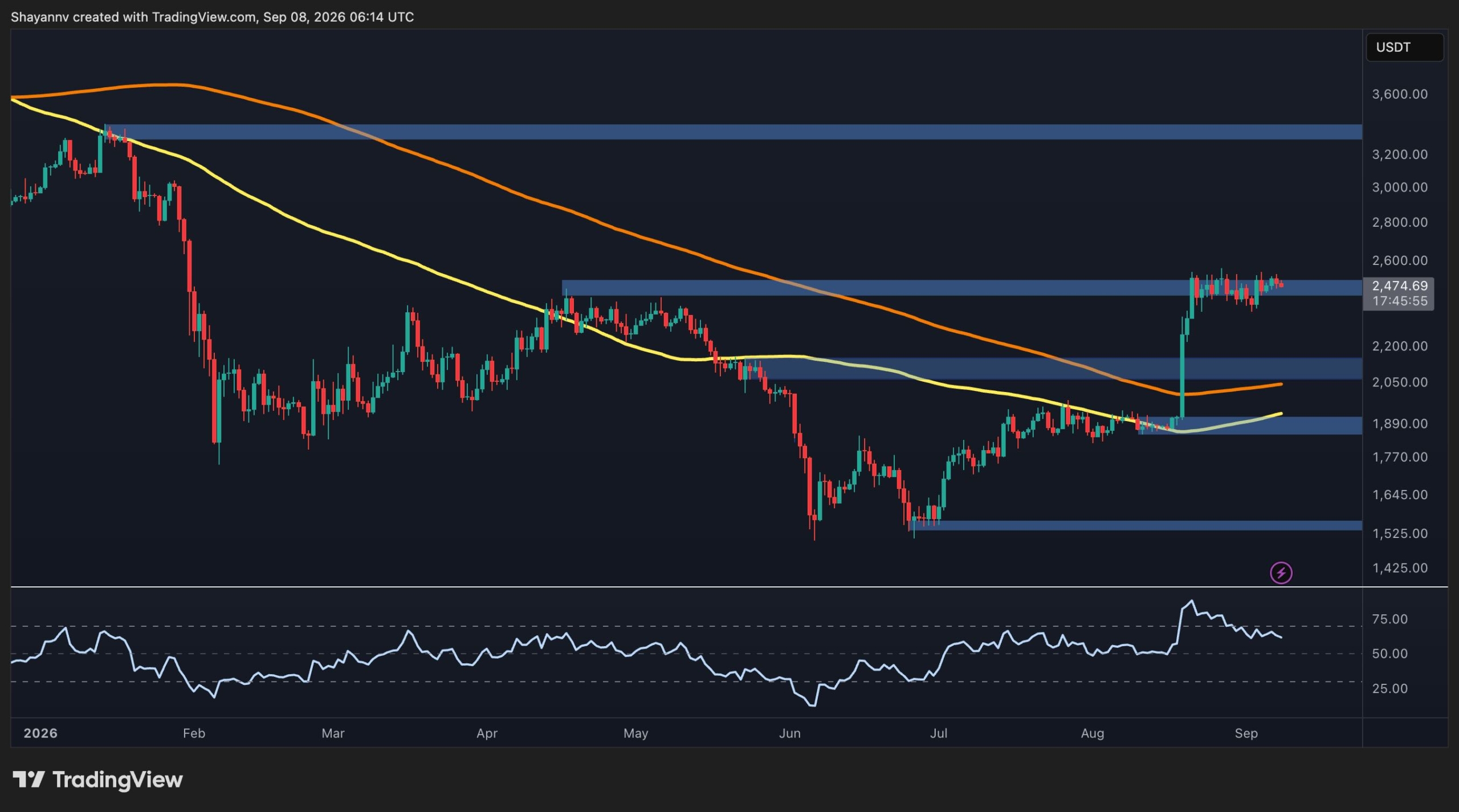
Ethereum has entered a consolidation phase following a sharp recovery from the $1.5K area, currently trading slightly below $2.5K with support from declining exchange reserves.
Technical Structure on the Daily Chart
The daily price structure has improved significantly in recent weeks. ETH broke out of a prolonged base around the $1.9K zone and reclaimed the $2.1K area, which previously acted as major resistance. Both the 100-day and 200-day moving averages have turned upward, indicating a transition from recovery toward a potentially bullish structure.
ETH is currently trading inside a significant resistance zone around $2.4K-$2.5K, with the price near $2.47K. The market has tested this area multiple times without a decisive daily breakout. A sustained move above $2.5K could open the path toward the next resistance area around $3.3K.
On the downside, the first important support level sits at the former breakout area around $2.1K. The daily RSI has risen considerably from deeply weak levels but has retreated below the traditional overbought threshold, suggesting potential consolidation or correction may occur until fresh buying pressure emerges.
Four-Hour Consolidation Range
The 4-hour chart displays a clearer consolidation structure. Following the explosive move from $1.9K, ETH has moved sideways inside a roughly $2.35K-$2.55K range. Repeated reactions from the upper end suggest sellers remain active around $2.45K-$2.5K, while buyers have consistently defended the lower boundary near $2.35K-$2.4K.
The 4-hour RSI is hovering around 50, reflecting indecisiveness. A confirmed breakout above $2.5K would strengthen the continuation setup, while a break below $2.4K would suggest the consolidation is turning into a deeper correction, with the $2.25K demand zone becoming the next major area of interest.
On-Chain Perspective
Ethereum's exchange reserves have declined steadily from above 21M ETH during 2025 to approximately 14.9M ETH currently, even as ETH recovered toward $2.4K. Exchange reserves measure the amount of ETH held on centralized exchanges, and a persistent decline generally indicates fewer coins are immediately available for potential selling.
This divergence suggests that the supply available on exchanges has not increased alongside the price recovery. From a market-structure perspective, this can be supportive if demand continues to expand, as fewer ETH on exchanges could make it easier for price to move higher with sustained spot demand. However, the declining reserve trend should be treated as a supporting factor rather than a standalone bullish signal.