Researchers Tackle Cryptographic Proof Gap
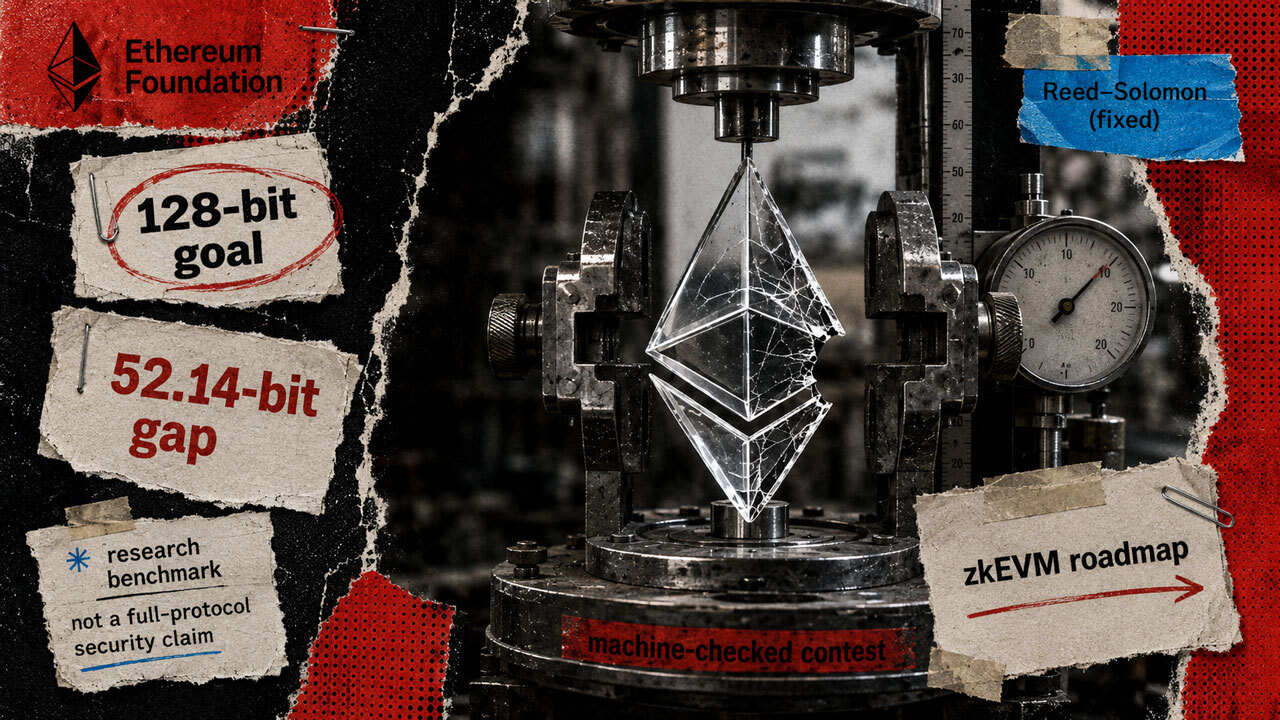
Ethereum researchers are utilizing the better.codes contest to measure and close a cryptographic proof gap for zkEVM security. The live leaderboard recently displayed a 63.99-bit lower certificate and a 116.13-bit upper certificate for koalaIRS12, a fixed parameter profile for an interleaved Reed–Solomon reduction used in proof-system research.
The resulting 52.14-bit unresolved interval sits short of Ethereum's 128-bit production target. The challenge repository expressly notes that its spot-check quantity should not be interpreted as minus-log2 of whole-system soundness or as full-protocol security.
Two-Track Verification Process
The contest employs two distinct tracks to close the interval. The soundness track raises the lower certificate by proving that the benchmark’s executable reduction-error bound meets the encoded target. Meanwhile, the attack track lowers the upper certificate by certifying an unsafe suffix under the benchmark’s winning-set-density condition.
Submissions are verified using a pinned theorem statement, parameter point, and verification harness. A comparator checks the statement against the target, and the Lean kernel verifies the proof before promotion. While this ensures rigorous component-level checking, production assurance also requires addressing model completeness, implementation fidelity, and the composition of separately analyzed components.
Roadmap and December Targets
The Ethereum Foundation's zkEVM security roadmap previously outlined a 128-bit provable security target, a final proof size of 300 KiB or less, and a formal soundness argument for the recursion architecture, with an early December deadline set during a security-sprint update.
Reaching a lower certificate of 128 bits would settle the soundness side for the koalaIRS12 benchmark at its fixed parameter point. However, a production zkEVM claim requires broader accounting across every relevant component, proof-size compliance, and evidence that specifications match implementations. These research developments remain distinct from Ethereum's current consensus-critical validation path, where ordinary execution-client re-execution continues to drive attestation.