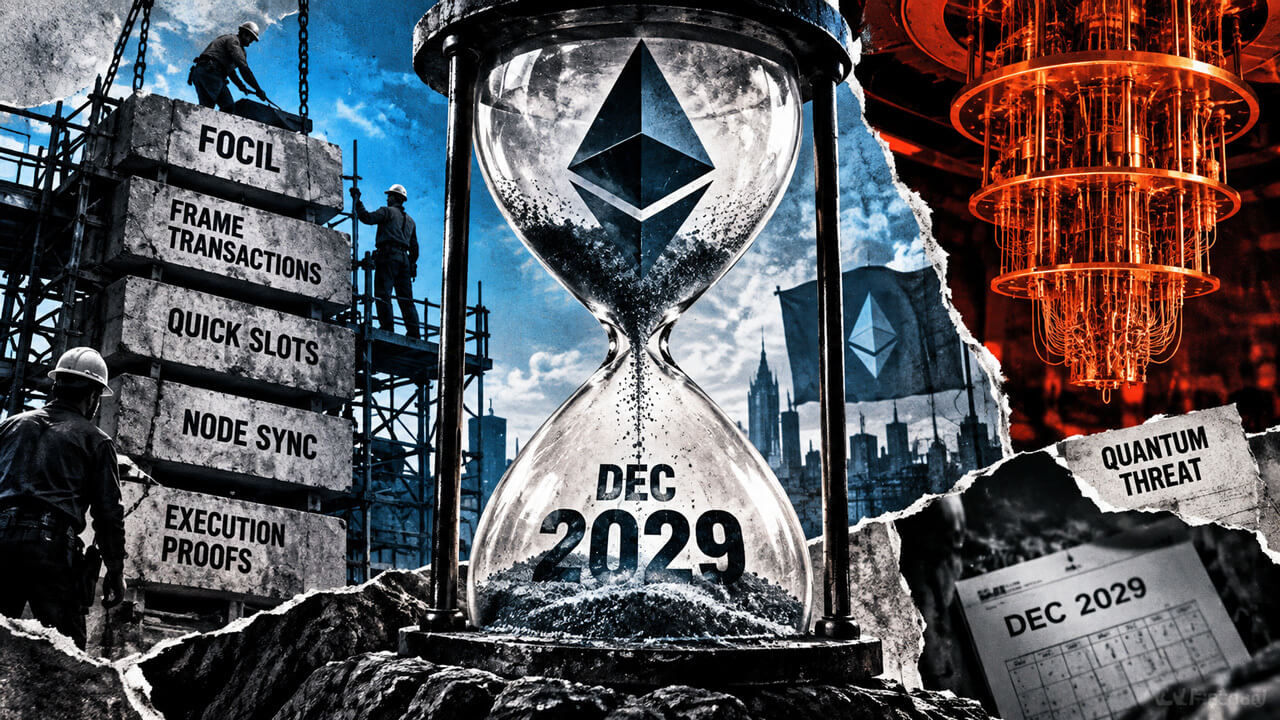
Ethereum is constraining what can be added to upcoming upgrades as developers work to make the network quantum-resistant by December 2029. The Ethereum Foundation's Protocol cluster confirmed on September 7 that the deadline will remain non-negotiable at least until a review with outside experts in January.
The deadline is creating direct competition between optional features and the engineering work needed to harden Ethereum's execution, consensus, and data layers. The Foundation stated its appetite for additional consensus-layer work beyond planned features is "close to zero" unless it supports the post-quantum roadmap.
Trade-offs in Upcoming Upgrades
The trade-off is already visible in Hegotá, the upgrade being scoped after Glamsterdam. Two protected priorities are FOCIL, designed to strengthen transaction-inclusion guarantees, and Frame Transactions, which introduces a new account transaction model and provides a path toward replacing cryptography vulnerable to future quantum attacks.
Developers are considering moving post-quantum attestations forward from a later upgrade while pushing mandatory execution proofs backward, accelerating one of Ethereum's largest remaining quantum-security changes at the expense of other timelines. The swap has not been approved but shows how a threat still years away is determining which upgrades can proceed today.
Why 2029?
The Foundation is not predicting that a cryptographically relevant quantum computer will arrive by 2030. Instead, it wants Ethereum to plan around Q-day, the point at which quantum computers could break widely used public-key cryptography, which experts estimate could occur as early as 2030. This 2029 target aligns with post-quantum cryptography migration timelines independently set by technology companies including Google, Cloudflare, and Microsoft.
Assuming Glamsterdam reaches mainnet in December 2026, Ethereum's current roadmap places full post-quantum readiness five hard forks later. Reaching that milestone by December 2029 would require upgrades to land every 7.2 months on average, a cadence the Foundation described as aggressive and vulnerable to delays.
Fallback Protections
Ethereum has built a fallback into the schedule. A minimum viable post-quantum milestone, or MV-PQ, is planned for an earlier fork. That would include a post-quantum consensus heartbeat and related components. An annual fork cadence could still reach this milestone by December 2029, though with reduced guarantees. The Foundation describes that milestone as a temporary safeguard intended to let Ethereum keep operating through a potential quantum threat rather than provide full resistance.
Feature Evaluation and Constraints
The Protocol cluster evaluated 62 proposals and divided them into tiers based on priority. S-tier proposals define the fork and are protected even if the schedule slips. A-tier items are expected to ship but can be cut before top priorities. B-tier proposals must wait until higher-priority features are stable and then compete for remaining capacity.
Quick Slots, which would shorten Ethereum's slot time, sits in B tier despite researcher support. Developers are requiring a complete specification, full prototype, analysis of downstream effects, and assurance that shorter slots will not complicate planned protocol designs. Engineering teams warned that changing slot timing affects assumptions throughout the protocol and wider ecosystem.
Flexibility on Cryptography
Not every proposal carrying a post-quantum label automatically moves to the front of the queue. The Foundation considers committing Ethereum to a specific post-quantum signature scheme at this stage premature, particularly while cryptographic standards and the network's longer-term architecture continue to develop.
Frame Transactions avoids some of that problem by making account validation programmable, giving Ethereum what developers call cryptographic agility. Accounts could adopt new signature schemes without requiring a separate hard fork every time new cryptography support is needed. That makes Frame Transactions useful before Ethereum settles on exact cryptographic tools for after Q-day.
Consensus upgrades face tighter scheduling constraints than execution-layer protections because validator signatures and consensus machinery cannot be swapped out account by account and require coordinated protocol changes across the network.
Ethereum plans to overlap much of the remaining work, with Hegotá implementation proceeding while specifications for later upgrades mature. The next consequential decision is whether developers actually move post-quantum attestations forward and mandatory execution proofs backward as currently under consideration.