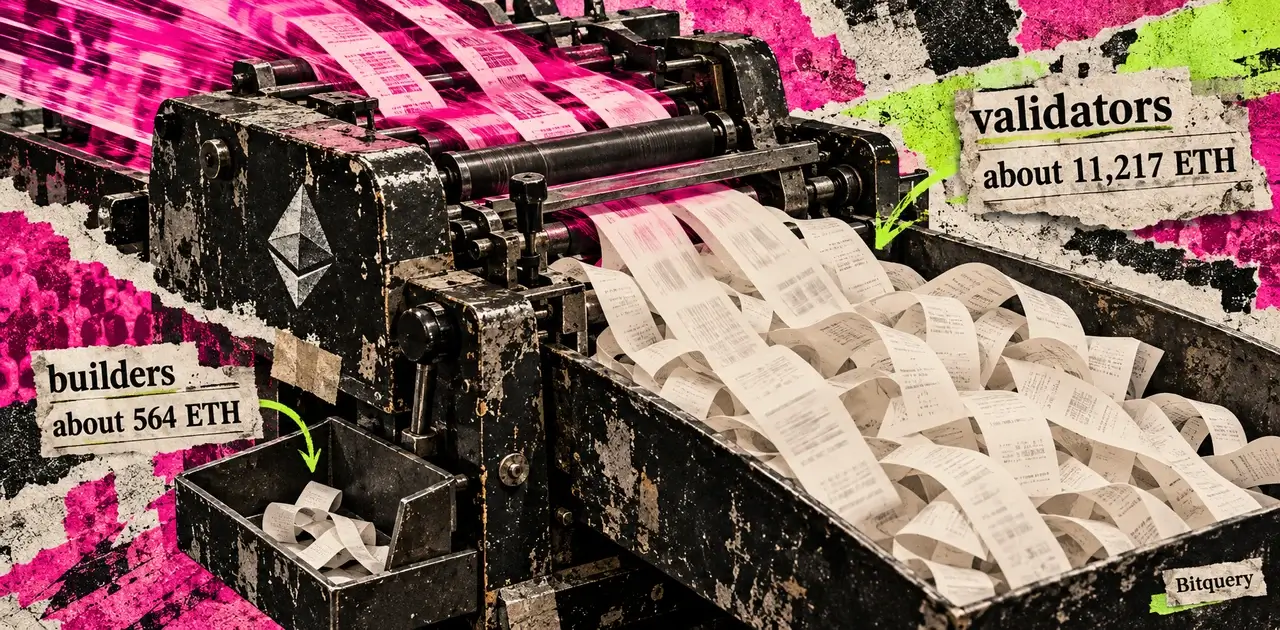
Ethereum validators captured approximately $30 million in payments during a trading surge following Binance's $6.3 billion hack, according to an October 30 investigation by Bitquery.
The attackers lost roughly $119 million by exchanging stolen cryptocurrency at unfavorable prices while attempting to move funds beyond the reach of stablecoin issuers. Their rushed transactions created significant arbitrage opportunities across multiple blockchains.
Extreme Price Movements Drive Validator Revenue
On Ethereum, the hackers paid approximately $71.5 million above prevailing market prices to acquire ETH. The buying pressure pushed prices in Uniswap's main WETH/USDT liquidity pool as much as 38% above the broader market.
Bitquery found that Ethereum block builders received 10,251 ETH in tips between 20:30 UTC on October 29 and 01:00 UTC on October 30, compared with just 4.6 ETH during the equivalent period the previous night—a more than 2,200-fold increase.
Competition for Blockspace
Capturing arbitrage profits required priority access to Ethereum's limited blockspace, triggering an intense bidding war among automated traders through Ethereum's maximal extractable value (MEV) market. Traders paid specialized block builders to prioritize transactions, with much of the revenue distributed to validators responsible for finalizing blocks.
Validators received approximately 11,217 ETH during the four-and-a-half-hour period, while builders retained about 564 ETH after distributing payments through Titan's relay.
Widespread Impact Across Blockchains
The frenzy extended beyond Ethereum. On Tron, the hackers exchanged approximately 234 million USDT for TRX, paying $22.4 million above market prices. Traders exploiting the resulting price differences generated another $12.4 million before fees.
The attackers also sacrificed approximately $24.8 million by selling stolen tokens including UNI, PEPE, and ENA below market prices.
Mixed Results for Trading Bots
While trading firms and automated bots retained approximately $60 million in profits after costs, competition proved costly for some participants. Bitquery recorded 10,235 failed Ethereum transactions during the period, compared with approximately 3,500 the previous night, as bots competed for the same opportunities.
One wallet associated with MEV bot jaredfromsubway captured $2.87 million in trading discounts but paid $2.95 million in fees, resulting in a loss of roughly $110,000. Another unnamed bot paid $3.51 million to capture $3.24 million in trading opportunities, recording a loss of approximately $820,000.