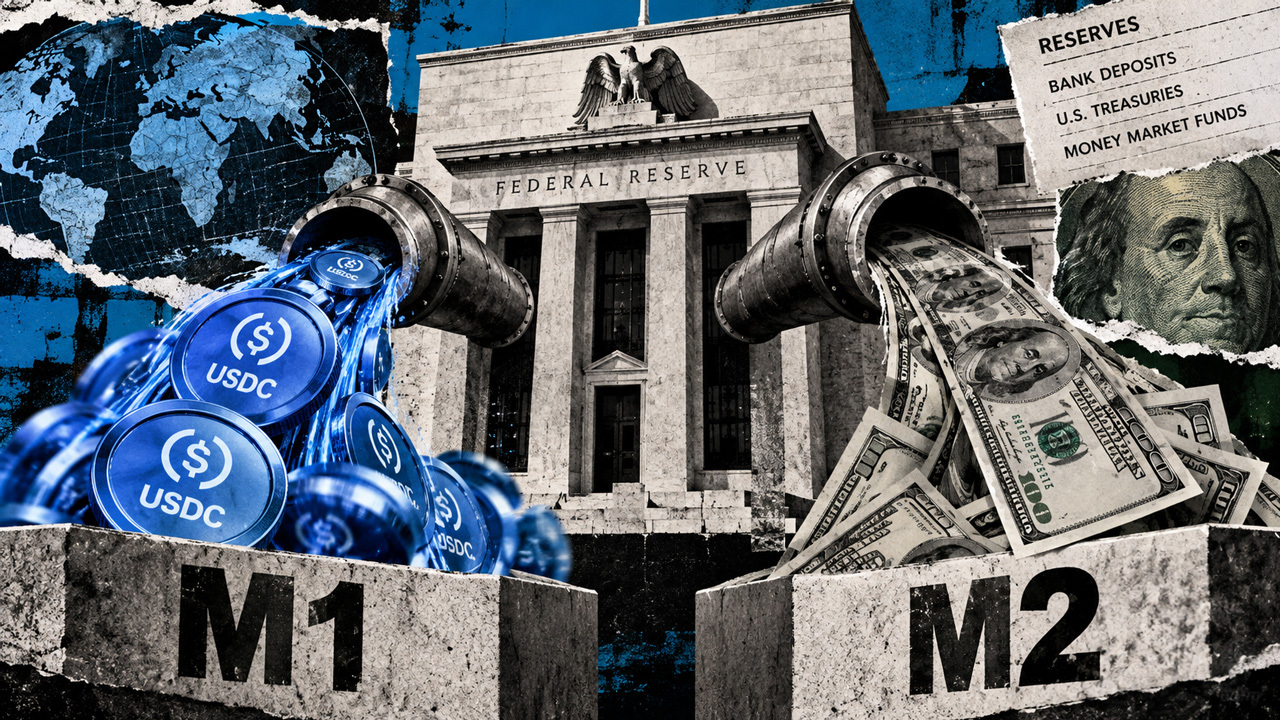
A Federal Reserve staff note published September 4 outlined a potential framework for including regulated payment stablecoins in the nation's official money supply measures, M1 and M2. The analysis highlights a central challenge: preventing the same dollar from being counted twice if stablecoins backed by existing dollar reserves were added to these aggregates.
Payment stablecoins are currently excluded from US monetary aggregates. The Fed's framework proposes that future inclusion would depend on how the tokens function economically, whether reserve assets backing them are already counted elsewhere, and how to distinguish US circulation from global activity.
How Stablecoins Could Fit Into Money Measures
M1 represents the narrowest US money measure, containing currency and highly liquid balances used for transactions by households and businesses. M2 includes M1 plus less liquid savings-type assets such as small-denomination time deposits and retail money market funds.
The Fed analysis applies this functional distinction to stablecoins. If used primarily as transaction money for household and business payments, stablecoins could qualify for M1 classification. If used mainly as a store of value or for crypto trading liquidity, they would fit better in non-M1 M2 categories.
The Double-Counting Problem
The core accounting challenge concerns reserve assets backing stablecoins. Under proposed frameworks like the GENIUS Act, permitted reserves can include bank deposits, Treasury instruments, and government money market funds. Many of these reserve types are already captured in existing M1 or M2 figures.
If a stablecoin issuer receives dollars, deposits them in a bank or money fund, and issues tokens against those reserves, counting the tokens at face value would add them to the money aggregate while their backing remains counted in another component. That overlap creates the same-dollar problem.
The extent of this overlap depends on the specific composition of reserves held by each issuer and how each reserve asset is statistically treated. Circle's USDC, for example, holds most reserves in the Circle Reserve Fund, an SEC-registered government money market fund, alongside Treasury securities and cash at regulated institutions.
Data Requirements for Classification
The Fed framework identifies three separate accounting tasks before any classification change could occur:
- Function: Determining whether stablecoins behave predominantly as transaction money or savings vehicles requires evidence of actual economic use, not just raw transaction counts.
- Reserve overlap: Consolidating reserve assets already represented in money aggregates requires matching issuer-level reserve composition to specific M1 and M2 components.
- Geography: Isolating the portion of globally circulating tokens that belongs in US money measures requires transaction-level geographic data that is currently lacking.
A Bank for International Settlements working paper analyzing over 593 million event logs from Ethereum transactions in 2025 found that roughly 60 percent of transfer events occurred inside complex transactions combining trading, lending, arbitrage, and settlement activity. This complexity means raw transaction counts cannot reliably indicate whether stablecoins function as payment instruments.
Scale and Current Data Gaps
Global stablecoins totaled approximately $292.1 billion across 73 assets as of early September, with USDC representing about $74.5 billion in market capitalization. These figures represent global outstanding supply and say nothing about US-resident ownership or usage patterns.
For comparison, seasonally adjusted US M2 stood at $23.218 trillion in July 2026. Adding stablecoins to either monetary aggregate without proper adjustments could significantly blur already-counted balances with genuinely new dollar liquidity.
The Fed note emphasizes that its analysis reflects independent staff research and does not represent Federal Reserve policy deliberation. Existing definitions of M1 and M2 remain unchanged, and the framework presents conditional possibilities pending further data and analysis.