Most traders evaluate exchanges by checking fees first, then available markets, leverage, and interface. Custody typically ranks last, if it's considered at all. This order is backwards, according to analysis from financial regulators including the Bank of England, which has identified custody and counterparty risk as recurring blind spots in cryptocurrency markets.
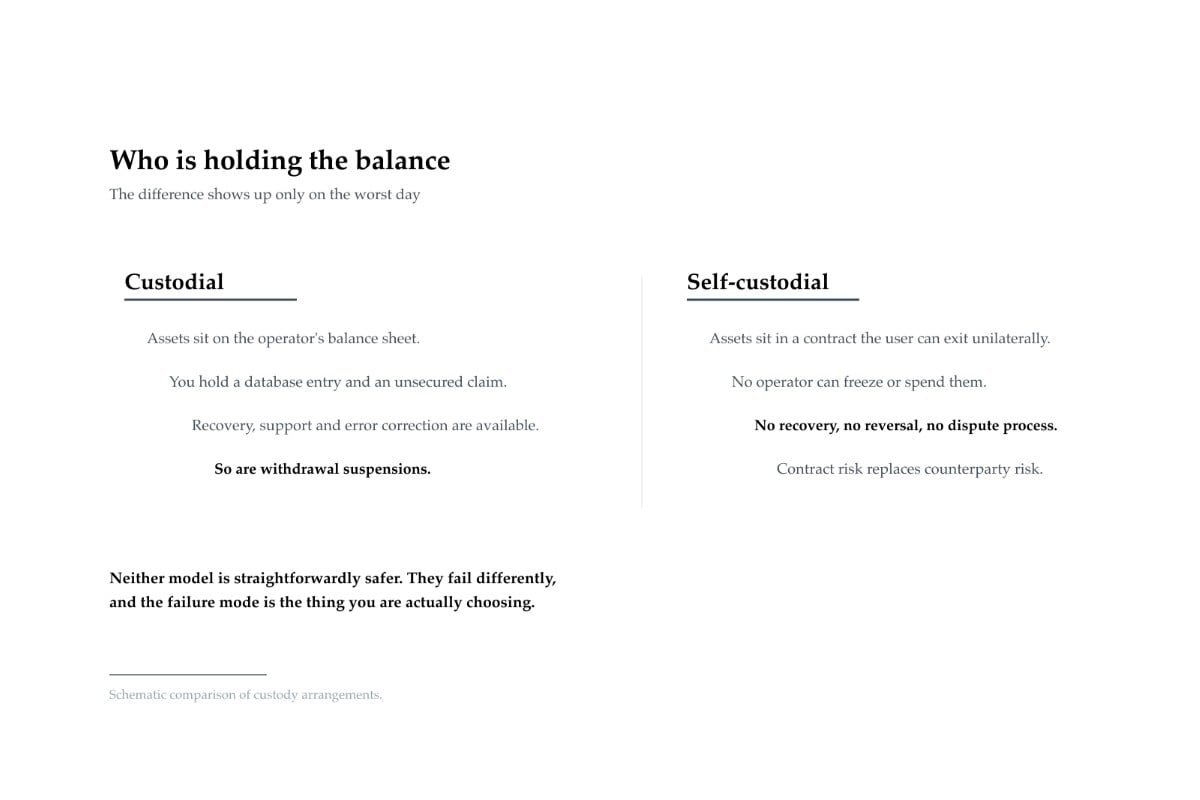
The distinction matters because fees affect individual trades, while custody affects your entire balance. On custodial platforms, you deposit assets and become an unsecured creditor of the business. On self-custodial platforms, assets sit in smart contracts or wallets you control, limiting the platform's role to matching and settlement.
Custodial Platforms: What Your Balance Actually Means
A balance on a custodial exchange is an entry in a private database. It remains enforceable only as long as the business is solvent, honest, and legally accessible from your jurisdiction.
Under normal conditions, custodial arrangements offer benefits including password recovery, customer support, and error correction. In regulated markets, client assets may be segregated from company funds.
Under stress, the picture inverts. If an operator becomes insolvent, customer claims follow the insolvency law of the jurisdiction where the company is incorporated—often not where customers live. Withdrawal suspensions typically precede public announcements, and customers cannot act during a suspension. Historical patterns show cryptocurrency platform customers often learned of problems only after the withdrawal button stopped working.
Self-Custody: What It Guarantees and What It Does Not
Self-custody guarantees one specific outcome: no third party can prevent you from moving your assets, because no third party holds the key. This eliminates the largest category of loss in cryptocurrency history.
It does not provide recovery for lost keys, reversal of mistaken transactions, or dispute resolution. Assets depend entirely on the security of the smart contract holding them. Well-audited contracts with years of operation differ substantially from new ones, but most users cannot distinguish between them.
Hybrid Models: The Compromise Most Volume Uses
Fully on-chain order books have historically struggled with latency and cost. Fully custodial exchanges offer fast execution in exchange for accepting a creditor position. The hybrid model now carrying significant derivatives volume matches orders off-chain for speed and cost, while settling positions and holding collateral on-chain.
This approach addresses custody risk but does not make the matching engine transparent, remove the operator's ability to change parameters, or mean the venue is decentralized in governance. Those are separate claims requiring separate evaluation.
How Each Model Fails During Stress
On-chain systems liquidate mechanically and publicly, creating procyclical effects: falling prices trigger liquidations, which push prices lower, triggering more liquidations.
Custodial platforms have discretion to halt trading, widen bands, pause withdrawals, or socialize losses. This discretion sometimes protects users and sometimes protects the platform.
Neither model is straightforwardly safer. They fail differently, and understanding which failure mode applies to your chosen platform is essential.
Five Questions to Answer Before Funding an Account
- Where do assets physically sit: a contract address you can inspect, or a balance sheet you cannot?
- Who is the legal entity and where is it registered? This determines your legal recourse.
- Can you withdraw unilaterally, or does the platform need to cooperate?
- What is the published policy for extreme volatility: auto-deleveraging, insurance fund, or socialized loss?
- Have you tested a withdrawal at real size on a calm day, before you need it to work on a bad one?
Financial regulators including the Financial Stability Board are converging on these questions, recommending client asset segregation and clear disclosure of custody arrangements as core standards for cryptocurrency platforms.
Custody is not the exciting part of choosing a trading venue. It is the part that determines whether the other parts ever mattered.