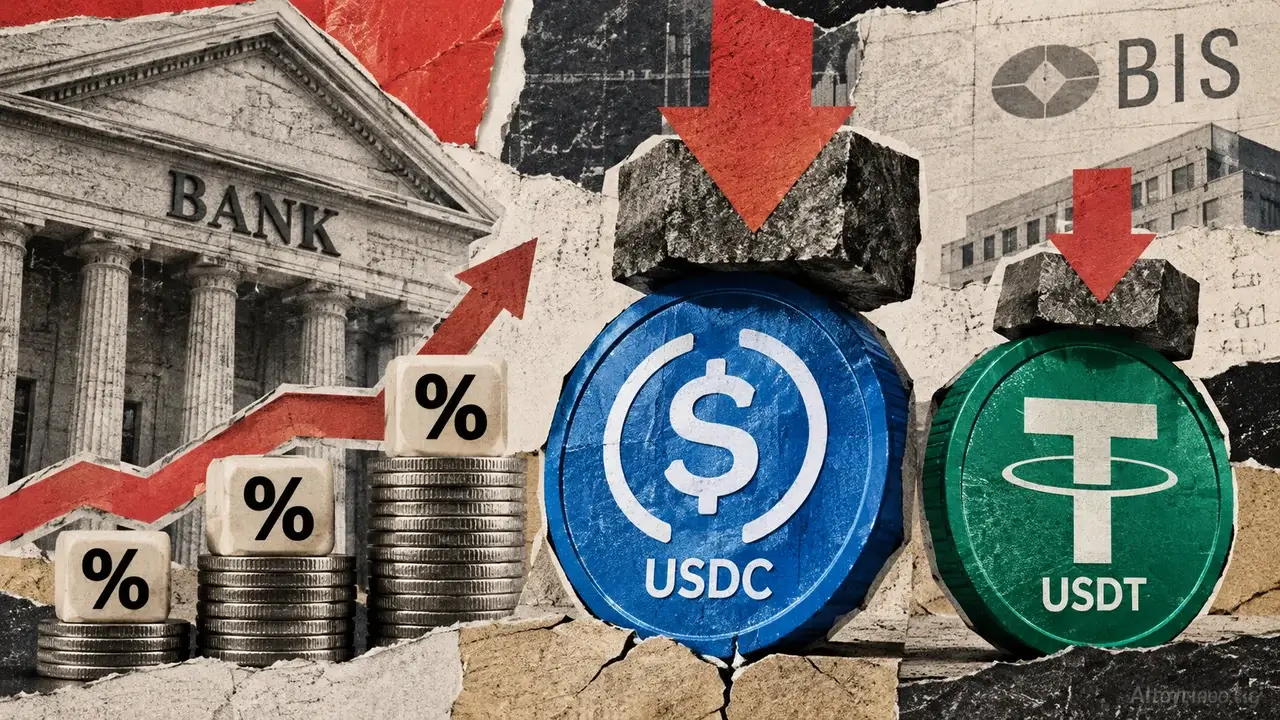
A study released by the Bank for International Settlements on October 13 links rising US deposit rates to slower stablecoin adoption, with effects that differ significantly between USDC and USDT.
Researchers Rashad Ahmed and Iñaki Aldasoro analyzed weekly data from January 2019 through June 2025, finding that a one-basis-point increase in deposit rates was associated with approximately 4.8% less cumulative USDC growth over ten weeks, compared with 1.9% less growth for USDT.
Why Deposit Rates Matter
Higher deposit rates offer holders a stronger financial incentive to maintain balances at banks rather than in stablecoins. The study suggests that USDC holders, who are more concentrated in US institutional and decentralized finance, may be more likely to compare bank deposit returns with stablecoin balances. USDT's weaker response to deposit-rate changes aligns with its use in offshore and developing-economy applications.
The research controlled for policy and Treasury rates, Bitcoin prices, the dollar index, and market volatility to isolate the effect of deposit competition from broader investment conditions.
Exchange Rewards Add Complexity
The returns available on stablecoin balances depend not only on bank deposits but also on exchange rewards. Coinbase and Binance use different models to fund stablecoin holder returns. Coinbase's approach is tied more closely to policy and reserve yields, while Binance's rewards are more exposed to crypto trading activity.
Coinbase's USDC Rewards program requires customers to meet eligibility criteria, hold at least $1 of USDC, and in some regions maintain Coinbase One membership. Rates vary by country and account type, and Coinbase can change or discontinue the program.
Implications and Limitations
The study's point estimates suggest a stronger US deposit-pricing relationship for USDC, but the authors note that applying a single deposit-rate assumption to all stablecoins can obscure different competitive pressures facing each issuer.
An instrumental-variable approach produced a larger estimate of about 9.1% less cumulative stablecoin growth per basis point of deposit repricing. However, the authors flag that this model has weak instrument strength and relies on limited high-rate episodes in the sample, constraining its applicability to different rate environments.
The data cannot identify which individual holders switched between platforms or which bank accounts were involved. Establishing how stablecoin demand responds to actual bank-versus-platform returns available to comparable users remains an open question for future research.