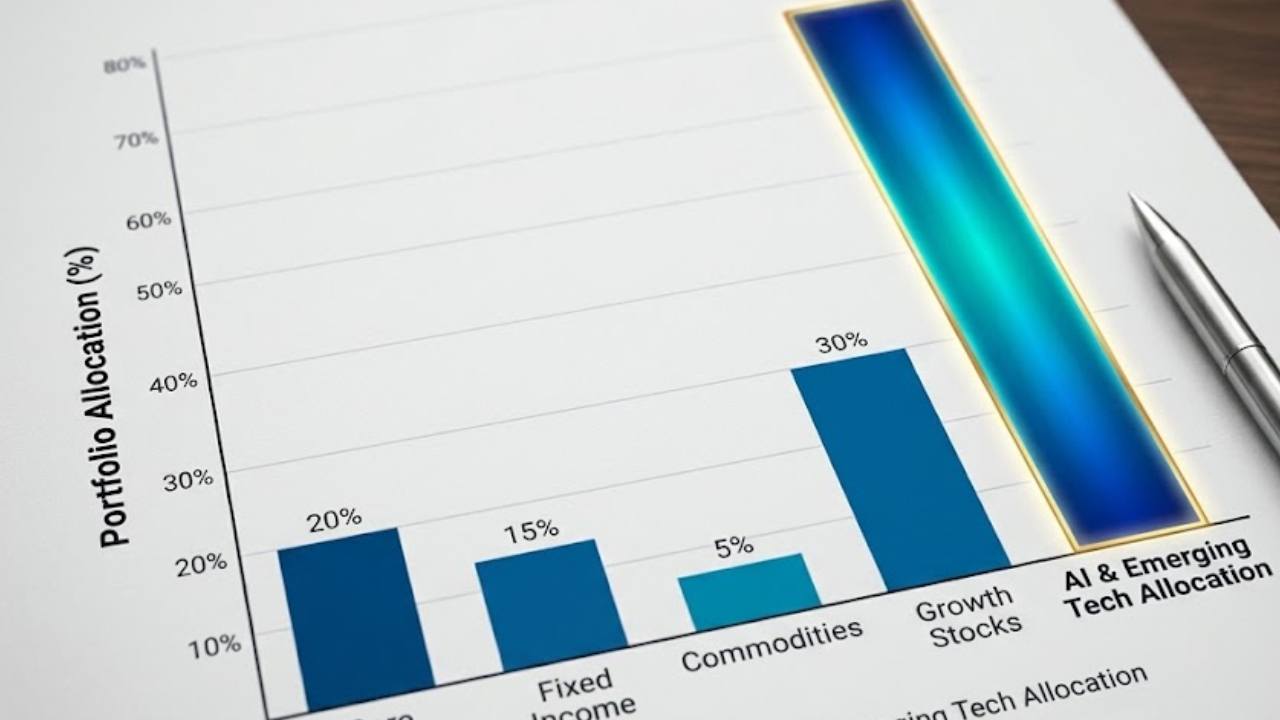
Everyday savers can accumulate substantial artificial intelligence exposure without ever purchasing shares in an AI company, according to Nigel Green, CEO of financial advisory firm Devere Group. A long run of AI-driven earnings growth has embedded technology concentration into broad investment products, pensions, and index trackers that savers may not recognize as technology-heavy holdings.
How AI Concentration Builds Gradually
Exchange-traded funds and other mainstream investment vehicles hold hundreds of companies, but their largest constituents and dominant earnings themes can heavily influence overall performance. As strongly performing holdings occupy a greater share of a portfolio, AI concentration can develop gradually without the saver making any deliberate technology stock selections.
Federal Reserve data illustrates the scale of household equity exposure. Directly and indirectly held corporate equities represented 45.42% of U.S. household financial assets in the fourth quarter of 2025, with the latest reading for the second quarter of 2026 at 48.23%.
Green stated: "Somebody who has never bought a tech stock in their life can still be sitting on a concentrated AI position through their pension."
Market Volatility Reveals Concentration Risk
Technology shares across Asia, Europe, and the United States fell on September 14, demonstrating how quickly a single investment theme can affect mainstream savings. The Nasdaq composite closed 0.6% lower, while Nvidia declined 3.4%, SoftBank fell 10.7% in Tokyo, South Korea's Kospi lost 3.3%, and Dutch chip equipment maker ASML declined 6%.
The sell-off followed a September 12 proposal by Anthropic CEO Dario Amodei to pace frontier AI development to allow alignment and safety work to advance. OpenAI CEO Sam Altman subsequently supported the proposal.
Computing Demand Persists Despite Safety Controls
Slowing AI development does not automatically eliminate demand for computing capacity. OpenAI reported on September 6 that GPU allocation to one restricted model class fell 59.2% in the week after security limits took effect on August 7, while allocation to other model classes rose 17.2%, offsetting approximately 85% of the decline.
The scale of AI infrastructure investment extends across multiple sectors. Nvidia and six financial institutions—Blackrock, Blackstone, Goldman Sachs, Apollo, Brookfield, and KKR—signed memorandums of understanding to establish platforms designed to mobilize more than $500 billion in third-party capital for AI infrastructure. Computing demand has connected bitcoin miners, power suppliers, data-center operators, and semiconductor companies to the same investment cycle.
Green concluded: "Reviewing that exposure doesn't require predicting where AI development goes from here. It requires an honest look at how a portfolio got built, and whether the concentration inside it was ever a deliberate decision."