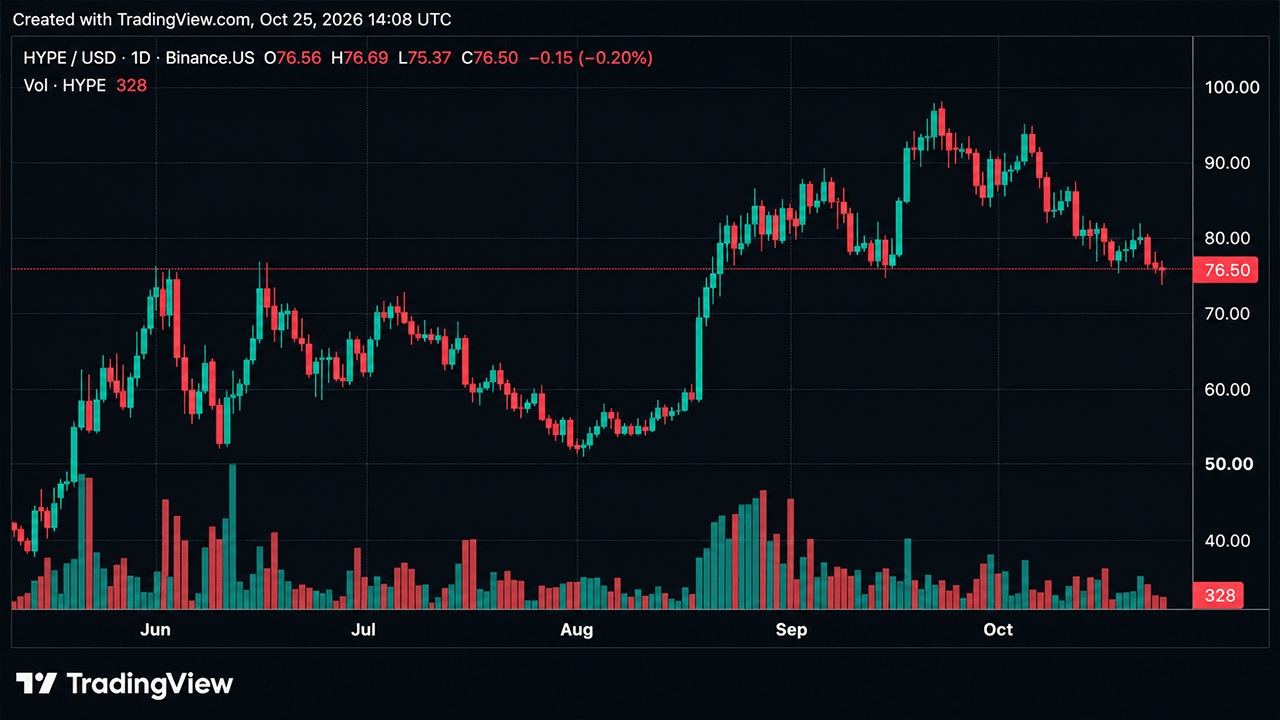
Hyperliquid remains the dominant decentralized perpetual futures exchange, yet its native HYPE token has retreated significantly. Trading around $76 to $77 in late October, HYPE sits roughly 22% below its September peak near $98, raising questions about whether the platform's revenue engine can overcome mounting competitive pressure and token supply challenges.
The platform operates a layer one blockchain dedicated to perpetual futures and spot trading. Hyperliquid has generated over $1.4 billion in cumulative protocol revenue, with approximately 97% to 99% of eligible net fees historically directed toward purchasing HYPE through its Assistance Fund. The token buyback program has associated roughly 48 million HYPE with the fund, while reserve yields provide additional purchasing power.
Hyperliquid commands an estimated 55% to 57% of tracked open interest in decentralized perpetual futures, with $11 billion in cumulative open interest recorded recently. Daily trading volume ranges between $4.6 billion and $7.3 billion. The platform supports a $17 billion market capitalization for HYPE and maintains a presence among the top ten cryptocurrency assets.
Competition and Market Share Erosion
The competitive landscape has shifted sharply in real-world asset derivatives. Hyperliquid's share of RWA perpetual futures volume fell from approximately 80% in July to 26% in recent measurements. Centralized exchanges including Binance and OKX have collectively captured around 64% of RWA volume, while decentralized competitors like Lighter, Aster, and Variational are pursuing similar market opportunities with comparable fee structures.
The broader derivatives sector has cooled considerably following an active 2025. Reduced leverage, diminished trading incentives, and lower speculative appetite have contributed to the retreat. Some observers have questioned whether HYPE can maintain its performance as competition intensifies.
Token Supply and Dilution Pressures
Future dilution presents a significant challenge for HYPE holders. Core contributors control an allocation representing approximately 23.8% of maximum supply, with vesting schedules extending into 2027 and 2028. Some monthly release schedules indicate distributions approaching 9 million to 10 million tokens, though actual tradable amounts may vary.
With only about 22% of maximum supply currently circulating, the token faces substantial future dilution. Hyperliquid's buyback program depends heavily on trading volumes and associated fees. Lower activity translates to fewer token repurchases, potentially making it more difficult to absorb newly released tokens entering the market.
Institutional Support and Revenue Diversification
Institutional participation offers some support for the token. Spot HYPE exchange-traded funds and publicly traded treasury vehicles have expanded access, with cumulative net inflows for three current HYPE ETFs reaching $303.5 million. Hyperliquid Strategies reportedly holds tens of millions of tokens.
Beyond cryptocurrency derivatives, Hyperliquid is pursuing revenue opportunities through real-world assets, prediction markets, HyperEVM, and developer infrastructure. The platform continues to command majority open interest in decentralized perpetual futures, though defending its valuation requires sustained revenue generation sufficient to offset token dilution while maintaining competitive advantages.