



Hyperliquid price crossed $50 as the first spot HYPE exchange-traded funds drew stronger early demand than Bitcoin products on a market-cap-adjusted basis, giving investors a regulated way to express exposure to one of crypto’s fastest-growing trading venues.
Data from SoSoValue show the two HYPE funds attracted nearly $50 million of inflows and held about $60 million in assets during their first week of trading.
Market Cap $14.69B
24h Volume $1.34B
All-Time High $59.39
The absolute figures remain small compared with the largest Bitcoin funds, but the launch has stood out because the products are scaling from a much smaller token economy.
The move has also strengthened Hyperliquid price momentum by linking ETF demand with a token economy that remains far smaller than Bitcoin’s.
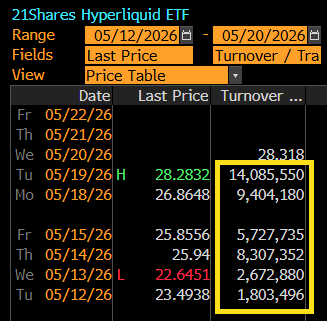
Bloomberg ETF analyst Eric Balchunas said trading volume in the Hyperliquid ETF rose each day after launch and was running at roughly eight times its first-day level. He said the pattern suggested organic interest rather than a short-lived opening burst.
That demand has arrived as investors reassess Hyperliquid’s position in the broader digital-asset market.
The platform began as a crypto perpetual futures exchange, but has expanded into non-crypto markets, including commodities, equity-linked products, S&P 500 futures, pre-IPO contracts, and prediction markets.
For ETF buyers, HYPE has become a proxy for that expansion. The token is being treated less as a simple exchange asset and more as exposure to a trading platform trying to move crypto rails into markets that have historically sat inside traditional finance.
Hyperliquid price outperforms broader crypto market
The early flows have already placed HYPE in rare territory among new crypto fund launches.
That makes the Hyperliquid ETF launch an early test of whether institutional demand can extend beyond Bitcoin, Ethereum, and Solana products.
Crypto analyst Aletheia said the first two spot HYPE ETFs outperformed Bitcoin spot ETFs on three of their first six trading days, after adjusting for inflow market capitalization.
The comparison came during a weak stretch for Bitcoin-focused products, which registered more than $1 billion of net outflows over the same reporting period.
Meanwhile, the HYPE products also beat Ethereum funds on five of those six days. Solana funds remained stronger across four of the six sessions, indicating that HYPE’s early demand has been notable, though not consistently ahead of every competing crypto ETF category.
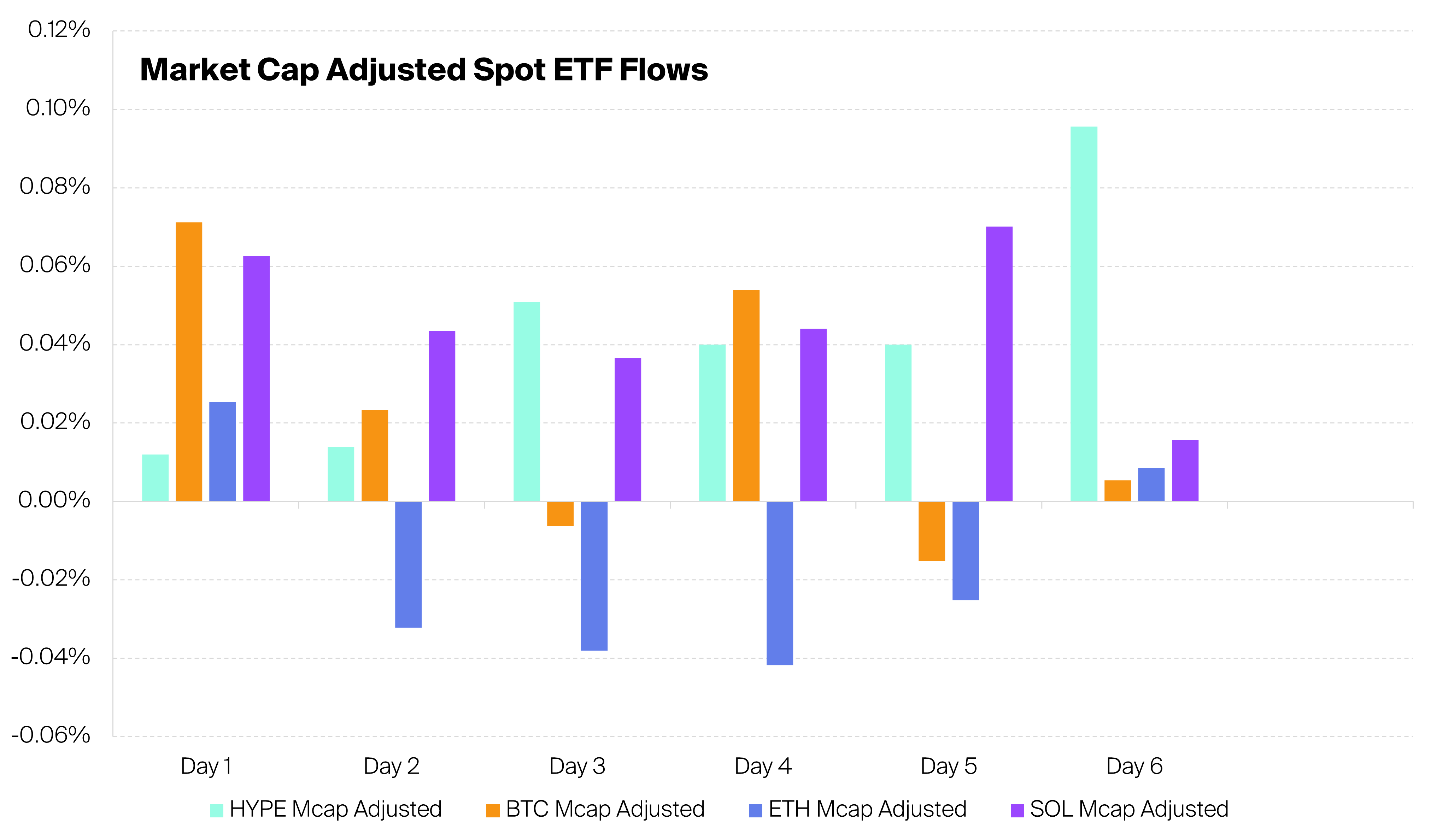
The adjusted-flow comparison narrows the focus from headline dollars to demand relative to asset size. Bitcoin ETFs still dominate the market in absolute terms, with deeper liquidity, broader access for advisers, and a longer trading record.
However, relative to Hyperliquid’s token economy, the first week of HYPE ETF activity showed unusually strong demand for a new crypto fund category.
The fund activity also changes HYPE’s market structure. During the first six trading days, the ETFs bought 2.5 times as much HYPE as Hyperliquid’s Assistance Fund bought and burned, Aletheia said.
That means ETF issuers are already creating more open-market buying pressure than one of the token’s existing internal support mechanisms.
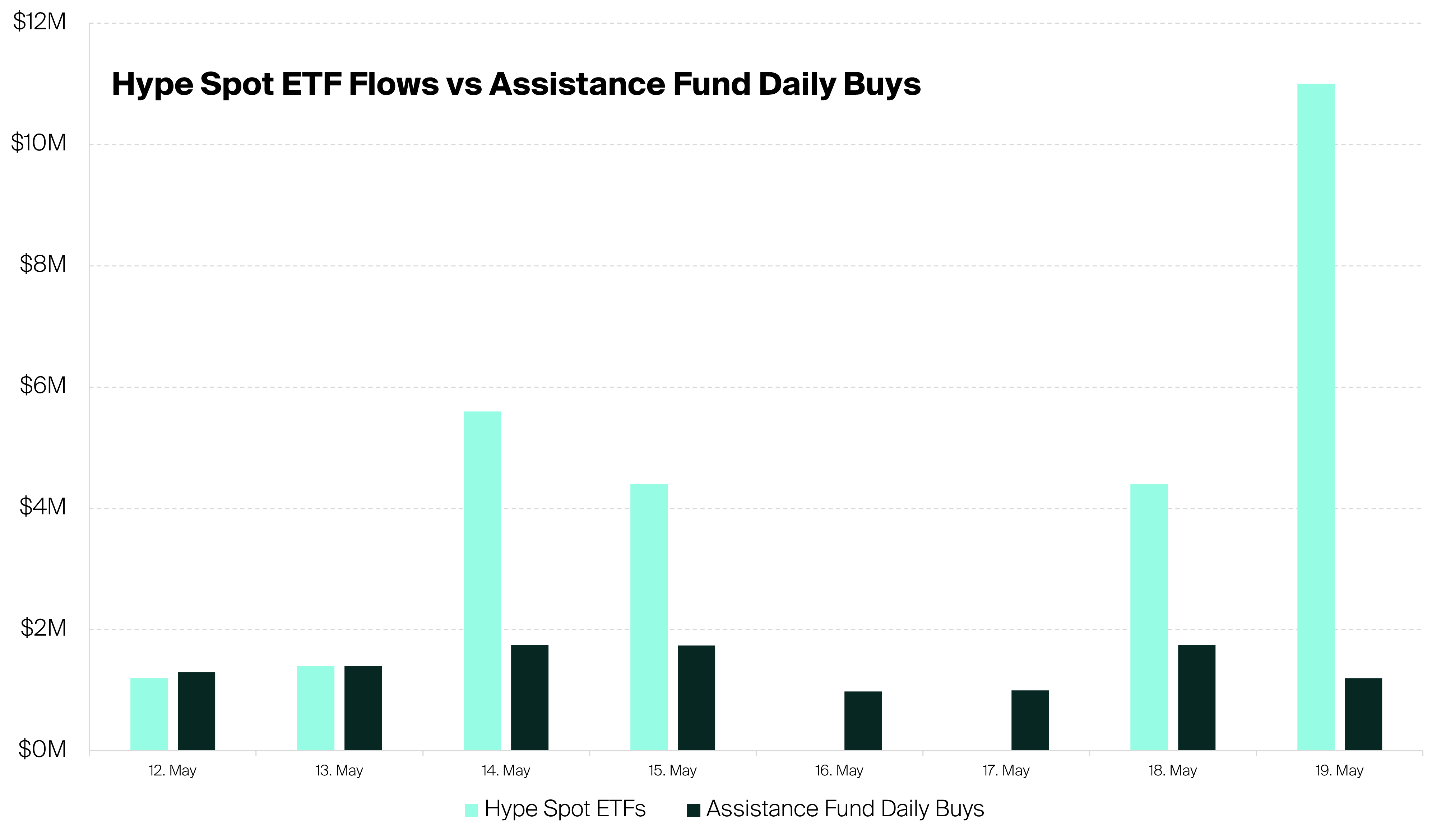
The Assistance Fund buys and burns HYPE, reducing supply over time. ETF issuers create a separate demand channel because they must acquire HYPE to support fund exposure.
The result is a blend of native protocol demand and traditional-market demand, a structure that only a small group of crypto assets have achieved through regulated products.
The flows remain early and could fluctuate as the funds move beyond launch week. Still, the first six sessions have moved HYPE into a different part of the market conversation.
Its performance is now being judged not only by crypto-native trading activity on Hyperliquid, but also by ETF inflows, secondary-market volume, and institutional allocation behavior.

Why institutional interest followed Hyperliquid
The demand for HYPE ETFs reflects a broader shift in how investors are valuing Hyperliquid.
The platform is increasingly being viewed as a financial infrastructure trade rather than a narrow crypto derivatives venue.
Data from Dune Analytics show roughly half of Hyperliquid’s volume now comes from non-crypto assets, including stocks, oil, S&P 500 futures, pre-IPO markets, and artificial intelligence-linked companies.
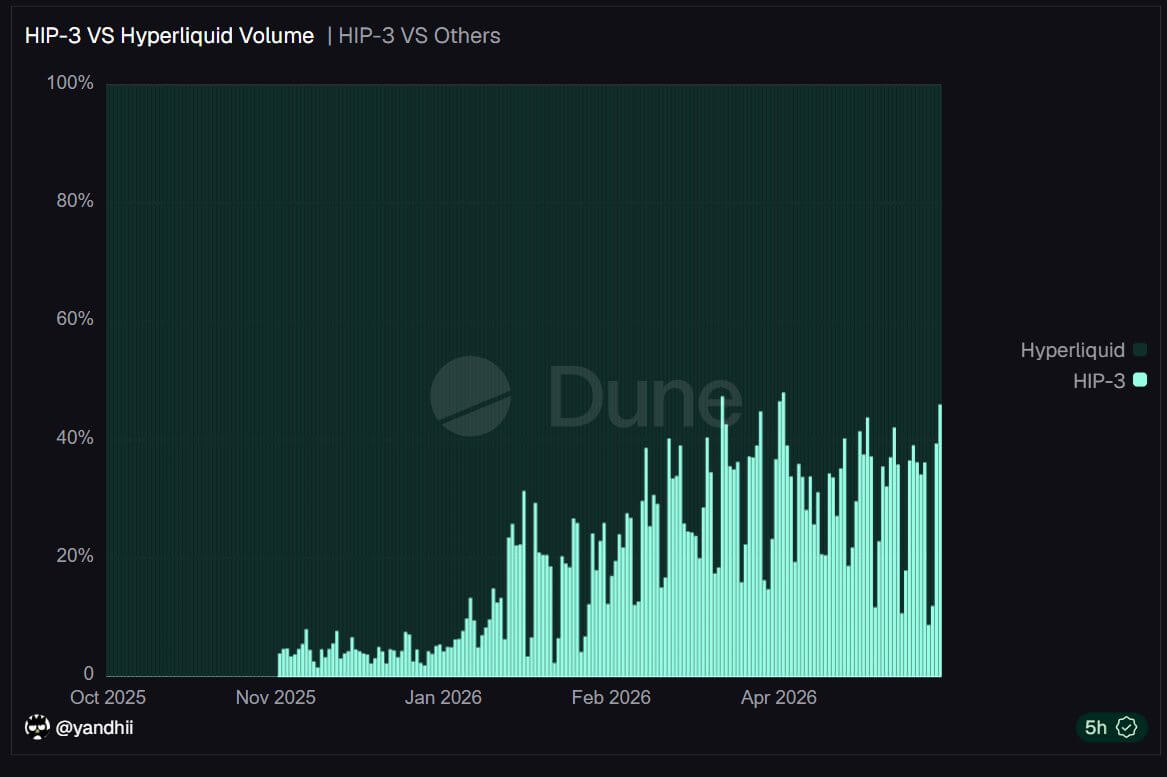
Hyperliquid data also show real-world asset trading on the platform reached a record $2.6 billion in open interest, roughly double the level from two months earlier.
That growth suggests users are moving beyond crypto perpetuals and using the platform for broader macro and equity-linked exposure.
Hyperliquid also gained attention during the US-Iran conflict because its 24/7 markets allowed traders to navigate Middle East geopolitical risks during weekends, when standard financial exchanges were closed.
Market participants could trade synthetic versions of traditional assets, including US equities and commodities, while conventional venues were offline.
That use case has strengthened the institutional argument for the platform.
Considering this, Bitwise Chief Investment Officer Matt Hougan has described Hyperliquid as crypto’s new “super app,” arguing that the platform is targeting the $600 trillion global asset market rather than only the roughly $3 trillion crypto economy.
He has pointed to its exposure across crypto, equities, commodities, foreign exchange, prediction markets, and structured products as evidence of a broader market design.
According to him:
“Hyperliquid has become the ‘super-app’ Atkins envisioned—a ‘non-SEC regulated platform’ offering investors exposure to ‘a variety of asset classes.’”
That framing helps explain why ETF demand appeared quickly.
Traditional investors already understand the exchange business model as they can compare trading volume, fee generation, market share, and user growth with public companies such as CME Group, Robinhood, and other financial platforms.
Hyperliquid gives them a crypto-native version of that model, with an added feature: token demand is directly tied to platform activity.
Fee growth gives HYPE a clearer valuation story
Meanwhile, market observers have also pointed out that Hyperliquid’s fee profile also supports institutional interest.
Market observers have pointed out that the platform accounts for roughly one-third of revenue across the top 10 protocols and captures about 43% of all chain fees, or about $11 million per week.
Most of that revenue comes from perpetual trading fees. Notably, nearly all of it is used to buy back HYPE in the open market, giving the token a direct link to platform activity.
That fee stream gives the Hyperliquid token a more direct economic link to platform activity than many earlier governance assets.
Hougan stated that this structure separates HYPE from many earlier DeFi tokens. First-generation governance tokens often struggled because protocol growth did not always translate into token value. Holders could vote on governance matters, but they often lacked a clear economic connection to fees, cash flow, or buybacks.
According to him, HYPE was launched with a different design. As trading activity rises, buybacks increase. As buybacks increase, investors have a clearer basis for connecting platform growth with token demand.
That gives ETF investors a more direct story to underwrite. They are buying exposure to a trading platform with rising volume, increasing penetration of the non-crypto market, and a buyback mechanism that links revenue to the token.
Hougan has estimated that Hyperliquid’s annual revenue is running around $800 million to $1 billion. At a market capitalization of around $10 billion to $11 billion, that places HYPE at roughly 10 to 14 times the buyback stream.
The comparison is imperfect because token holders do not have the same legal rights as equity holders. Still, it gives investors a framework for valuing HYPE against trading-platform businesses rather than older DeFi governance assets.
That valuation framework helps explain why the ETFs attracted demand so quickly. HYPE offers a high-growth exchange thesis, a token-linked buyback model, and exposure to a platform moving into markets far larger than crypto perpetuals alone.
HYPE outperforms broader crypto market
Against this backdrop, HYPE’s market performance has significantly diverged from the broader crypto market.
Data from Tradingview shows that HYPE is now up more than 120% this year and has pushed above $50, its highest level in roughly eight months.
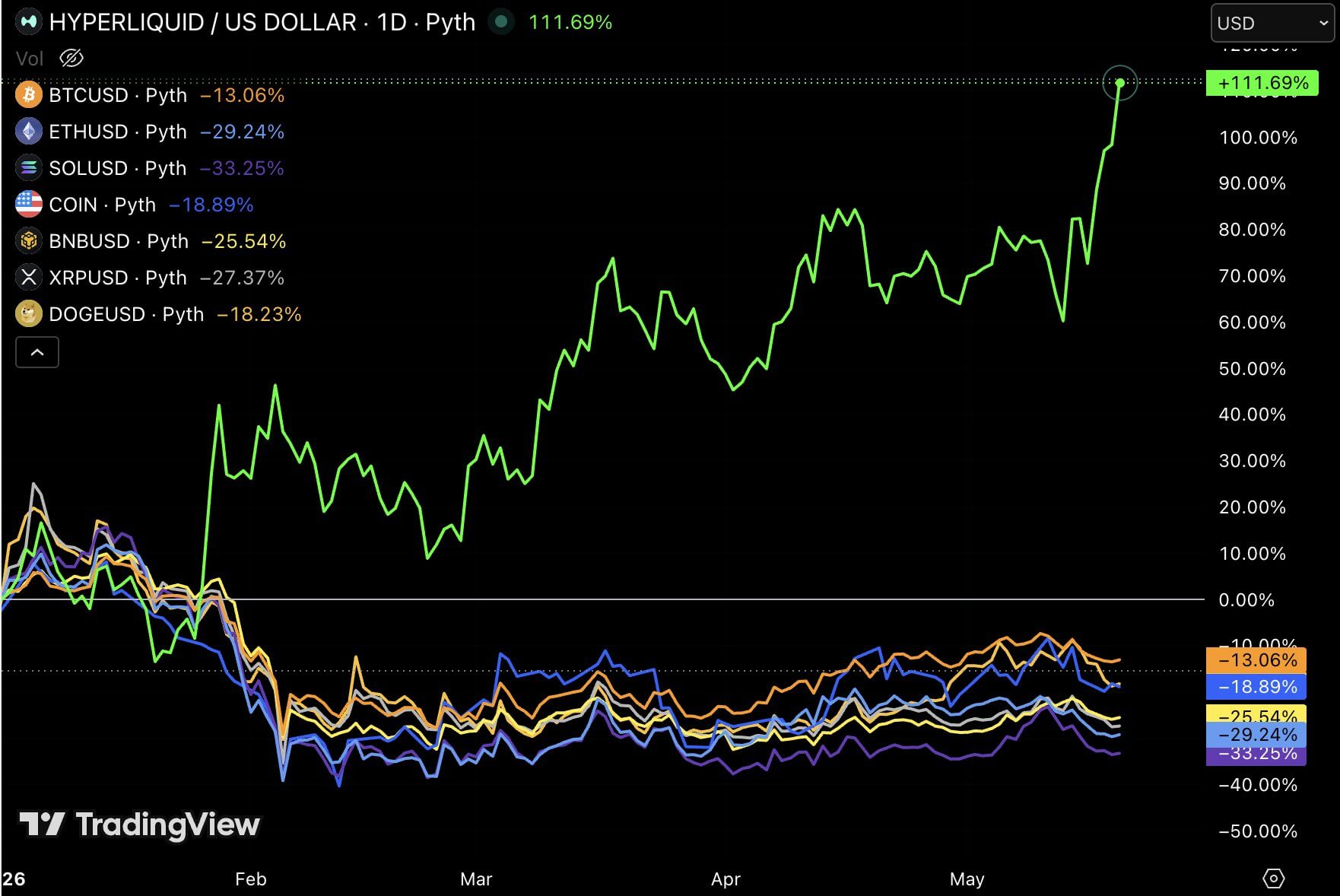
The move has left it ahead of major crypto assets and crypto-linked equities, including Bitcoin, ETH, XRP, Solana, BNB, Dogecoin, and Coinbase, all of which are down by double digits year-to-date.
In fact, HYPE’s fully diluted valuation of $54.6 billion has flipped Solana’s $54.3 billion.
Blockchain analytics firm Santiment said:
“HYPE’s open interest (which measures the total value of active futures contracts that are still open) has remained extremely high, currently above $1.92B.”
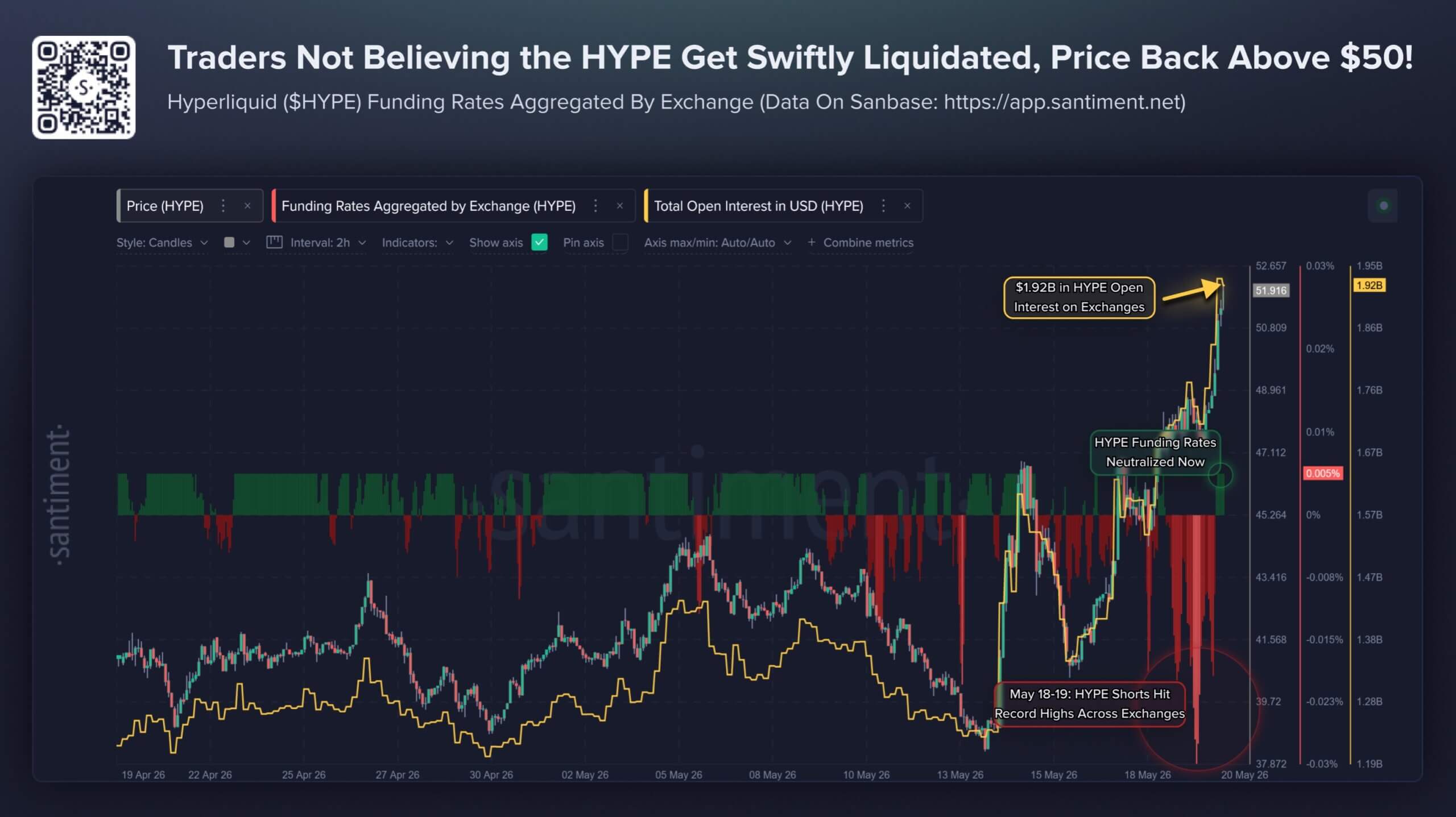
The firm further explained that improved price performance reflects several overlapping catalysts. This includes the recently advanced CLARITY Act, which improves sentiment around the US regulatory outlook for digital assets.
At the same time, Coinbase and Circle named Hyperliquid an official USDC deployer, strengthening the platform’s stablecoin rails. Additionally, the launch of synthetic pre-IPO products added another growth narrative, while ETF inflows gave traditional investors a new access point.
The result is that HYPE is trading more like a growth-linked market infrastructure token than a broad crypto beta asset.
Still, the platform’s risks remain substantial.
Hyperliquid is unavailable to US users; its newer non-crypto products are still in their early stages, and synthetic exposure to private companies or real-world markets could invite closer regulatory scrutiny.
The platform also needs to show that demand can persist beyond launch-week ETF activity and high-volatility trading windows.