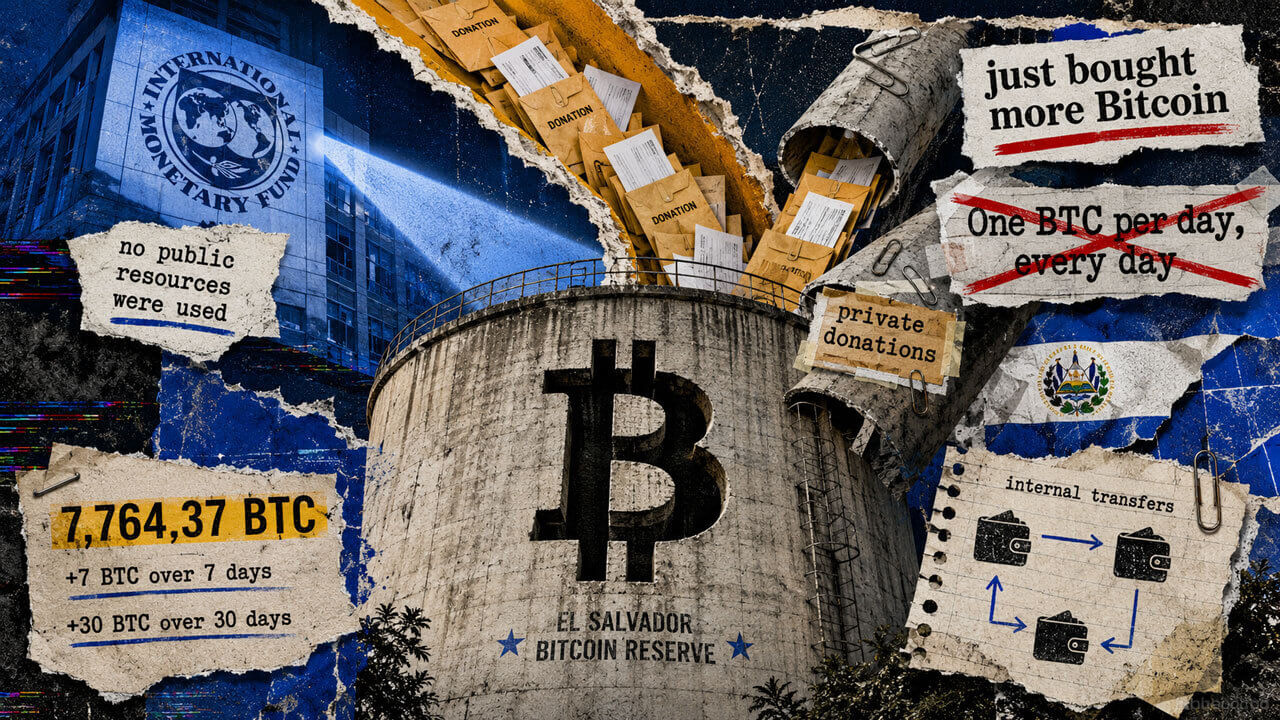
The International Monetary Fund said El Salvador's Bitcoin reserve growth over the past year came from private donations, not new government spending, according to its latest review of the country's loan program.
The IMF stated that documents supplied by El Salvador showed Bitcoin accumulated since the previous review reflected private donations, with no public resources used. The Fund added it expects no further accumulation beyond those documented contributions.
El Salvador's Bitcoin holdings jumped from approximately 6,224 BTC at the end of June 2025 to more than 7,764 BTC, an increase of roughly 1,540 BTC. If the IMF's assessment applies to this subsequent accumulation, much of the increase came from private donations rather than taxpayer-funded purchases.
The IMF also noted that earlier changes in El Salvador's Bitcoin position had not necessarily represented new buying. Increases in the Strategic Bitcoin Reserve reflected transfers among government-controlled wallets, while small fluctuations were linked to Bitcoin-denominated deposits held through Chivo, the country's state e-wallet.
The government has substantially unwound its stakes in Chivo, transferring majority ownership and operational control to a private operator while retaining a minority stake and custodial responsibilities for customer assets.
El Salvador's official messaging continues to emphasize active Bitcoin accumulation. As recently as August 28, the National Bitcoin Office stated the country had purchased additional Bitcoin and repeated its message: "One BTC per day, every day." President Nayib Bukele has maintained a pro-Bitcoin stance, and the country has expanded Bitcoin education initiatives.
The country restructured its Bitcoin treasury last year, spreading holdings across multiple addresses rather than a single reused wallet. Officials cited digital-asset security best practices and reduced exposure to quantum-computing threats. The new structure keeps addresses public for reserve verification but does not distinguish between Bitcoin bought with public money, private donations, or transfers between government wallets.
El Salvador clearly owns substantially more Bitcoin than it did a year ago. What remains unresolved is whether "one BTC per day" describes government-funded purchases or simply the rate at which Bitcoin is entering the reserve.