Indonesia's Financial Services Authority (OJK) has outlined a regulatory roadmap to expand digital assets beyond cryptocurrency trading and integrate them deeper into the national financial system, marking a shift toward what officials describe as an "on-chain economy."
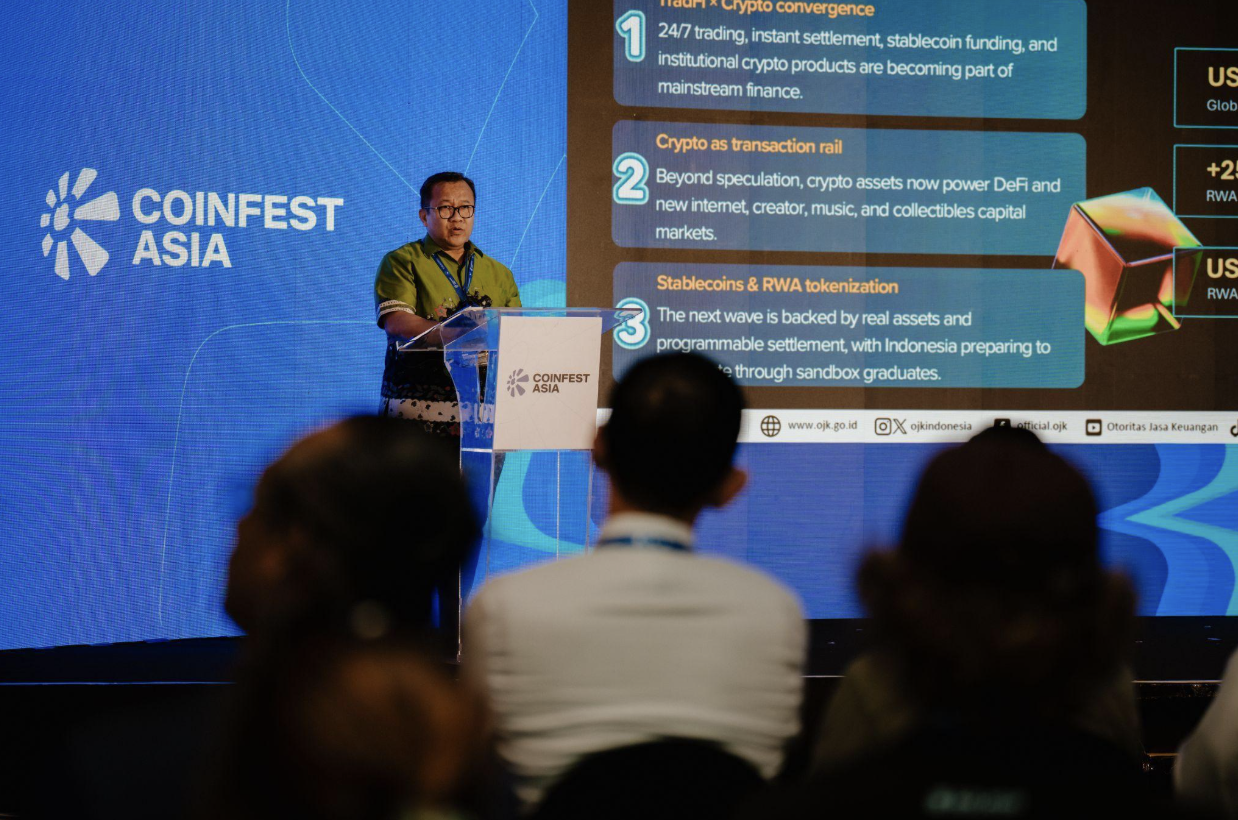
Adi Budiarso, OJK's Chief Executive for Financial Sector Technology Innovation, Digital Financial Assets and Crypto Assets Supervision, presented the framework at Coinfest Asia 2026 in Bali on August 20-21. Budiarso stated that blockchain technology is increasingly being applied to transactions, decentralized finance (DeFi), stablecoins, and asset tokenization rather than serving solely as a speculative investment vehicle.
Market Expansion and Infrastructure
Indonesia's domestic crypto market has grown substantially. As of June 2026, OJK recorded 22.69 million crypto asset consumers, compared to 22.40 million in May, with transaction value reaching IDR 28.58 trillion, up 24.2% from the previous month. The regulatory framework now includes 26 licensed digital financial asset traders, two exchanges, two clearing institutions, and two custodians.
Four Regulatory Priorities
Following revisions to Indonesia's Financial Sector Development and Strengthening Law, OJK has identified four priorities for the digital asset sector:
- Recognition of crypto providers as financial services institutions: OJK plans to classify crypto asset service providers as part of the financial services industry, subjecting them to governance standards comparable to conventional financial institutions and capital market firms.
- Single Investor Identification system: OJK is implementing a unified investor ID system for crypto investors, modeled on the existing capital markets identification framework to enhance transparency and efficiency.
- Stablecoin regulation: Stablecoins will be regulated as transactional instruments rather than payment tools, with OJK coordinating with Bank Indonesia on oversight. Several stablecoin business models have passed OJK's regulatory sandbox.
- Real-world asset tokenization: OJK is finalizing comprehensive regulations for RWA tokenization, which converts real-world assets into digital representations. Current sandbox models include tokenization of gold, government securities, and property rights.
Global Market Context
Global stablecoin supply expanded from approximately US$200 billion in early 2025 to between US$317 billion and US$320 billion in early 2026. The real-world asset tokenization market grew approximately 256.7% between the first quarter of 2025 and the first quarter of 2026, reaching approximately US$33.5 billion by mid-2026.
Regional Ambitions
OJK has positioned digital asset development as part of Indonesia's broader economic strategy under the 2025–2029 National Medium-Term Development Plan, which targets 8% economic growth by 2029. Budiarso stated that OJK aims to establish Indonesia as a regional center for digital asset innovation, investment, and transactions in Asia.