Justin Sun has established the Justin Sun Prize, a decentralized academic initiative that awards monetary prizes for breakthroughs in mathematics and formal verification. The prize was announced in September 2026 and represents a new approach to scientific incentives designed for the artificial intelligence era.
The inaugural awards recognized solutions to 66 mathematical problems. The top prize of $1 million was awarded to OpenAI's research team for their work on the Existence and Smoothness of the Three-Dimensional Navier–Stokes Equations problem, one of the seven Millennium Prize Problems identified by the Clay Mathematics Institute in 2000.
The Navier–Stokes equations, which describe fluid motion, were developed in the 19th century and have applications across physics and engineering. The Clay Mathematics Institute originally offered a $1 million reward for solving this problem.
Prize Structure and Principles
The Justin Sun Prize operates on three core principles: openness to all contributors regardless of nationality or institution, public benefit with funds used exclusively for awards, and open-source access to problem lists and verification materials.
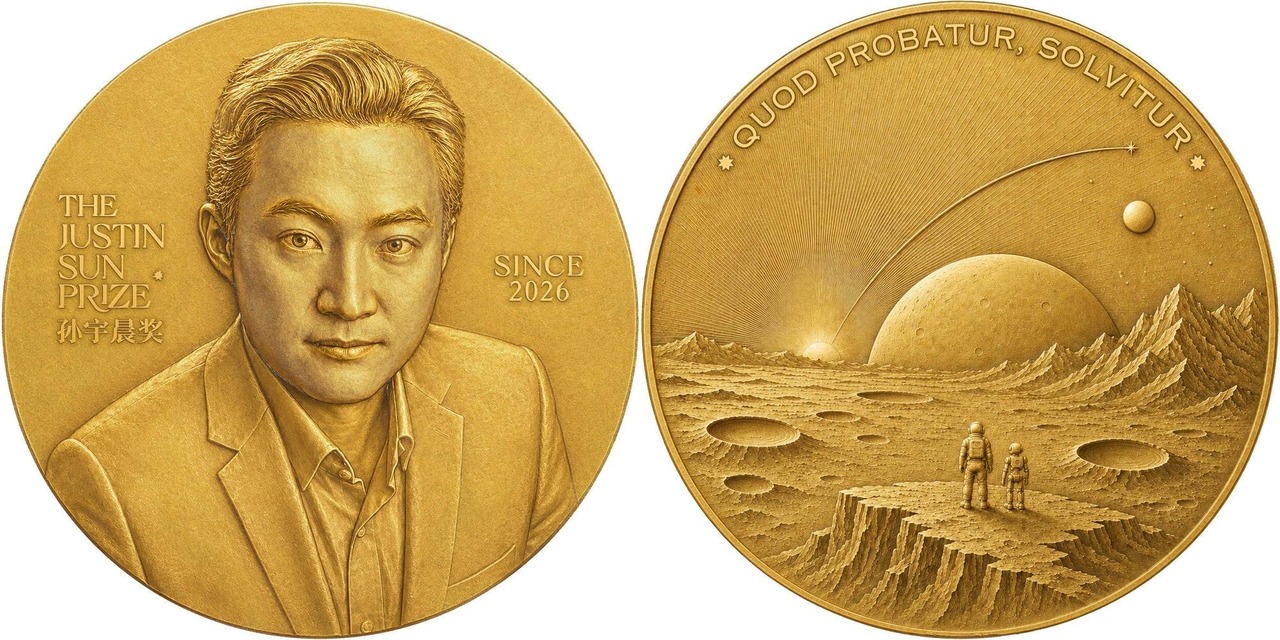
Unlike traditional academic prizes, the Justin Sun Prize requires no nominations or credential thresholds. Winners are determined by being the first to submit a machine-verifiable formal proof for a listed mathematical problem. Prize recipients also receive a certificate and medal inscribed with the Latin phrase "Quod probatur, solvitur," meaning "Proved, then paid."
The current problem list includes formal verification challenges related to the Poincaré Conjecture, the Riemann Hypothesis, Goldbach's Conjecture, and other unsolved problems.
Funding and Distribution
Prize funds are distributed in either USDT on TRON (TRC-20) or USDC on Ethereum (ERC-20), selected by recipients. Sun has previously donated more than $45 million across technology, environmental protection, and disaster relief efforts.
"My wealth is rooted in mathematics," Sun said. "It came from mathematics, and it will return to mathematics."