Monero's network hashrate is hovering near record highs, with computing power reaching approximately 7.12 gigahash per second (GH/s) on October 26. However, the distribution of that mining power reveals a more complex picture, with three major pools commanding the majority of the network's computational resources.
According to mining pool statistics, SupportXMR leads with approximately 1.87 GH/s, followed by Nanopool at 1.23 GH/s and Kryptex at 1.17 GH/s. Together, these three pools represent approximately 4.27 GH/s, or roughly 60% of the estimated network total. SupportXMR alone accounts for approximately 26.3% of the hashrate, while Nanopool and Kryptex represent approximately 17.3% and 16.4%, respectively.
The concentration extends further when examining additional pools. Hashvault contributes 730.76 megahash per second (MH/s), while C3Pool contributes 481.17 MH/s. The five largest listed pools collectively direct roughly 77% of the estimated network hashrate, demonstrating substantial coordination of mining activity despite the underlying hardware potentially belonging to thousands of independent participants.
Rising Hashrate Follows Qubic Challenge
Monero's elevated hashrate follows a contentious 2025 campaign in which Qubic directed substantial outside computing resources toward the network. Qubic claimed it temporarily controlled more than 51% of Monero's hashrate, equivalent to approximately 2.7 to 3 GH/s at that time. The episode produced short blockchain reorganizations and orphaned blocks, though the network continued operating.
The current hashrate of 7.12 GH/s remains below the all-time high of 7.54 GH/s logged earlier this year at block height 3589072.
Specialized Hardware Challenges CPU Mining
Monero relies on the RandomX proof-of-work algorithm, introduced in November 2019 to favor general-purpose CPUs over application-specific integrated circuits (ASICs). However, specialized equipment has emerged to challenge this design. Bitmain's Antminer X5, released in 2023, delivers approximately 212 kilohash per second (KH/s) while consuming 1,350 watts. The company also produces the X9, which delivers 1 megahash per second (MH/s) of hashpower. According to Bitmain's shop, both units are currently sold out.
RandomX is currently the second most profitable proof-of-work mining algorithm, just under Zcash's Equihash.
Price Gains Drive Mining Interest
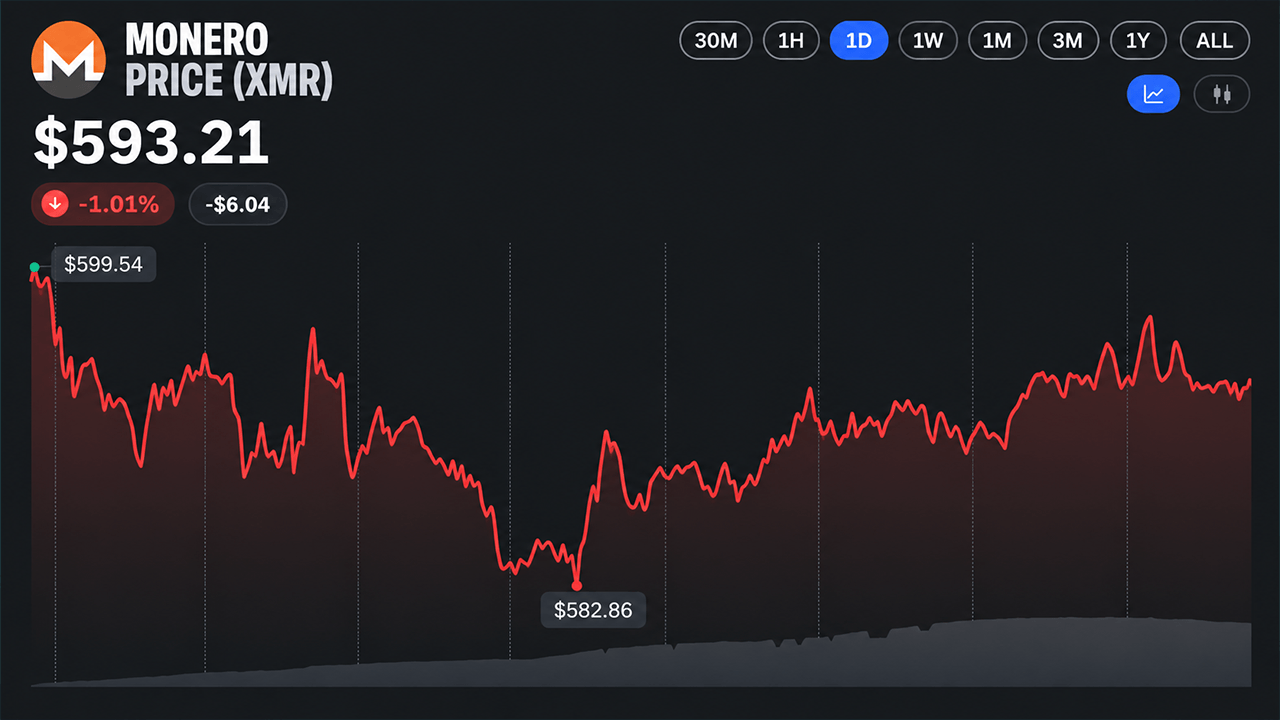
Monero's price performance has likely contributed to increased mining activity. Over the past 12 months, XMR has gained approximately 70% against the U.S. dollar, while year-to-date statistics show a 37% gain.
Monero produces blocks approximately every two minutes, awarding miners a permanent base reward of 0.6 XMR plus transaction fees. This tail emission creates roughly 432 new XMR daily, providing continuing incentives for miners regardless of transaction volume.
Decentralization Questions Persist
While higher network hashrate generally increases the computing resources required to challenge Monero's consensus, the distribution of that hashrate matters significantly. The concentration of mining power among a small number of pools raises questions about the network's ability to resist coordinated challenges, even if the underlying computing equipment is dispersed among independent miners who retain the technical ability to redirect their machines elsewhere.