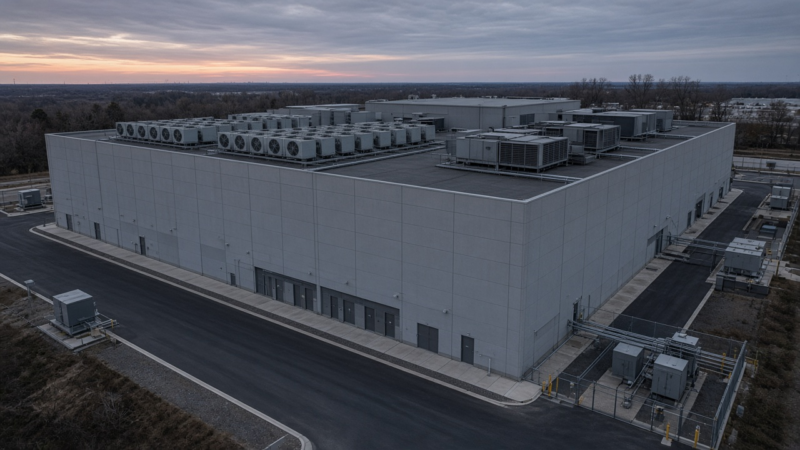
Morgan Stanley projects global data center capital expenditures will reach approximately $2.9 trillion between 2025 and 2028, driven primarily by artificial intelligence infrastructure requirements. The bank estimates that the largest technology companies can self-fund only about half of this total, leaving a $1.5 trillion external financing gap.
The $2.9 trillion forecast divides into two categories: roughly $1.6 trillion for IT hardware including chips and servers, and $1.3 trillion for physical infrastructure and construction.
Who bears the costs
Amazon, Microsoft, Alphabet, Meta, and Oracle are projected to self-fund approximately $1.4 trillion through their own cash flows. This self-funded portion represents the difference between the total spending and the estimated $1.5 trillion shortfall requiring external financing.
Private credit fills the gap
Morgan Stanley's research indicates private credit markets are expected to contribute roughly $800 billion of the shortfall. These arrangements typically use asset-specific structures, where loans are tied to particular facilities or equipment rather than a company's overall balance sheet.
Hyperscaler lease commitments exceed $1.2 trillion in undiscounted future payments, according to the bank's findings. Nvidia has also been involved in discussions regarding backstop guarantees ranging up to $250 billion to support data center debt financing, though the research does not indicate these discussions have been finalized.
Infrastructure constraints beyond financing
Financing represents only one constraint on data center expansion. Revised forecasts show the U.S. data center power shortfall is expected to increase to 32 to 33 gigawatts by 2028.
Market implications
The data suggests the largest AI infrastructure buyers have exceeded what their cash flows can support. Private credit arrangements tied to specific assets may offer opportunities for investors seeking higher yields compared to conventional corporate debt. The $1.2 trillion in lease commitments warrant attention, as these payments support much of the construction lending; any pullback in hyperscaler demand could create ripple effects through developers and creditors.