A mosaic traditionally assembles fragments of stone, glass, and ceramic into enduring artworks. For the generative artist known as BitArt, those fragments are satoshis, the smallest units of bitcoin.
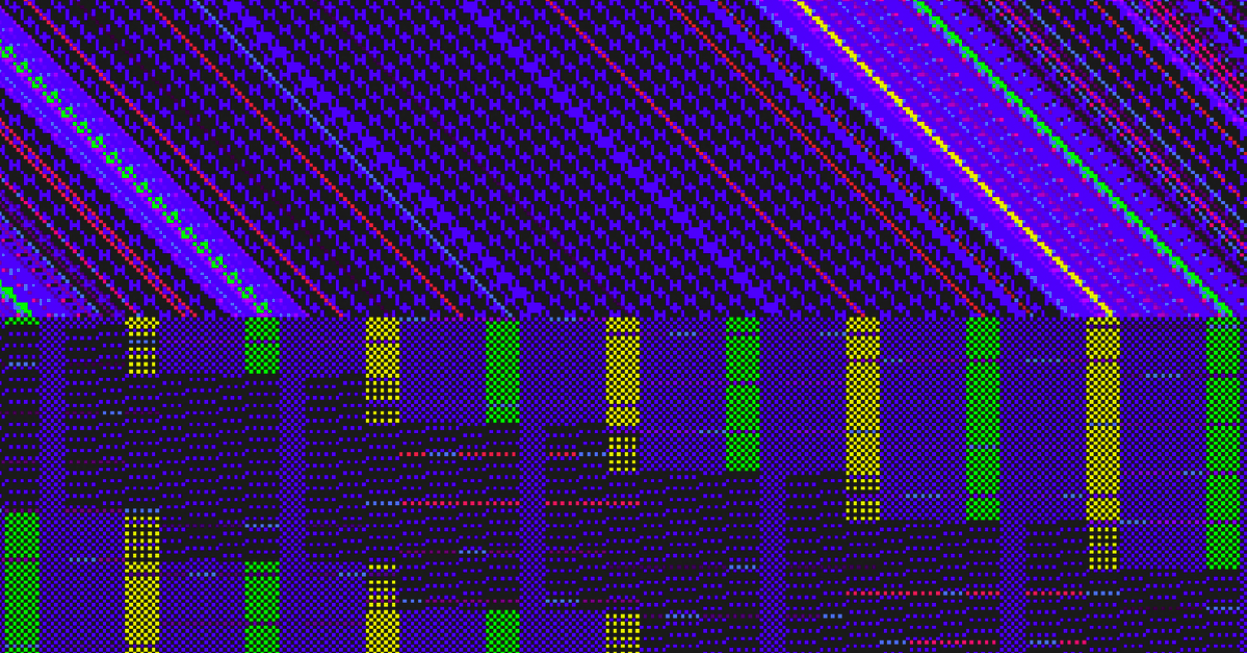
In Mosaic, a continuously evolving artwork developed through the Bitcoin Art Society (BAS), the numerical properties of satoshis are translated into color and spatial coordinates. Each contribution adds to an expanding composition of pixels resembling digital textiles, early computer graphics, or abstract paintings. According to BitArt, Mosaic now contains more than 127 million tiles and one billion layers.
Rather than illustrating bitcoin through familiar iconography, Mosaic treats the network itself as artistic material. Satoshi positions and unspent transaction outputs (UTXOs) become inputs for a rule-based system that determines the artwork's appearance. The approach extends the conceptual art tradition of Sol LeWitt and generative artists such as Vera Molnár and Manfred Mohr, who explored how mathematical systems and computational procedures could produce visual compositions.
The project has expanded into sound, with its musical component drawing from the same satoshi data that generates the imagery. Together, these elements create an audiovisual artwork shaped by bitcoin's underlying structure and the contributions of its participants.
Preservation and Collective Authorship
The Bitcoin Art Society was founded by Serge Ajamian and Yara Al Chammaa to support the creation, exhibition, and preservation of digital art on bitcoin. Following the 2020 Beirut Port explosion, which destroyed much of the artwork housed in her family's gallery, Al Chammaa began reconsidering how cultural heritage might survive physical destruction. That experience informed BAS's interest in bitcoin as a potential medium for preserving cultural works.
In Mosaic, authorship is distributed across multiple layers. Individual intentions generate collective structures that no single person controls. Each transaction becomes a non-verbal gesture that changes the artwork, but the resulting composition belongs to the system as a whole. Participants become simultaneously collectors and contributors, with the distinction between collecting and creating becoming less clear.
BitArt describes this approach as establishing conditions under which something can emerge rather than specifying what the artwork should become. The rules are deterministic, yet the results remain difficult to anticipate in practice, creating what BitArt calls creative uncertainty.
Exhibition and Scale
BAS has presented bitcoin-native digital art internationally, including Mosaic accompanied by live musicians at the Galileo Galilei Planetarium in Buenos Aires. The organization's inaugural artist residency features BitArt and CyberSea, whose practices investigate generative systems and blockchain-native artistic production.
At Bitcoin Amsterdam 2026, Mosaic will be presented on the conference's main-stage LED installation, bringing its intricate visual structures to an architectural scale. The artwork's surface is not fixed; each presentation allows audiences to experience different aspects of the same underlying system. In interactive environments, viewers navigate individually, while large-scale screens create a collective experience as the artwork unfolds.