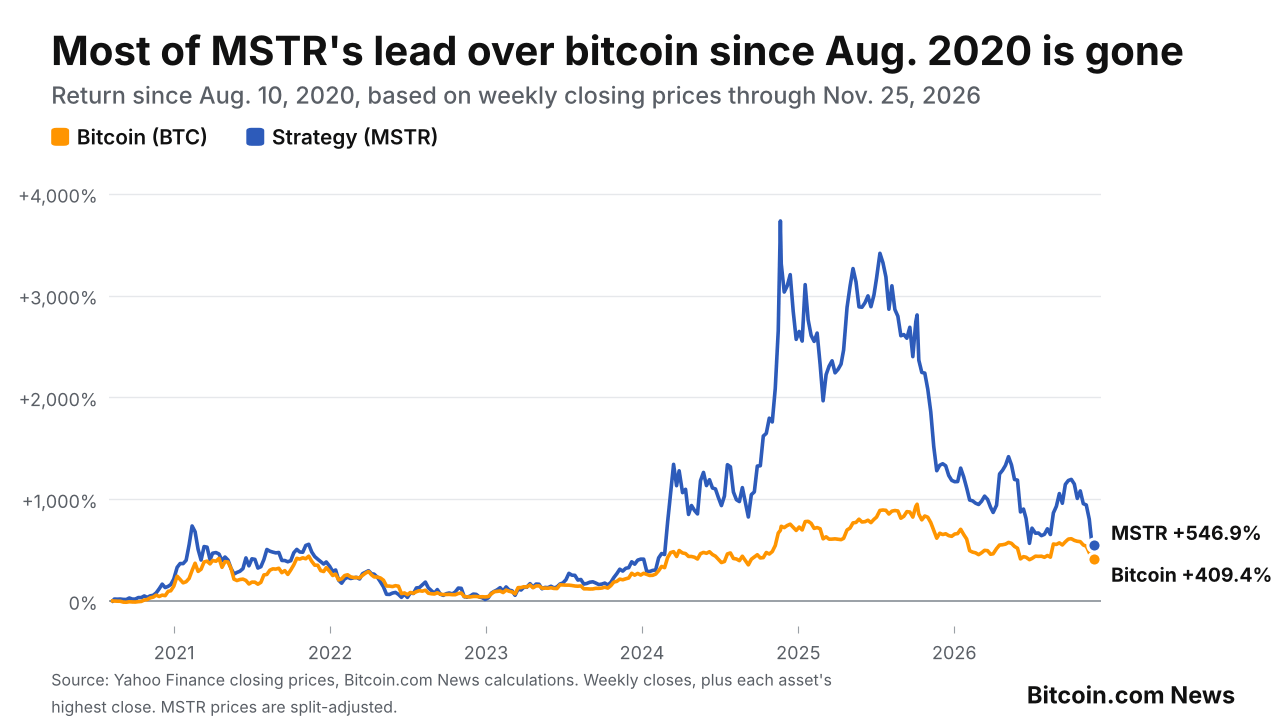
MicroStrategy's (MSTR) performance relative to bitcoin depends heavily on when investors entered the market, according to an analysis of returns since the company adopted bitcoin in August 2020.
Executive Chairman Michael Saylor has claimed that MSTR returned 34% annually since August 2020, outperforming bitcoin's 29% return. However, examining specific entry dates from August 10 of each year between 2020 and 2025 reveals inconsistent results.
Performance Varies by Entry Point
Investors who purchased MSTR on August 10, 2020, would have gained 547%, compared with 409% for bitcoin. But MSTR's outperformance narrowed considerably at other entry points. At the August 10, 2023 entry date, MSTR only marginally outperformed bitcoin. Over the remaining four timeframes examined, bitcoin either gained more than MSTR or fell less than the stock.
Different analysis windows produce different conclusions. One analyst's five-year comparison showed MSTR returning 33% while bitcoin was essentially flat, yet the same analyst's four-year window showed MSTR returning 524% versus 280% for bitcoin. Since mid-November, MSTR has declined 23% while bitcoin dropped around 6%.
Amplified Volatility Works Both Ways
Saylor has pitched MSTR as offering "amplified exposure" to bitcoin, with the stock rising or falling more than bitcoin's price. A Strategy chart from early October showed MSTR's 30-day volatility at 94% compared with 39% for bitcoin. However, this amplification applies to downside movements as well.
Saylor previously advised investors to hold MSTR for at least four years, ideally seven to ten years. Based on available data, this holding period worked for some timeframes but not others. Investors holding for five, four, two, or one year would have been better off with direct bitcoin ownership.
Different Assets, Different Needs
MSTR and bitcoin serve different investor profiles. While bitcoin provides direct ownership of the asset, MSTR offers leveraged equity exposure with company-specific risks and benefits. The stock faces both bitcoin price movements and separate challenges, including an MSCI index removal effective November 30 that could create selling pressure.
Shifting Focus Away From Bitcoin Purchases
MicroStrategy's recent capital allocation has shifted toward supporting its preferred stock, STRC, which pays a 12% annual dividend. The company funds STRC buybacks primarily through MSTR share sales, diluting existing shareholders. In one recent week, $147 million of a $212 million STRC buyback was funded through MSTR sales, while only $30 million went toward bitcoin purchases.
Since launching the STRC buyback program on June 29, MicroStrategy has spent approximately $2.88 billion on preferred stock buybacks through November 22. Bitcoin purchases have slowed significantly since late June. As of November 22, the company held 851,305 BTC valued at $51.8 billion, with holdings growing by only about 7,530 BTC since early July.
MicroStrategy's bitcoin per share yield has declined during 2024, standing at plus 13% for 2026 as of May 25 but falling to negative 4.9% as of November 26.