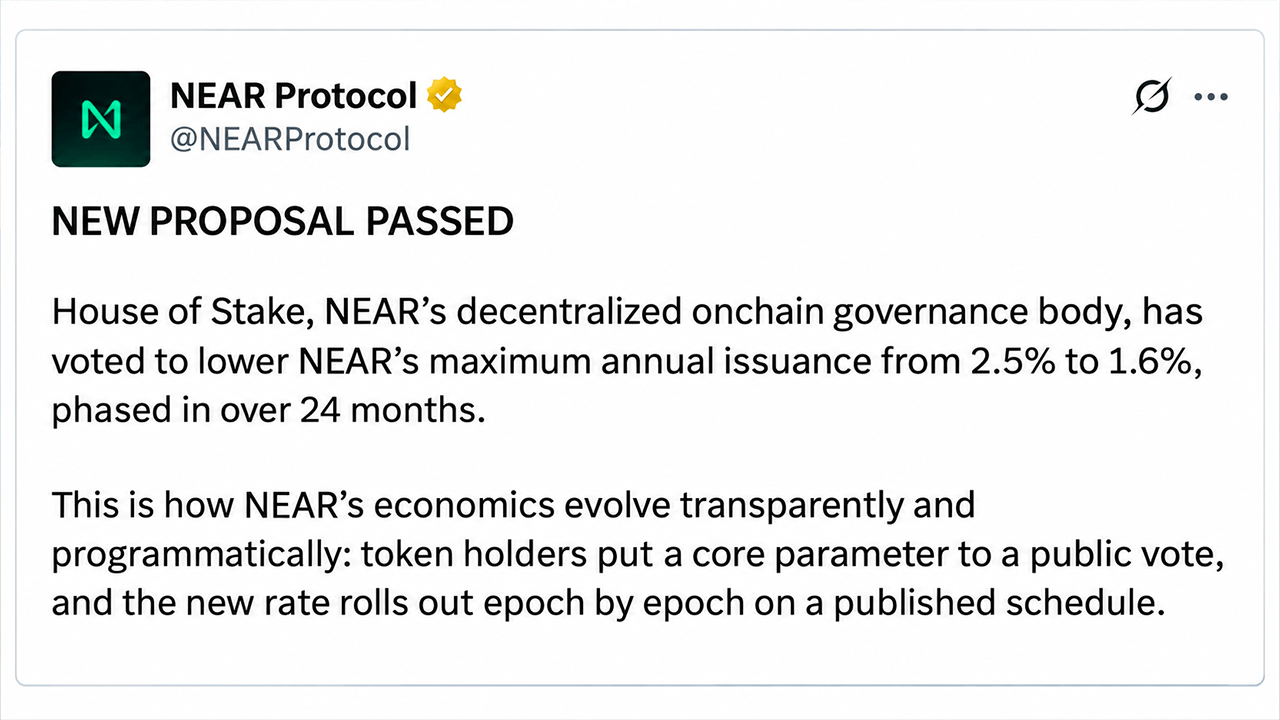
NEAR Protocol's governance body, the House of Stake, has approved a proposal to reduce the blockchain's annual token issuance ceiling by 36%, from 2.5% to 1.6%, according to a Nov. 2, 2026 announcement. The measure, HSP-029, passed with approximately 99.96% support, representing 3.29 million veNEAR in voting power.
Gradual Reduction Over 24 Months
The adjustment will be phased in over 24 months, with each epoch bringing an incremental reduction averaging 0.0375 percentage points monthly. This gradual approach avoids an abrupt change that could disrupt staking operators. The proposal modifies only the issuance ceiling; the existing distribution formula remains intact, allocating 90% of newly minted tokens to staking participants and 10% to the treasury. No additional spending authority is included.
The initiative was authored by Sal Ternullo, CEO of Nasdaq-listed SVRN, which disclosed holdings of approximately 55 million NEAR, predominantly staked, representing more than 8% of the network's staked supply. The vote follows NEAR's previous halving of its maximum issuance rate in October 2025.
Implementation Steps and Timeline
Approval does not immediately activate the change. The House of Stake Security Council must first ratify the result, followed by an approximately 90-day preparation period for exchanges, custodians, wallets, and staking services. Validators must then implement a protocol upgrade before the scheduled reductions become binding. Quarterly disclosures will compare actual issuance against the published trajectory.
The proposal also follows the withdrawal of a separate Sovereign Fund proposal from NEAR co-founder Illia Polosukhin, who cited risks associated with placing additional responsibilities on the protocol.
Supply Savings and Staking Yield Impact
Economic modeling accompanying HSP-029 estimates that approximately 11.8 million NEAR in additional issuance would be avoided during the first two years, expanding to 66.1 million over six years compared with maintaining the previous ceiling. At full implementation, projected daily token creation falls from approximately 89,500 to 57,300.
However, gross staking yields are expected to decline from 5.268% to 3.372%, assuming participation levels remain comparable. Validator commission income faces a projected 36% reduction under unchanged conditions, potentially squeezing smaller operators dependent on issuance-based compensation. Non-staking holders stand to experience slower dilution without sacrificing rewards they were not collecting.
NEAR has no fixed maximum supply, although transaction fee burning offsets some emissions. With approximately 1.31 billion tokens circulating, its monetary policy increasingly centers on balancing security incentives against long-term supply growth. The tension is straightforward: a blockchain protocol can mint fewer tokens, but its validators still need enough economic incentive to keep securing it.