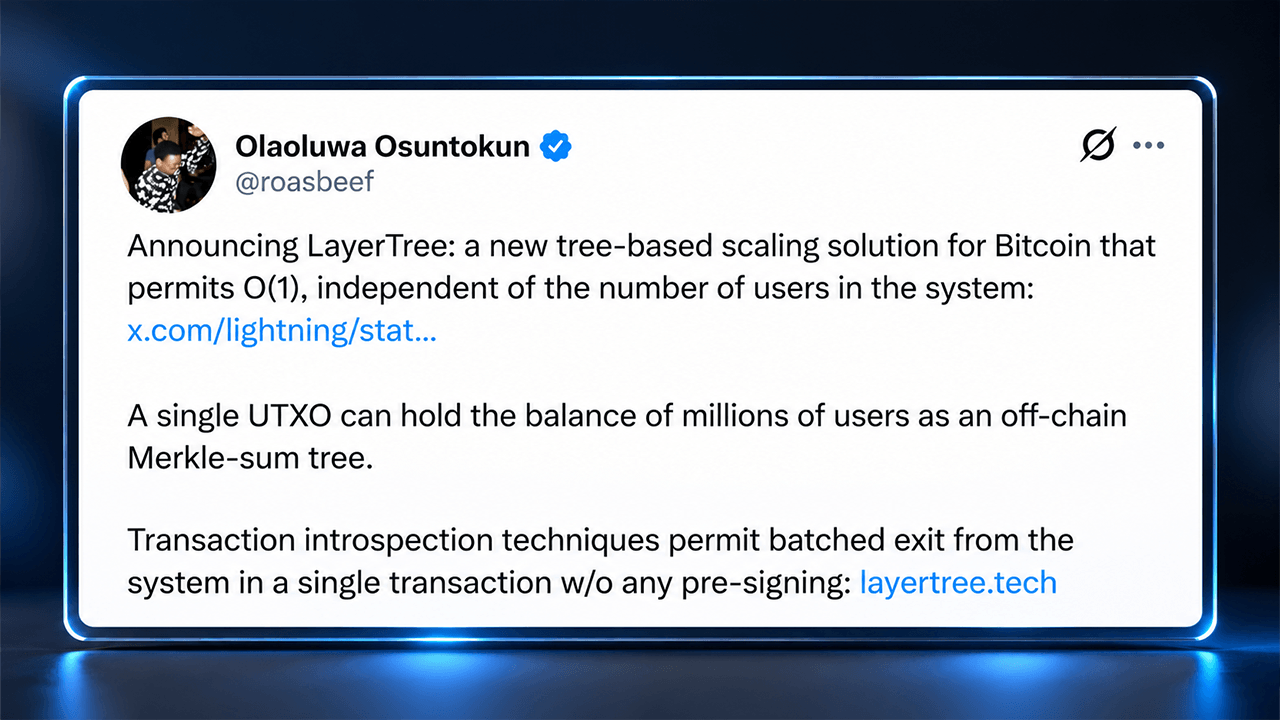
Bitcoin developer Olaoluwa Osuntokun has unveiled Layertree, a proposal designed to let millions of users share a single Bitcoin output without surrendering custody of their funds. The system uses a mathematical structure called a Merkle-sum tree to track individual balances outside the blockchain while allowing Bitcoin to verify ownership.
Currently, Bitcoin records individual holdings as separate unspent transaction outputs (UTXOs), each consuming blockchain space and requiring transaction fees to move. Layertree reverses this arrangement, allowing thousands or potentially millions of people to pool resources into one shared output while maintaining separate balance records.
How Layertree Operates
An operator manages the shared system and approves new members, but cannot seize funds or prevent valid withdrawals. Users can exit by submitting a mathematical proof of their balance. A Bitcoin rule known as a covenant verifies the proof, releases funds, and updates remaining balances without requiring operator permission or imposing waiting periods.
According to Osuntokun's paper, a system with 65,536 available positions would require approximately 1,020 virtual bytes (vB) for an individual withdrawal—roughly nine times larger than a basic Bitcoin transaction but significantly smaller than comparable Ark-style alternatives. When members join together, enrollment costs could drop below 1 vB per person for groups of around 1,000 members.
Significant Limitations
Layertree faces multiple constraints. Operators control membership admission, though they cannot block valid withdrawals. Because all users share one Bitcoin output, simultaneous withdrawals could create congestion as many participants attempt to exit at once.
Members must verify mathematical records proving their balances before depositing bitcoin; failure to do so could render funds permanently inaccessible. Most critically, Layertree cannot function under Bitcoin's current scripting rules and requires protocol changes including new instructions that have not been activated.
While Osuntokun has developed reference software and mathematically verified portions of the design, these accomplishments do not establish that the complete system operates securely in everyday use.