A Federal Reserve Bank of New York study has identified a new challenge for central banks managing currency crises: dollar stablecoins are increasingly flowing into wallets tied to countries experiencing financial stress, potentially circumventing traditional capital controls.
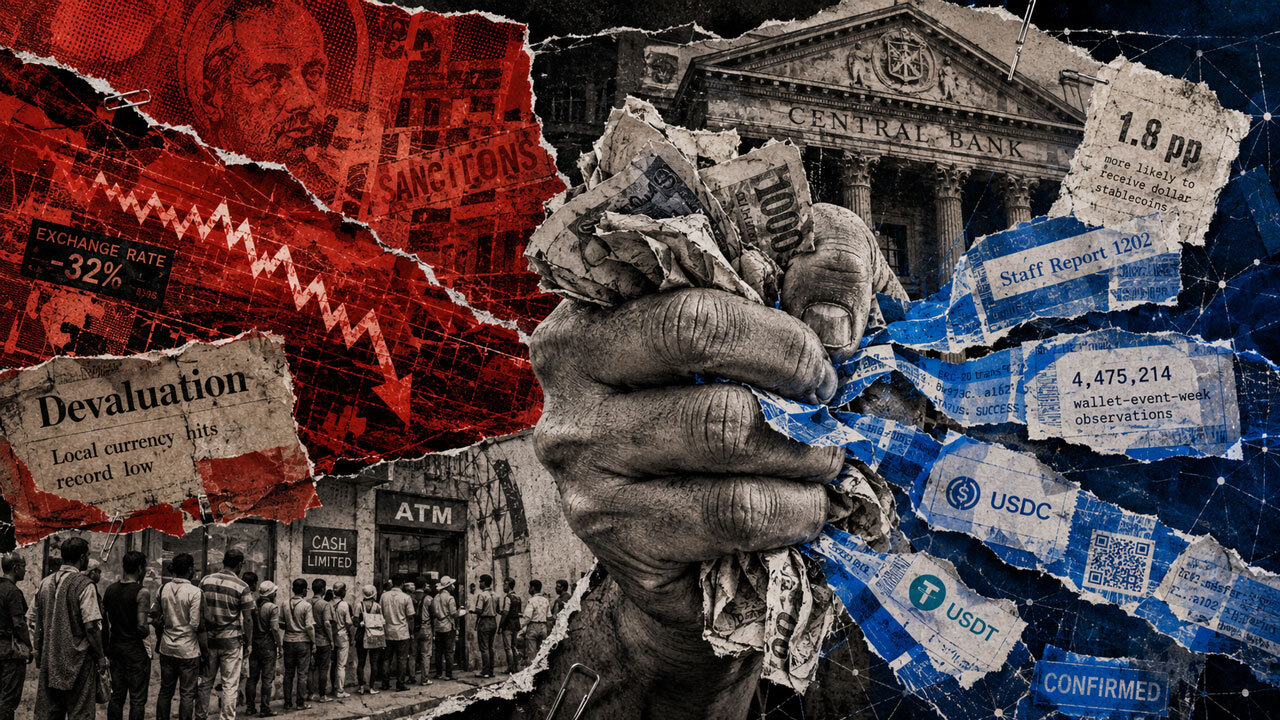
Researchers Pablo Azar, Maryam Farboodi and Nish Sinha analyzed nine financial crisis episodes between 2021 and 2025 across eight countries including Argentina, Egypt, Iran, Myanmar, Nigeria, Russia, Turkey and the United Kingdom. They found that wallets linked to countries experiencing financial crises were 1.8% more likely to receive dollar stablecoins during the week a crisis began, with receipt volumes also increasing significantly in those periods.
How Stablecoins Bypass Traditional Controls
Historically, governments have enforced restrictions on foreign-exchange purchases and cross-border transfers through regulated banks and financial intermediaries. However, dollar stablecoins provide an alternative route to dollar exposure that operates outside domestic banking channels.
The research tracked activity by linking Ethereum Name Service registrations with country identifiers to transfer histories for 19 major dollar-pegged stablecoins. A separate specification found no significant increase in stablecoin receipts in the two weeks before crises, but the probability rose 1.9% during crisis weeks, supporting the theory that demand for blockchain-based dollars rises when confidence in domestic financial systems weakens.
The researchers note important limitations: their dataset represents roughly 4.5 million wallet-event-week records and captures behavior changes among wallets already connected to stablecoin activity rather than measuring adoption across entire national populations.
Monetary Policy Constraints Widen
The findings highlight a challenge rooted in economic theory. Under the Mundell-Fleming framework, countries cannot simultaneously maintain a fixed exchange rate, unrestricted capital mobility, and independent control over domestic interest rates. Governments seeking to protect a currency while retaining monetary autonomy typically restrict capital movement through banks.
By providing an alternative to banking-based dollar access, stablecoins weaken that enforcement channel. As households gain access to blockchain-based dollar tokens, governments must devote more enforcement resources or accept greater currency depreciation and interest-rate pressure.
A Growing Market Raises Stakes
The policy implications become more significant as the stablecoin market expands. The market has already surpassed $300 billion and is expected to reach trillions of dollars by the end of the decade. Blockchain analysis firm Chainalysis projects stablecoin transaction volume could reach $719 trillion by 2035.
Major dollar stablecoins such as USDT and USDC remain centralized, with issuers able to freeze addresses and regulated exchanges subject to government restrictions. However, once tokens move between self-custodied wallets, governments have fewer immediate control points. Federal Reserve Vice Chair for Supervision Michael Barr flagged in June that secondary-market transfers involving unhosted wallets present enforcement vulnerabilities.
The distinction becomes critical during currency crises, when demand for alternative payment systems rises precisely as authorities attempt to restrict capital movement. At the scale projected for coming years, stablecoins may shift from a niche payment mechanism into a material constraint on how governments manage currencies during financial stress.