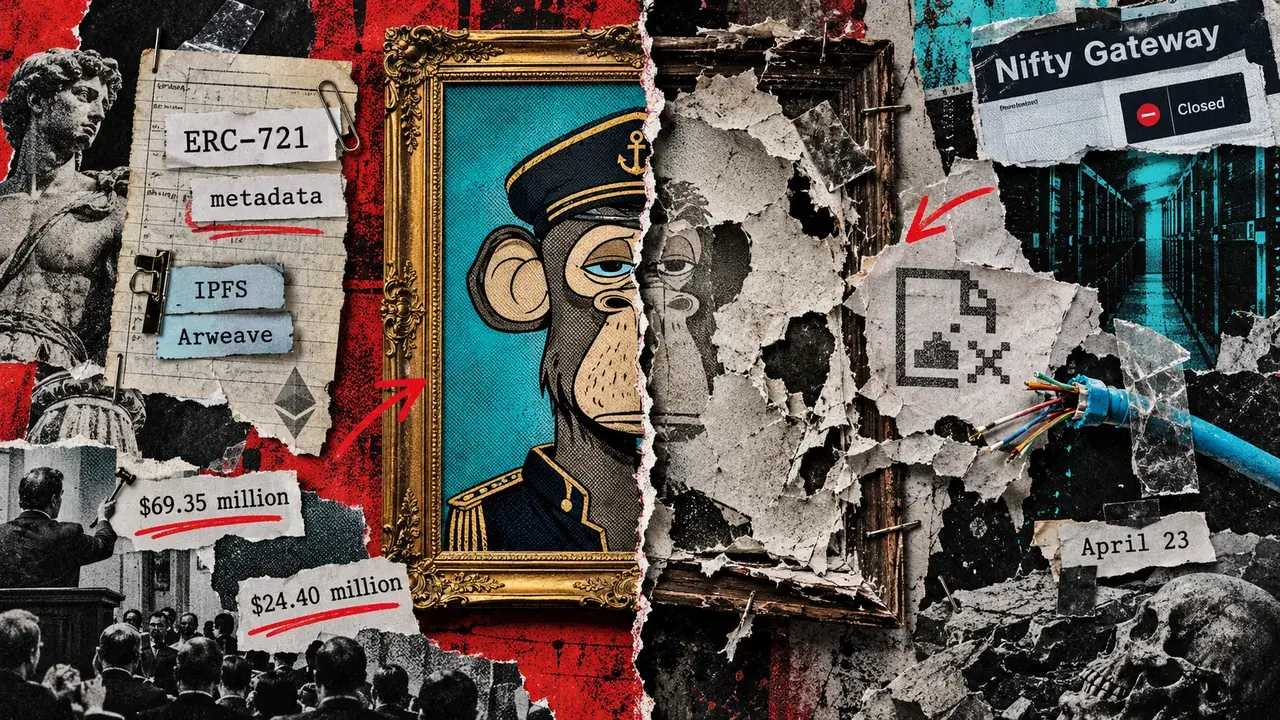
The NFT market boom of 2021 saw record-breaking sales, including a Beeple artwork that sold at Christie's for $69.35 million and 101 Bored Ape Yacht Club NFTs auctioned by Sotheby's for $24.40 million. But marketplace closures are now revealing infrastructure gaps in digital art ownership.
Nifty Gateway, the NFT marketplace owned by crypto exchange Gemini, announced its closure in January as its parent company shifted focus to its primary financial application. The closure highlighted a fundamental problem: owning an NFT token does not automatically preserve the associated artwork.
How NFT Ownership Actually Works
When collectors purchase an NFT, the blockchain records ownership of the token itself through standards like Ethereum's ERC-721. However, the artwork—whether an image or video—typically resides on separate servers, with the token pointing to metadata and a link to the media file.
This design choice keeps large files off the blockchain but creates a dependency. Transferring a token to a personal wallet gives collectors control over the token, but does not automatically download the artwork, transfer server hosting, or arrange payment for ongoing storage.
Nifty Gateway's closure plans included moving descriptive records and media to Arweave, a network designed for long-term storage. However, some NFTs created in 2021 or earlier had metadata permanently linked to Nifty Gateway's own servers. The company committed to hosting that metadata indefinitely and extended its withdrawal window to April 23.
The Storage Problem
Distributed storage networks like IPFS can reduce dependence on a single company by allowing different computers to serve the same content. However, files stored on IPFS are not automatically retained. A process called pinning tells a computer to preserve specific content, but someone must pay for that service or run the infrastructure themselves.
If nobody maintains a copy, the data can become inaccessible even when distributed storage technology exists. Collectors may need to troubleshoot whether a missing image reflects a problem accessing the file or a loss of all surviving copies—a technical challenge for buyers who expected to simply own a picture.
Museums and Long-Term Preservation
Cultural institutions have confronted similar challenges for years. LACMA's digital preservation manager and computer scientist examined the software, storage, and ongoing responsibility required to keep NFT artworks accessible in a December 2021 discussion. MoMA's 2016 restoration of an interactive installation by Teiji Furuhashi involved obsolete technology including MS-DOS and LaserDiscs, demonstrating that preserving digital art often requires maintaining functional environments, not just storing files.
Preserving interactive works can demand documentation and maintenance of the systems that allow them to function. Saving only the original files may not preserve the experience collectors came to see.
The Economics of Stewardship
The core tension is economic. Selling an NFT generates revenue at the moment of purchase, while preservation creates ongoing costs and work. Those timelines can diverge significantly, particularly when marketplaces built their business around selling new collections rather than maintaining existing ones.
Some NFT systems reduce these risks by storing artwork data directly on the blockchain or using storage networks with financial incentives for long-term retention. Each approach carries its own dependencies—from blockchain continuity to the incentives that keep storage providers engaged.
Collectors can take on preservation responsibilities themselves, and systems allowing independent file retention provide real control. That freedom requires accepting custodial duties, however, which asks considerably more from buyers than a simple purchase transaction.
If digital artworks remain accessible decades from now, it will be because collectors and preservation specialists maintained them long after the market moved to other interests.