Tokens tracking Nvidia shares can trade at different prices across issuers and exchanges, but buying the cheaper version and selling a dearer one leaves little room for profit in two modeled comparisons published by data provider Coin Metrics on Nov. 3.
The execution study shows about one basis point remaining in one $1,000 comparison after entry and exit slippage, and a negative 15 basis points in another. The results illustrate how a visible price difference can shrink when an order reaches the market, while preserving a small positive remainder in the first example.
Two modeled comparisons
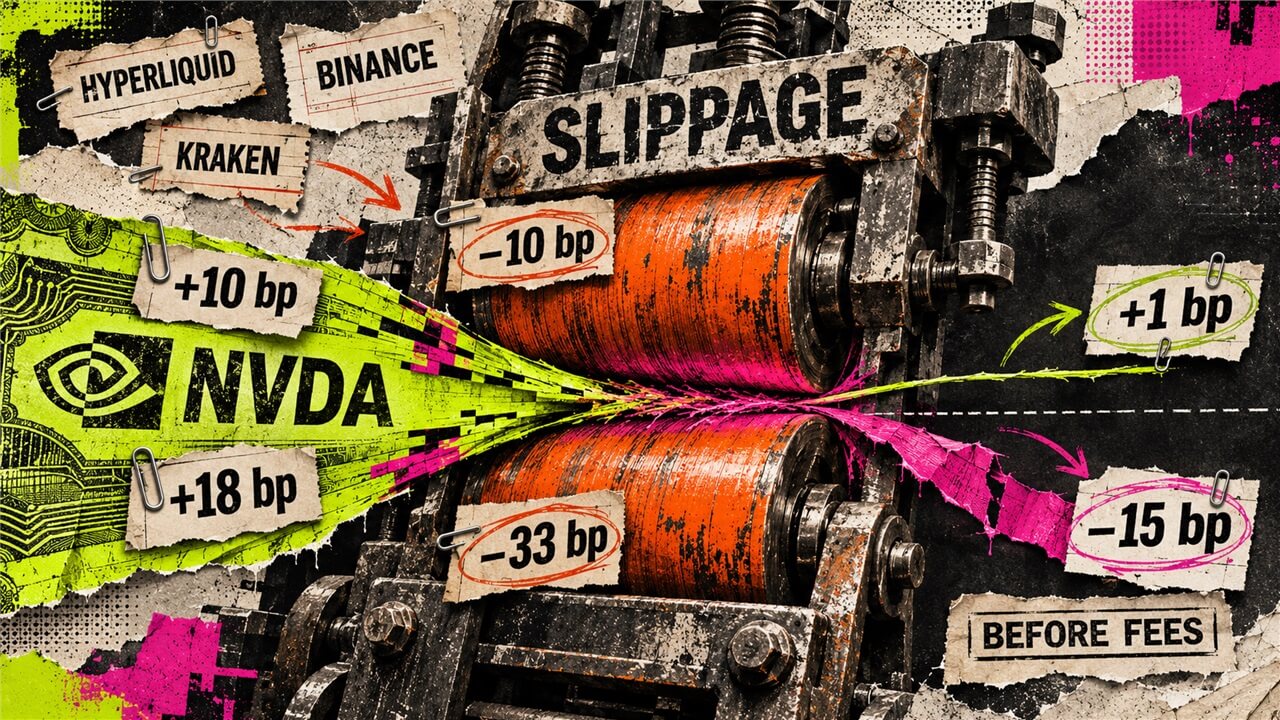
Coin Metrics' spread and slippage chart compares buying Hyperliquid NVDAx with selling Binance NVDAb. It shows a gross gap of 10 basis points, entry and exit slippage of 10 basis points, and a one-basis-point remainder before trading fees.
The second comparison buys Hyperliquid NVDAx and sells Kraken NVDAx. There, an 18-basis-point gross gap faces 33 basis points of entry and exit slippage, leaving a negative 15-basis-point gap before fees.
The chart supports almost no remaining edge in the first example and a negative remainder in the second, before trading fees. It does not establish simultaneous executable quotes, realized profit, or a universal absence of opportunities. The labels are rounded independently, so the printed +10 and −10 do not sum exactly to the printed +1.
Operational and structural hurdles
Even a positive modeled remainder may not be accessible. A holder must compare the same share exposure, have something to sell on the expensive side, and qualify for the route used to settle the trade.
Tokenized-equity framework xStocks announced NVDAx/USDC spot trading on HyperCore on Aug. 10, separately from equity perpetuals. Moving those spot tokens to or from HyperEVM involves wrapping and bridging. The chart's venue labels alone do not establish that transfer route for every observation in its June-November sample.
A second dataset from Bitquery, corrected on Nov. 1 to normalize Nvidia tokens per underlying share and adjust dividend treatment, shows pairwise median daily gaps among the four busiest versions of no more than 0.12% across its Sept. 15-Oct. 13 public-pool sample. The widest pair was 0.1225%, rounded to 0.12%.
Kraken's multiplier explanation shows that dividend reinvestment can increase the share exposure displayed in an xStock balance while the number of on-chain tokens stays unchanged. For wrapped xStocks, the issuer separately says token prices must be adjusted using its multiplier.
Bitquery says its Nvidia tokens have separate contracts without a direct bridge or issuer swap between them, so buying the cheaper product does not supply the different token needed for the sale.
Fees and access restrictions
Kraken's Oct. 30 FAQ lists a 10-basis-point taker fee and a two-basis-point maker rebate for its Pro spot order book. App purchases using US dollars or USDG have no trading fee but may include a spread, while xStock conversions carry a 1% fee.
The issuer's primary-market documentation requires onboarding, identity and anti-money-laundering checks, and whitelisted wallets. Its named cash Market Flow lists a $5,000 minimum, 24/5 availability, and fees currently set to zero.
Kraken also excludes US persons and customers in the US, UK, Canada, and Australia from xStocks access. Compatible-wallet withdrawals are supported, but transfers into a traditional brokerage account are not. The issuer classifies xStocks as tracker certificates providing economic exposure, without direct share ownership or voting rights.
The usable margin depends on executable prices for matching exposure, both legs' costs, and the ability to deliver or sell the relevant instrument.