Ethereum Researcher Warns of Accelerated AI Threat
Recent mathematical advancements by OpenAI have prompted Ethereum researcher Justin Drake to urge the blockchain industry to prepare for "bunker mode." Drake suggested that large and sophisticated holders should consider a controlled migration of digital assets into fresh addresses whose public keys have never been exposed.
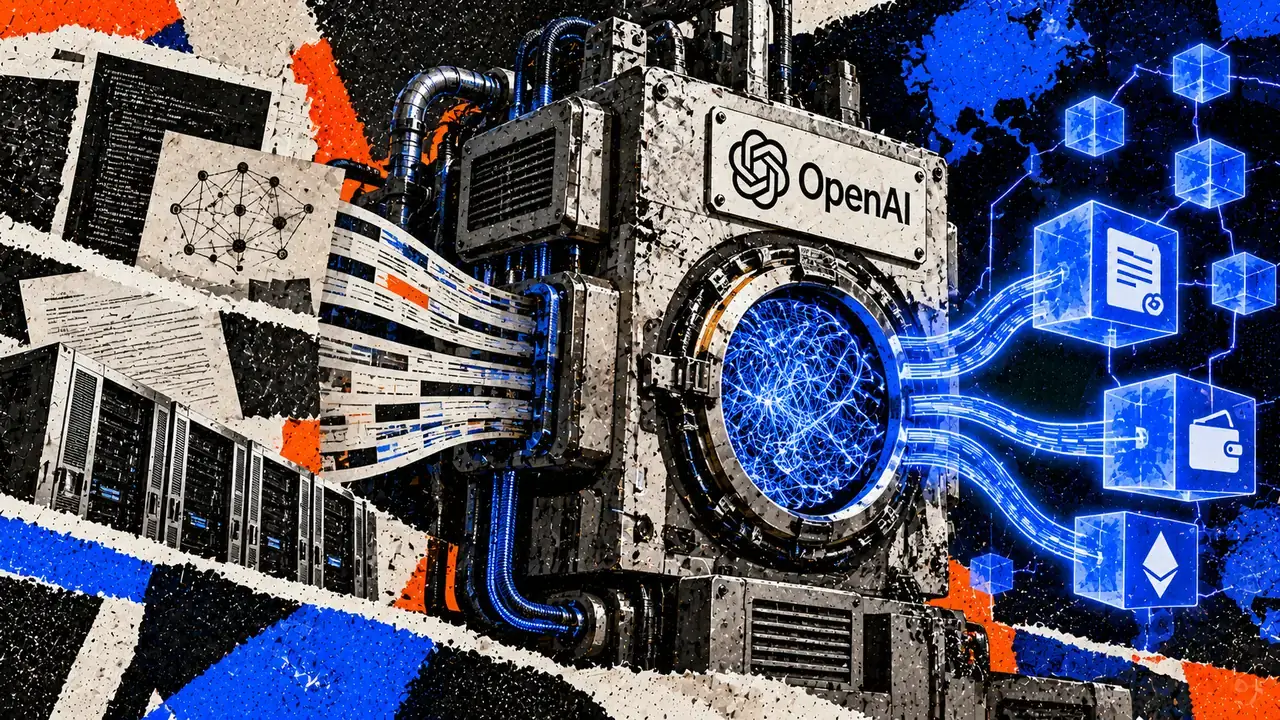
Drake's warning followed OpenAI's release of a collection of new mathematical results produced by an internal frontier model on Oct. 6. The company tested the model across thousands of problems, publishing proofs with computer-checkable Lean formalizations. Drake argued that the accelerating pace of AI-driven mathematical discovery challenges assumptions about how long elliptic-curve cryptography will remain secure, noting that in a worst-case scenario, an effective break of the Elliptic Curve Digital Signature Algorithm (ECDSA) could arrive in months rather than years.
OpenAI's announcement did not report a practical attack on ECDSA or RSA, and Drake's timeline is a worst-case conjecture rather than a demonstrated capability.
Implications for Bitcoin and Ethereum
Bitcoin and Ethereum rely heavily on elliptic-curve cryptography to establish ownership and authorize transactions. Standard Ethereum externally owned accounts use ECDSA on the secp256k1 curve. Once an account sends a transaction, its public key can be reconstructed from onchain information, allowing a party that can efficiently derive the private key to take control of the assets.
Standard Ethereum accounts whose public keys remain unexposed have an additional layer of protection because only the address, which is a hash of the public key, is visible. While the industry has traditionally treated this vulnerability as a future quantum-computing risk, Drake challenged the assumption that quantum computing will necessarily be the first technology capable of breaking these systems. He pointed out that a sufficiently capable AI could uncover a classical algorithm that dramatically reduces the difficulty of recovering private keys, thereby bypassing the need to wait for large fault-tolerant quantum computers.
Separately, Europol warned that quantum computing could eventually undermine cryptography protecting cryptocurrency wallets, urging the industry to begin preparing before the threat becomes practical.
Proposed Interim Defenses and Long-Term Solutions
Drake's proposed response does not require waiting for new blockchain infrastructure. He suggested moving funds to addresses that keep public keys hidden behind hashes and avoiding unnecessary outgoing transactions. However, address types differ in their exposure; Bitcoin Taproot outputs expose a public key from the outset.
Drake urged large custodians—specifically naming Binance, Bitbank, Robinhood, Bitfinex, and Tether—to lead the transition and harden cold-storage practices. He also recommended that critical blockchain infrastructure, such as oracles and layer-2 security councils, rotate ECDSA keys after signing messages or combine existing signatures with hash-based systems like SPHINCS.
These measures serve as interim defenses. Drake's preferred long-term approach relies on hash-based cryptography, which possesses less algebraic structure for future AI systems to exploit compared to elliptic curves, lattices, or isogenies. Ethereum already has a post-quantum roadmap including hash-based validator signatures, though Drake cautioned against a rushed migration that could introduce new operational risks.