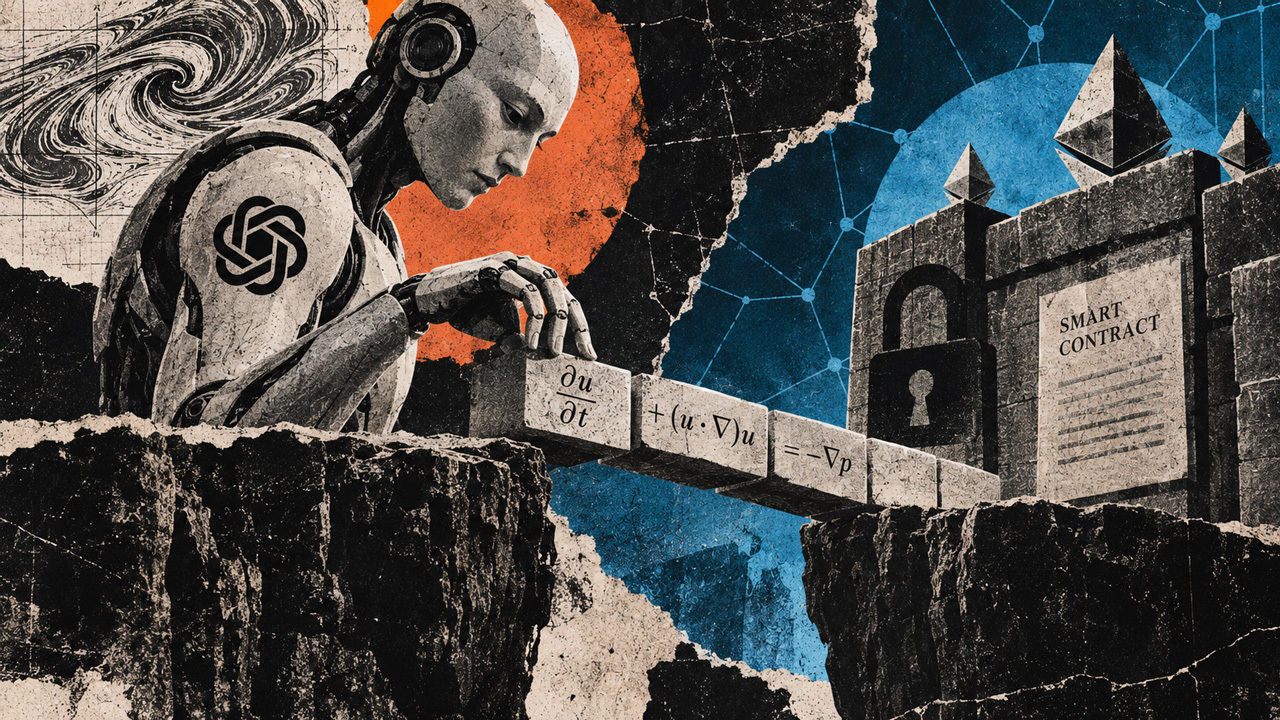
OpenAI's latest mathematics breakthrough could accelerate automated theorem proving in smart-contract security, though it raises questions about what security measures might be overlooked in the process.
On September 8, OpenAI reported that approximately 10,000 concurrent AI agents produced a solution to the Navier-Stokes fluid-motion problem over roughly 88 hours. Formalization and verification using Lean, a software proof assistant, required an additional 17 hours with GPT-6 Astra. The system generated an analytical proof demonstrating that an initially smooth fluid can develop a singularity in finite time while retaining finite energy. OpenAI released both the proof and its Lean formalization for independent review.
For cryptocurrency developers, the implications center on how formal verification works. Formal verification uses mathematical specifications and theorem proving to confirm whether smart-contract code behaves as intended—a process that has historically required significant human effort and expertise.
Security Requirements Move Upstream
As AI systems become more capable at generating and verifying proofs, the security bottleneck shifts upstream toward specification design. Ethereum documentation notes that formal verification establishes whether a contract satisfies properties developers have specified in advance. Poorly written or incomplete specifications can allow vulnerabilities to escape detection even when verification technically succeeds.
Access controls, withdrawal conditions, accounting invariants, and privileged functions must all be expressed accurately before an automated prover can test them. This concentration of responsibility on specification quality could reshape how formal verification is deployed across DeFi protocols, bridges, and tokenized-asset platforms.
Challenges Remain for Production Use
Mathematician Terence Tao raised concerns about what might be lost when autonomous AI systems generate complex proofs largely independently. Failed approaches and intermediate discoveries often provide insights that outlast the final proof, while a highly autonomous system could deliver a correct result without transferring the same depth of understanding to humans.
The critical next test is whether systems capable of handling research mathematics can be adapted to production software and generate proofs that developers and auditors can meaningfully inspect. Firms combining automated theorem proving with rigorous specification design could verify more contracts before deployment while concentrating human expertise on defining the failures that must never occur.