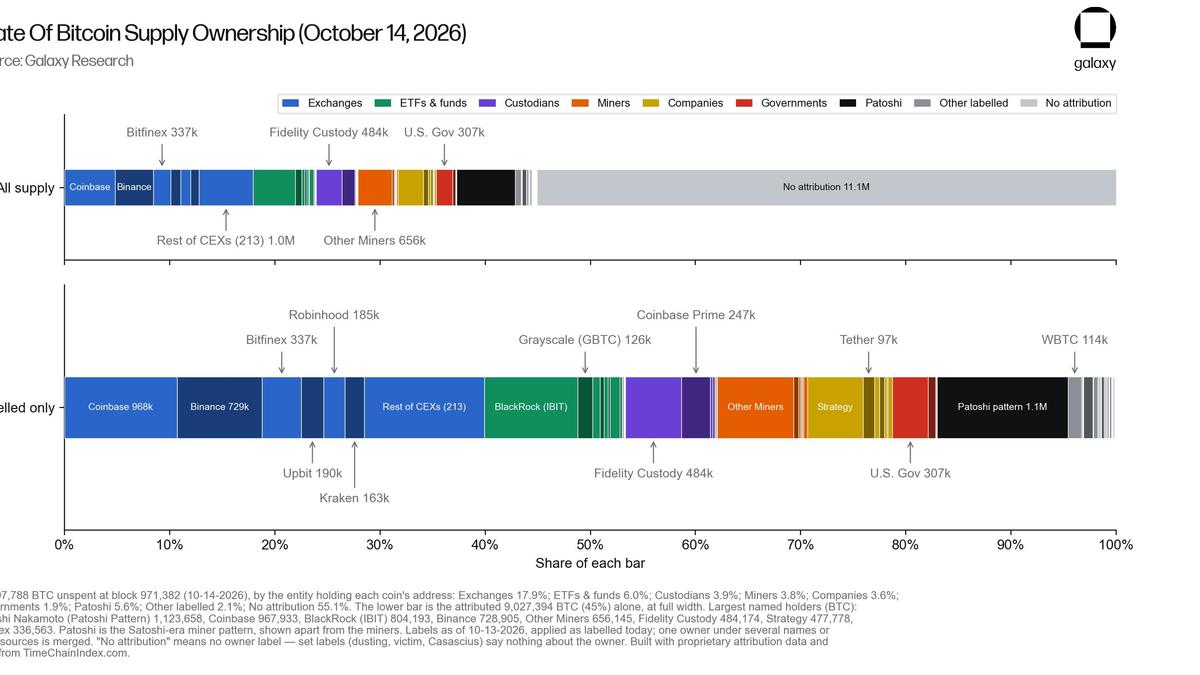
About 11.1 million bitcoin, representing roughly 55% of the approximately 20.1 million mined coins, is held in addresses that Galaxy Research cannot link to an exchange, fund, government, or other known entity.
The large volume of unattributed holdings indicates that self-custody—where individuals control their own private keys rather than depositing coins with custodians—remains widespread in the Bitcoin market. This persists despite years of institutional adoption and the growth of centralized exchanges and funds.
Alex Thorn, Galaxy's head of research, characterized the finding as evidence that individuals continue to hold significant portions of Bitcoin's supply. "More than half of all BTC supply is sitting in addresses with no known attribution despite all the institutionalization and centralized ownership over the years, still a ton of bitcoin (maybe even most) is held by individuals in self-custody," Thorn wrote.
What the Unattributed Holdings May Include
The 55% figure comes with important caveats. The unidentified addresses could include coins that are likely lost, held in wallets whose owners have forgotten their keys or passed away. Some may belong to unidentified institutional holders such as private funds, companies, or over-the-counter desks that arrange large trades away from public exchanges.
Additional coins may be distributed across complex custody arrangements designed to obscure their holdings. Some of the earliest mined bitcoin—attributed to miners other than the one behind the Patoshi pattern linked to Bitcoin's anonymous creator, Satoshi Nakamoto—also falls into the unattributed category.
The Identified 45%
The remaining 45% of Bitcoin's supply can be traced to known holders, including major exchanges, BlackRock-led ETFs, the U.S. government, and the Satoshi-era miner pattern, which holds 1,123,658 BTC as the single largest attributed holding.