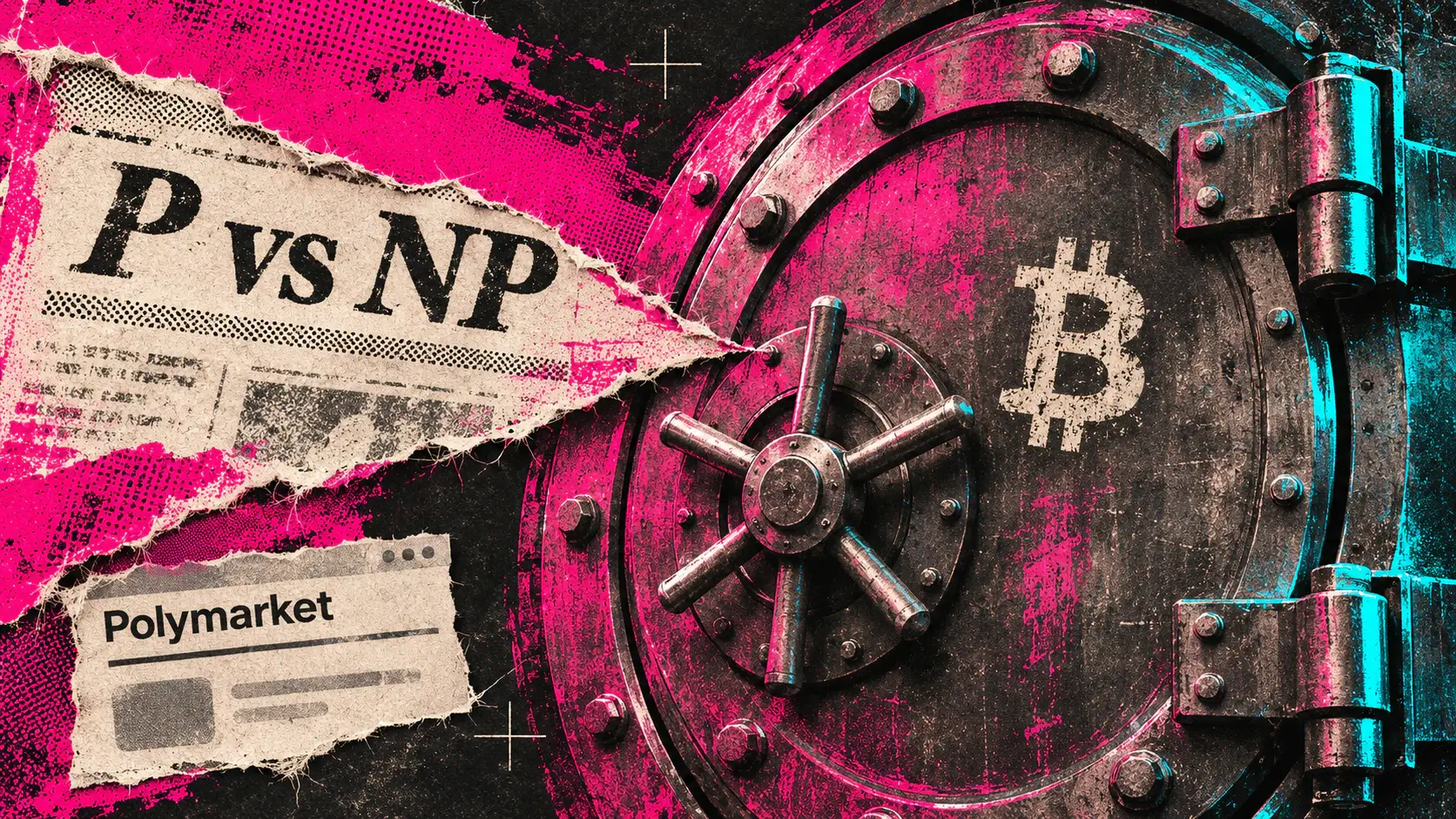
Social media has circulated claims that artificial intelligence labs have secretly broken cryptography and that a proof of P = NP would doom Bitcoin. However, the mathematics tells a different story.
A proof that P = NP would guarantee that polynomial-time algorithms exist for certain problems underlying cryptography. But the proof itself might provide no usable algorithm, and any algorithm it yields could remain impractically slow.
The confusion stems from what P = NP actually means. It asserts that checking an answer and finding it can both be done in polynomial time, though the two polynomials can differ dramatically. For example, checking an answer might take n² steps while finding it takes n¹⁰. At n=256 with a billion steps per second, checking takes about 66 microseconds while finding takes approximately 38 million years.
What a Proof Would Actually Mean
A P = NP proof would not prove Bitcoin is quantum-resistant. Peter Shor's quantum algorithm for discrete logarithms exists independently of the P versus NP question. Its practical relevance to Bitcoin depends on whether a quantum computer can run it at the scale required for Bitcoin's signatures.
If P = NP were proved, it would demonstrate that some problems can be checked quickly by a classical computer even though no classical algorithm can solve every instance in polynomial time. This would still leave open the question that matters to Bitcoin holders: how difficult is it to recover the private key behind a Bitcoin public key?
Conversely, if P ≠ NP were proved, some efficiently checkable problems would have no deterministic classical polynomial-time algorithm that works on every input. This would leave the hardness of a typical Bitcoin key unresolved.
Market Odds and Qualification Rules
Polymarket displays betting odds on whether an AI lab will announce a complete P = NP solution by December 31, 2026. The odds dropped from 13 percent on November 27 to 7 percent on November 28. Under Polymarket's rules, an eligible AI lab or its official representative must announce a complete solution by 11:59 p.m. ET on December 31, 2026. The lab must present it as work by the lab, its researchers, or its models.
Testing a Cryptographic Breakthrough
To verify whether a claimed breakthrough matters for Bitcoin, observers should look for independent reproduction on a fresh challenge and a full-size test key, with the secret kept out of reach. Reproducible recovery of the secret would also count as evidence.
A useful report would name the signature scheme and hardware, provide elapsed time and memory use, and show how often the test worked across independently generated keys. Bitcoin's traditional ECDSA and Taproot's Schnorr signatures both use the secp256k1 curve.
Key Exposure Windows
Different Bitcoin payment types reveal public keys at different times. A Taproot payment puts the public output key in the transaction that creates it, leaving it exposed for the entire time the payment sits unspent. A pay-to-witness-public-key-hash payment initially shows only a hash and typically reveals the key when the owner broadcasts a spend transaction.
Bitcoin targets an average block interval of ten minutes. Analysis of 135 consecutive block-header timestamps from November 26 showed a median interval of 7 minutes 56 seconds, with some gaps exceeding 20 minutes. A capability to forge signatures would need to work within these windows to pose a practical threat.
Mining Implications
A miner earns a chance at the block reward by finding a valid block whose header hash meets the network target. The cost of a signing capability determines whether it could affect mining economics before a miner deploys enough capacity to impact the network. Bitcoin nodes independently verify transactions inside blocks against network spending rules, providing a check on any mining advantage.