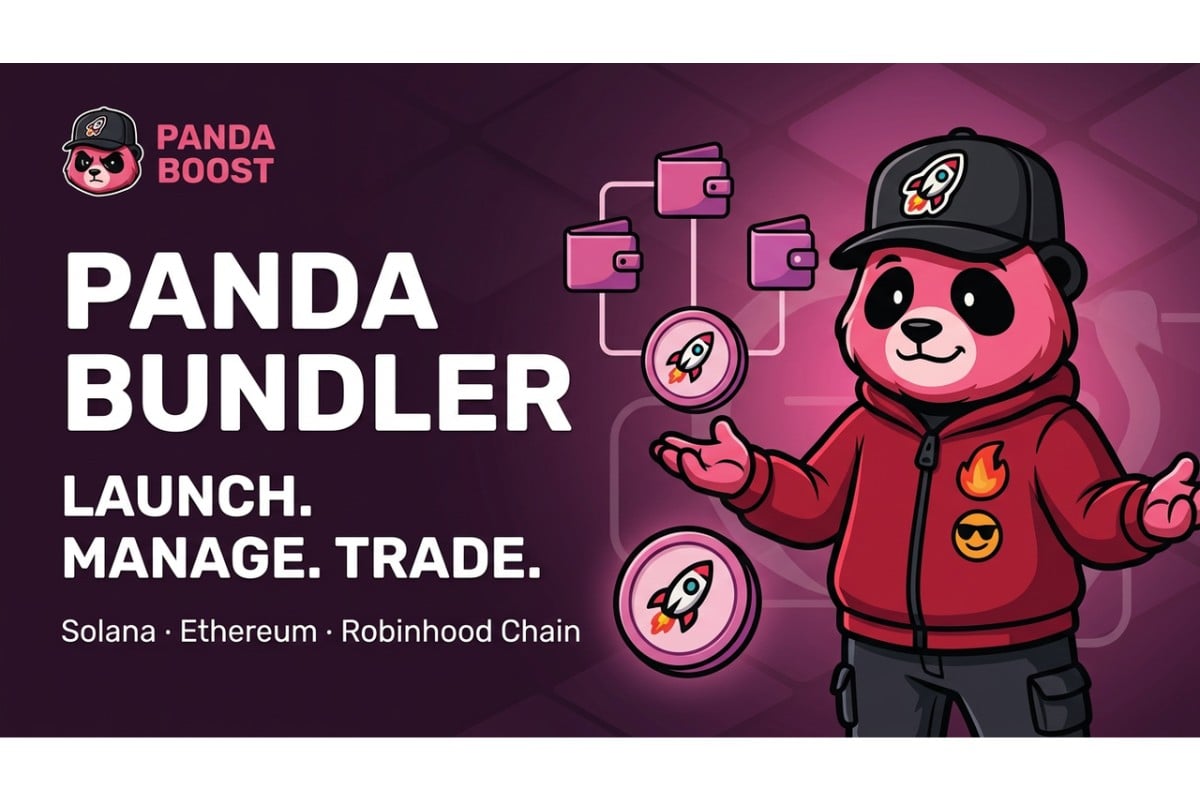
Panda Bundler, PandaBoost's web-based token launch and trading application, combines three venues: Pump.fun on Solana, Pons on Robinhood Chain and Uniswap on Ethereum. Teams can prepare launches, configure wallets and manage post-launch operations from a single workspace, though features and funding requirements vary by venue.
Multi-chain, not cross-chain
The documentation describes the product as offering multi-chain support. It is explicitly not a cross-chain bridge and does not guarantee simultaneous execution across networks. Features, launch modes, wallet limits and funding routes differ by venue.
These differences are operational. SOL reserves, account rent and Jito tips are specific to Solana, not universal EVM requirements. An operator who applies a Solana checklist to Robinhood Chain or Ethereum will budget for the wrong items.
Access by invite key only
Authentication is invite-key only. There is no email, username and password, Telegram-bot login or WalletConnect. The operator pastes a key into the Invite code field in the web app. The key identifies the Bundler account and grants access to its launches and managed wallets. Access is requested through PandaBoost support.
The documentation treats the key as a private credential. It should never appear in a screenshot, an open chat, a repository or a shared document. Support will never need a seed phrase or private key.
One scope note: PandaBoost's service-ordering API does not cover Panda Bundler. The Bundler is web-only.
Launch settings
In the draft workspace, Block-0 Mode prepares the configured creation and initial-buy transactions as a coordinated launch sequence. The documentation qualifies it immediately: it is an execution setting, not a guarantee. Network conditions, launchpad behaviour, bundle inclusion, third-party trading and transaction failures can all change the result.
Other settings cover the total token-buy target, developer allocation and preset or custom allocation patterns. On Solana only, there are also Jito-tip and pacing controls. Higher tips do not guarantee inclusion or execution, and the funding requirement must be rechecked after any change to tip, delay or wallet count.
Wallets and holder distribution
A launch configuration can contain up to 200 holder wallets. The live product view is the source of truth for the allowed count and role combinations. Wallets can be:
- generated in the workspace
- imported from existing addresses
- added as empty holders with no initial allocation
- assigned operational roles: developer, MEV, worker, funding and others shown by the current mode
Allocation runs through a Token Buy % per wallet. The interface shows total allocated percentage, required network asset per wallet, role labels, generated-versus-imported status, and whether a wallet is already assigned elsewhere.
On the holder map, the documentation is plain. Allocation affects holder distribution but cannot guarantee a clean graph or hide on-chain relationships. Funding paths, transfers, timing, token accounts and later trades remain public, and third-party analytics can group them differently. "Clean Bubblemaps" is described as a configuration goal, not a concealment guarantee. PandaBoost cannot guarantee how Bubblemaps or other analytics group a launch.
Sniper Guard and automation
Sniper Guard monitors external buys and runs a configured response when the accumulated external amount crosses a threshold. Its controls are:
- an enable toggle
- Max External SOL as the threshold
- Trigger Mode, with Stop Buying or Sell Everything responses
- a whitelist of excluded addresses
- an optional duration
It is conditional automation. It does not prevent third-party transactions, guarantee an exit price or inclusion, or eliminate launch risk. Automated sells can create price impact and incur the 5% sell fee.
Auto Trade Strategies run Auto Buy and Auto Sell across selected launch wallets. There are three types:
- Replication strategies respond to a qualifying tracked trade or wallet event.
- Time-based strategies act after a delay or at repeated intervals.
- Market-cap strategies trigger at configured levels.
Several can be stacked in one plan, each with its own wallet scope, amount, trigger and end conditions. Automation can submit trades without another confirmation. It does not guarantee execution, fill price, timing, profit or protection from market movement.
Activity Generation runs configured buy-and-sell cycles across selected managed wallets. Each run is set by volume per trade, loop count, delay between cycles, funding option and sell-after-buy behaviour. A summary estimates required SOL, transaction count and duration, and those estimates shift with network conditions and failures. The documented limit: it creates public transactions and market activity. It does not make wallets unrelated, conceal control, guarantee how analytics classify them or guarantee a financial result.
Fees
The first launch carries 0% Panda Bundler platform fees. Contact support before starting to activate the first-launch offer. Network, gas, launchpad and DEX fees remain separate.
The standard Panda Bundler platform fee is 5% on sells, with no buy fee, subscription fee or launch-creation platform fee. For higher-volume activity, users can contact support to agree a reduced sell-fee rate. This is arranged individually, not an automatic discount or a published fixed tier. Confirm your rate and check the fee shown in the app before submitting.
External costs are unaffected by the first-launch offer. These include network and gas fees, priority fees, launchpad or DEX trading fees, exchange withdrawal fees and account-creation costs. Solana launches also carry SOL reserves, account rent and Jito tips.
Who it is for
Panda Bundler is an operator tool. It brings the following into one surface for teams that would otherwise coordinate them across separate tools:
- token setup, wallet allocation and funding
- launch execution
- post-launch trading through a chart, trade panel, wallet scopes and task feed
- automation and withdrawals
- wallet management, batch creation and cleanup
The value is coordination.
It does not offer, and its documentation does not claim, an undetectable launch, a sniper-free launch, a guaranteed block position, a particular chart shape or any financial outcome. Public-chain activity stays public.
The venue-specific detail is where decisions get made. PandaBoost's Pons bundler guide for Robinhood Chain covers how that workflow differs from Solana.