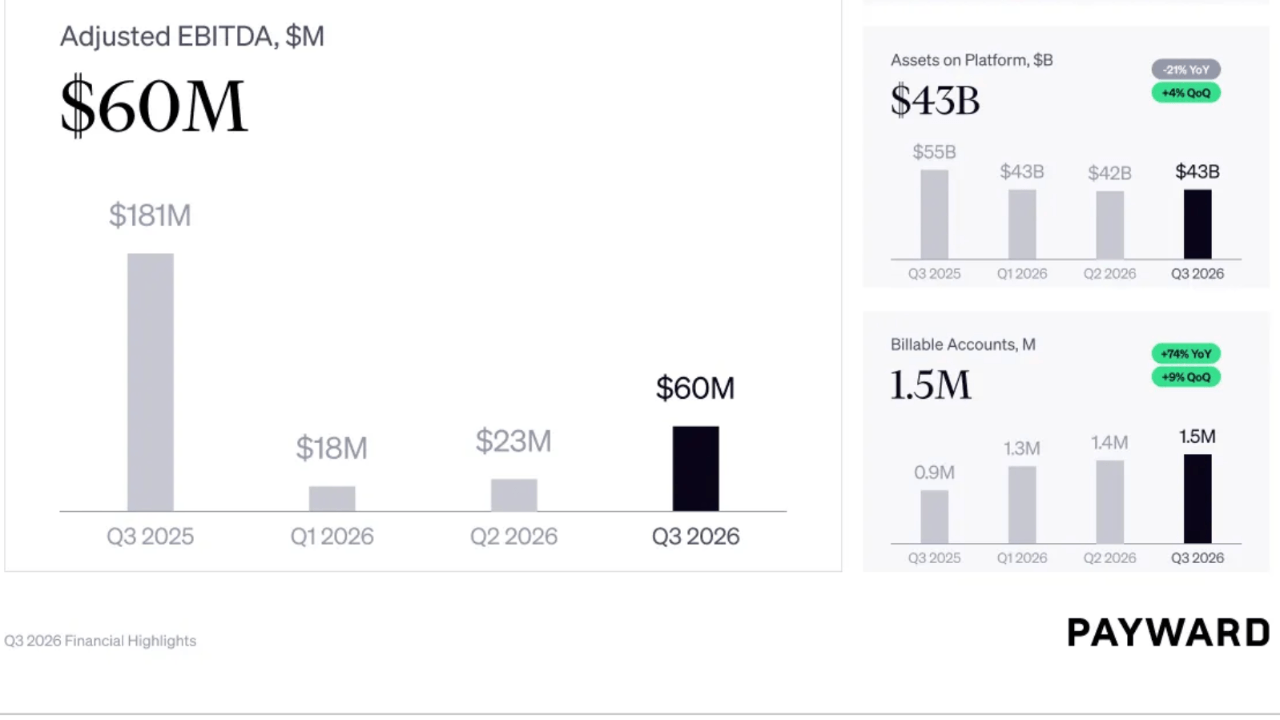
Payward, the parent company of crypto exchange Kraken, reported a 66% year-over-year decline in Q3 adjusted EBITDA to $60 million, marking a significant profitability challenge even as the company expanded its customer base and market share.
Despite the earnings pressure, Payward is pursuing a broader financial platform strategy. Q3 adjusted EBITDA fell from $60 million a year earlier, though it improved sequentially from $23 million in Q2. Total Platform Margin, the company's preferred revenue measure, reached $487 million, up 12% sequentially but down 12% year-over-year.
Growth in Customer Base and Market Share
Payward showed mixed signals on trading activity. Total platform transaction volume reached $353 billion, up 22% from Q2 but down 30% year-over-year. However, Kraken's share of industry spot trading rose to 6.5% in September from 3.3% a year earlier, gaining ground despite an overall decline in market volume.
Customer acquisition accelerated, with funded accounts climbing to 7.1 million, up 37% year-over-year, and billable accounts jumping 74% to 1.5 million. Asset- and access-based margin now represents 52% of total platform margin, reducing dependence on transaction fees.
Expansion Into New Asset Classes
Payward announced plans to expand into U.S. prediction markets and equity perpetual futures through its own regulated exchange, clearinghouse, and futures broker. The company's tokenization business, xStocks, surpassed $1 billion in assets under management in October and now covers more than 700 tokenized equities. Payward also announced plans with the London Stock Exchange to bring the 100 largest London-listed companies into the xStocks ecosystem, subject to regulatory approval.
AI as a New Business Pillar
The company officially treats AI as a fifth business pillar alongside trading, banking, asset management, and Payward Services. Payward plans to develop a personal finance agent that could operate across a client's portfolio. The company stated the agent would operate only within user-defined limits, require approval before trades or workflows run, and record every action it takes. Payward plans to train proprietary models on its own trading, balances, payments, identity, and risk data.
The strategy reflects Payward's shift toward a diversified financial platform where crypto trading represents only one component, as the company seeks to offset weaker trading economics and reduce exposure to cryptocurrency market volatility.